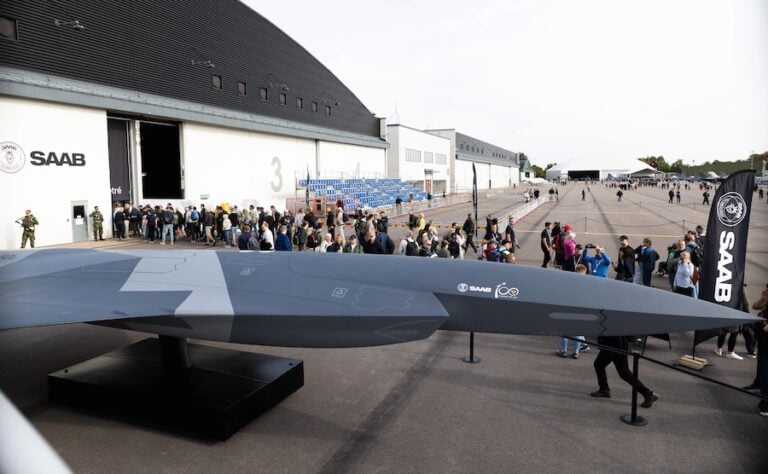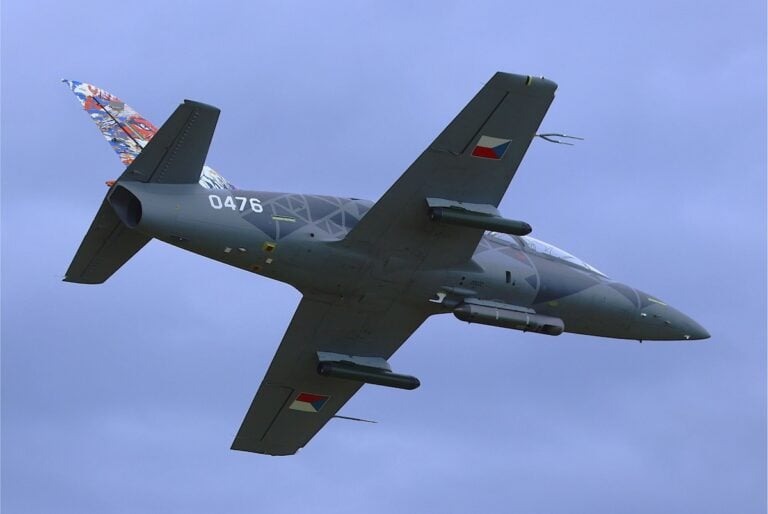
European industry has reached the same conclusion as its American counterparts. Everyone involved knows that the Old Continent’s air forces will soon need an additional fleet of uncrewed combat aircraft to add combat mass and improve the survivability of their crewed fighters, which are few in number and very expensive. Those jets are too valuable to send on the riskiest missions, the dull, dirty and dangerous work, as the saying goes.
Recent conflicts have made it plain that the problem can be eased by using, wherever possible, cheaper aircraft that are easier to build and do not need an army of pilots, whose training is long, expensive and done in many stages. Taking the wider view, the 2025 figures on Europe’s shortage of mass also have to be considered, not least the annual production rate of European combat aircraft. Last year it stood at a modest 50 or so: 26 Rafales from France, 12 Gripens from Sweden and 15 Eurofighters built for the UK, Germany, Italy and Spain.
Order books for new European aircraft keep growing, but production cannot be transformed overnight, and no one should expect output suddenly to reach 100 to 150 aircraft a year. The same applies to stocks of advanced air-to-air missiles, which have recently run dry following the spring crisis in the Middle East. Here, too, Europe needs to find a way of producing at much greater scale, so that a conflict like the recent one does not wipe out its thin, peacetime stockpiles.
For now, though, Europe appears to treat CCA the way it treated drones for decades. Until the urgent need for this long-underrated capability was finally recognised, drones were not taken entirely seriously. They were seen as just another experiment: useful in many ways, but never likely to match crewed aircraft, and a source of unnecessary disruption.
When crewed aircraft were all that was needed, because they rarely faced a real threat, Europe saw little reason to buy advanced drones such as the Reaper. France, Italy and the UK each acquired them in numbers you could count on two hands at most. The US, by contrast, had 185 MQ-9As when its conflict with Iran began.
The US war with Iran showed for the first time that, where the option exists, the riskiest missions go not to crewed aircraft but to armed drones such as the MQ-9A, since CCA are not yet in service. The aim is simple: not to risk pilots, whose lives are too valuable on every count. Over Iran, the MQ-9A came under real pressure for the first time, and Iran destroyed dozens of them; estimates range from 45 to 55.
For years there were doubts about whether drones like the MQ-9A would be of much use in a full-scale war, given their vulnerability to enemy fire. Yet when the choice came, commanders often accepted the lesser risk: losing a drone that costs a far from trivial $30-50 million, depending on configuration, rather than putting even more expensive crewed aircraft in harm’s way.
Judging by Europe’s hesitancy over building mixed fleets of crewed and uncrewed aircraft, its decision-makers have yet to learn this lesson. They still question whether large sums should go into CCA, which remain unproven and under development, even though the YFQ-44A has already fired air-to-air missiles. The first exercises with these aircraft, planned for 2027, may finally give the green light to funding what is still seen as a risky investment.
Since the start of 2026, news of ambitious industrial initiatives has been arriving from across Europe, one hard on the heels of another. Somewhat unexpectedly, Italy’s Leonardo and Turkey’s Baykar have got serious about pairing the M-346 jet trainer with the ambitious Kizilelma uncrewed fighter.
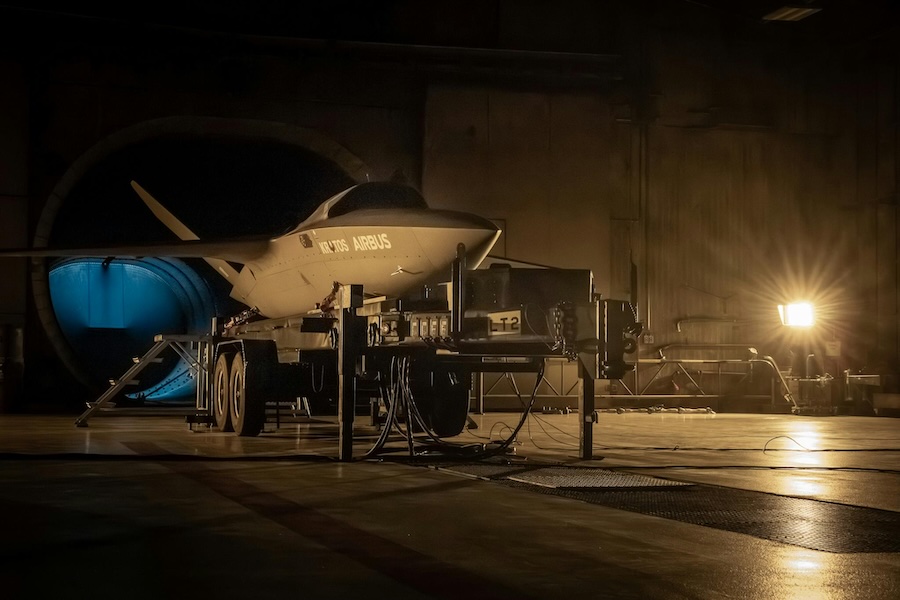
Elsewhere, near Munich and in northern Germany, Airbus has been testing a pair of Valkyrie drones built by the American company Kratos and packed with European electronics. Integrating the US airframe with European equipment has produced a European-American hybrid called the U740 Valkyrie. There is a transatlantic precedent, and not a happy one: the German-American Euro Hawk, built by Northrop Grumman and EADS on the Global Hawk airframe, which ended in failure and was cancelled in 2013.
Airbus announced the U740 Valkyrie’s first flight on 12 October. The company bought two Kratos Valkyries as test platforms, and in September the first demonstrator carried out its initial trials in Sweden before being modified to take German autonomous mission systems and artificial intelligence technology. Airbus plans to make the trials progressively more complex with each round of flight testing.
In 2027 it intends to demonstrate autonomous operations, with control from a business jet specially adapted for the trials. The first use of onboard weapons is pencilled in for 2028, and work with the Eurofighter is due to follow in 2029.
BAE Systems, meanwhile, is close to completing Brontanax, a demonstrator of roughly the same size as the now-retired Hawk trainer. Its first flight is planned for the second half of 2027.
Airbus is also developing its own Ravenstorm, due to be available early in the next decade. It will be an uncrewed aircraft of up to six tonnes, drawing on the configuration of Barracuda, a long-forgotten technology demonstrator developed by Airbus’s predecessor, EADS, which first flew in 2006. Behind all this is a manufacturer investing in autonomous systems and cockpit interfaces that will make hybrid crewed-uncrewed teaming possible.
What is less certain is whether government money will ever follow. Germany has moved quickly on its CCA ambitions, Leonardo is struggling to win support from the Italian Air Force, and Poland has still not set aside adequate funding for its ambitious Harpii Szpon (Harpy’s Talon) initiative, which aims to back up crewed aircraft such as the F-35A with uncrewed ones.
For the time being, manufacturers are on their own. They have no choice, and they are betting that their work on autonomy and crewed-uncrewed teaming will eventually turn into firm military contracts. That work also paves the way for more complex testing of MARS (Multiplatform Autonomous Reconfigurable and Secure), a recently proposed European mission system described as the aircraft’s “European brain”. It would give German and other European operators control over software, mission applications, data and hardware. MARS uses AI-assisted software to carry out missions autonomously and coordinate formations, while the chain of command keeps a human in the loop for key decisions.
Germany’s CCA ambitions remain uncertain, and there is no CCA programme on the table yet. Even so, besides Airbus, Rheinmetall has expressed interest together with Boeing Australia, offering the MQ-28 Ghost Bat, as has General Atomics’ German subsidiary in Oberpfaffenhofen with the YFQ-42A Dark Merlin, the prototype familiar from the US programme.
To let the Eurofighter work with CCA without complex avionics changes, Airbus has developed a simple tablet-based interface. The idea is not new. It proved its worth in Ukraine, where it helped Western weapons to be used from post-Soviet aircraft such as the MiG-29. Pilots can use the tablet to give orders to a CCA flying in the same formation, via communications equipment integrated with the Rafael Litening 5 targeting pod.
Like Airbus’s Valkyrie, the Eurofighter is also due to be tested with Baykar’s Kizilelma. The Turkish drone has made significant progress, including weapons release trials and the integration of an AESA radar and an electro-optical targeting system. The joint Leonardo-Baykar K-Swarm project concentrates on designing and developing interoperability between crewed and uncrewed aircraft. The UK’s Defence Investment Plan deserves a mention: it has earmarked $400 million for CCA development. BAE Systems is preparing to fly Brontanax alongside the Eurofighter during NATO exercises in 2027, and the RAF plans to have an operational CCA capability by 2030.
About the author
Col. (Ret.) Józef M. Brzezina, a former Polish Air Force officer, is a defense writer and analyst with more than 25 years of experience contributing to leading military publications and online outlets. His work focuses on unmanned aircraft systems (UAS), manned combat aviation, and the employment of weapons and military equipment in modern armed conflict.