This follows the recent upheaval among Europe’s leading fighter manufacturers, chiefly the split between French industry (Dassault Aviation) and German industry (Airbus). Saab has already taken several interesting steps towards autonomy on board its aircraft, and is now fitting the Gripen with another “brain” designed to support Swedish fighter pilots in the future.
The outlook for the Swedish manufacturer, which built only 12 new combat aircraft in 2025, is considerably better. Saab is considering options for increasing production and currently plans to reach a rate of up to 36 fighters a year. The Gripen E/F is already produced in Sweden and Brazil, while production in Canada remains in question, and only 117 aircraft are currently on firm order. Saab and Embraer are already in talks about using additional capacity in Brazil to meet future demand, with the agreement with Ukraine a major driver. Tripling annual output will mean expanding the existing production lines in both countries.
A possible Canadian Gripen order would open the way to promising industrial cooperation with Canadian manufacturers that currently produce components for the F-35. Saab has long been known as a flexible partner, as shown by its work with Boeing on the T-7A Red Hawk advanced jet trainer, which is to replace the T-38 Talon.
Investing in the future
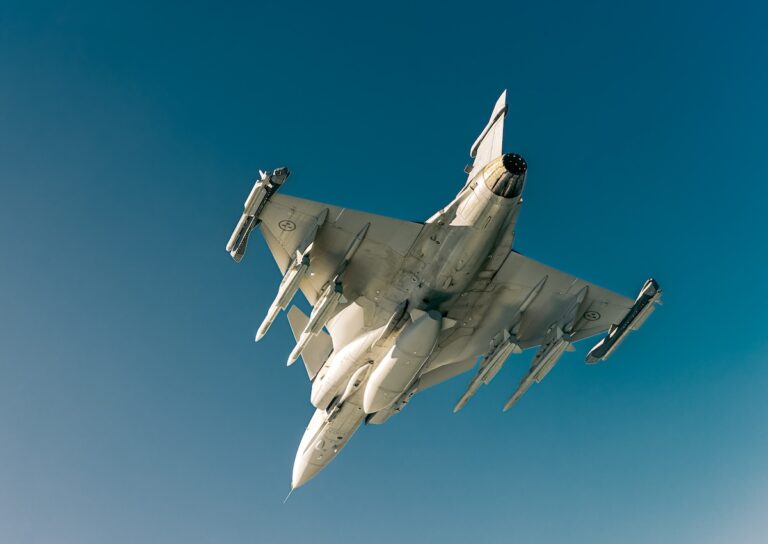
On 3 November 2026, Saab announced that it had developed its own AI agent, which is already being tested on board the Gripen E fighter. The agent is able to take control of the aircraft while testing more demanding combat scenarios that a pilot could face in beyond-visual-range (BVR) air combat. Saab had flown AI on the same variant of the aircraft before.
Until now, however, it had relied mainly on an AI agent from a German partner. In May and June 2025, Saab tested Centaur, an AI agent developed by Germany’s Helsing, as part of Project Beyond. Helsing is also known for the CA-1, an autonomous uncrewed combat aerial vehicle (UCAV) designed around the use of AI (Centaur), and one that can be produced at scale. The CA-1 Europa, intended for European air forces, is due to fly in 2027.
Swedish AI
The latest Gripen AI trials bring an important change. Two years on, it is now the turn of AI agents developed by Saab itself, so the company no longer has to depend on an outside partner. The new capability will be used together with dedicated training environments and the tools used to create them. The agents were developed by Saab’s Advanced Programs business unit as part of the AI Fighter Pilot Academy project.
Most of the training takes place in simulators. There, the AI agents test a variety of air combat scenarios and build up millions of simulated flight hours. Their decisions are continuously assessed against specific mission objectives, which allows Saab to fine-tune how they respond to situations that could arise in future air combat.
Saab has now moved this work from the ground into the air. The company said that, while testing BVR combat scenarios, one of its AI agents successfully controlled a Gripen E in flight. Few details of the test flights have been released, including when they took place, how many have been flown and what adversary the AI was used against.
Reducing the Gripen pilot’s workload
The Gripen E’s software architecture is key to the aircraft’s development, as it can take new onboard software without major hardware changes. This means Saab can test AI directly on an operational fighter instead of building a separate experimental testbed. The AI systems delivered under the Project Beyond partnership with Helsing will focus on enhancing the Gripen E’s capabilities by automating other tasks, allowing pilots to concentrate on their missions.
Project Beyond was announced at IQPC’s International Fighter Conference 2024 in Berlin. The partnership was intended to integrate Helsing’s AI with the Swedish aircraft, give it autonomous capabilities as early as possible and streamline mission tasks. The aim is not necessarily to replace the pilot. Saab sees several possible uses for its AI agents, from assisting crews in the cockpit to controlling uncrewed aircraft flying in a combined formation alongside crewed Swedish fighters.
Preparing for a crewed-uncrewed future
Training AI agents also requires significant computing power. Part of this comes from Sferical AI, a Swedish sovereign AI initiative in which Saab is a founding partner. The move into AI comes as Saab prepares for a future very different from the one it knows, in which crewed and uncrewed combat aircraft will work together more and more. None of the world’s sixth-generation fighter initiatives now involves a “lone” aircraft. Every concept is accompanied by uncrewed aircraft designed to operate directly with it.
On 9 September 2026, Saab also announced that the Swedish Defence Materiel Administration (FMV) had awarded it a contract worth around USD 303 million to develop technology demonstrators and study future crewed and uncrewed fighter concepts. The work will run from 2026 to 2028 and takes Sweden’s future fighter project into its next phase. It is another such step in Europe, where Germany, the UK and France are following similar paths, though separately. Further reshuffles, including ones involving India and Canada, are possible.
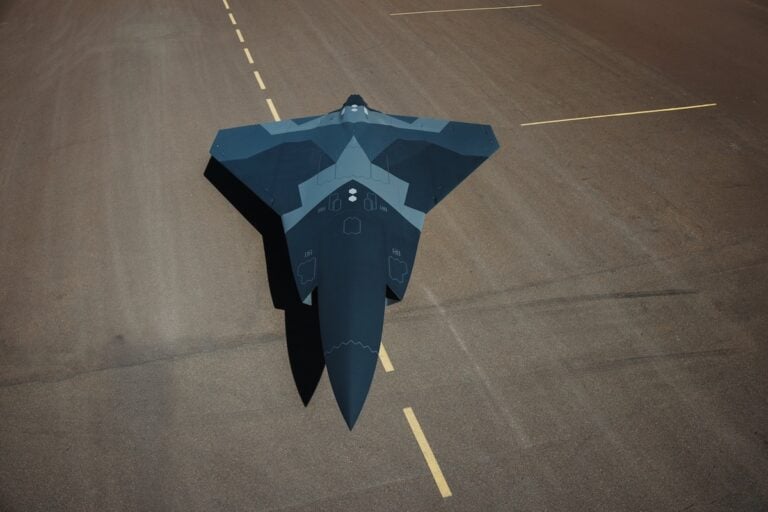
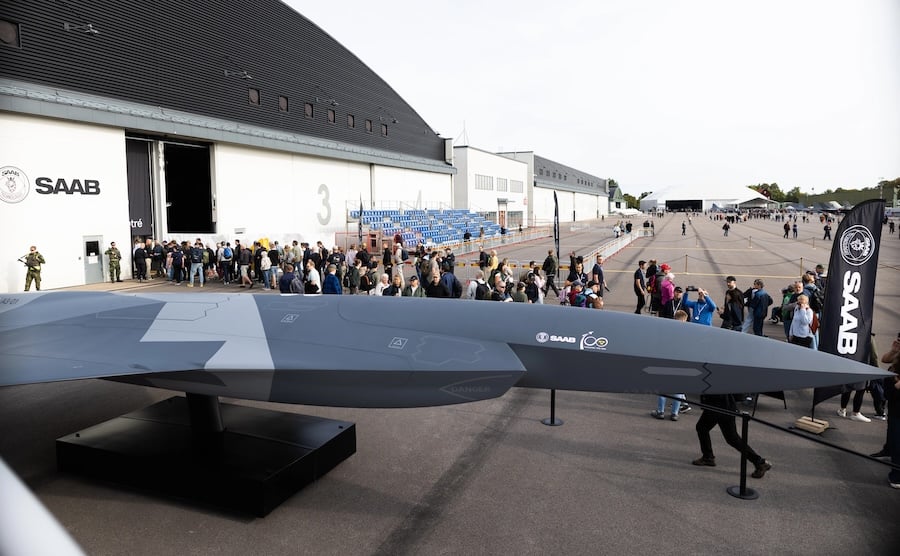
A month earlier, Saab unveiled a full-scale mock-up of its A3-001 uncrewed combat aircraft (pictured). The company plans to demonstrate a new type of air platform with fighter-like characteristics before 2030. The first such design was Türkiye’s Kızılelma, built by private company Baykar. Saab has not directly linked its new AI agents to the FMV contract, but the technology could eventually play a role in the uncrewed aircraft being developed in parallel. The company plans to expand its AI agents’ capabilities and test them in more complex mission scenarios, using the same development infrastructure that will support Sweden’s future uncrewed combat aircraft.
About the author
Col. (Ret.) Józef M. Brzezina, a former Polish Air Force officer, is a defense writer and analyst with more than 25 years of experience contributing to leading military publications and online outlets. His work focuses on unmanned aircraft systems (UAS), manned combat aviation, and the employment of weapons and military equipment in modern armed conflict.