If officially confirmed, the move would mark one of NATO’s most important decisions in airborne early warning since the 1980s. The Alliance would not be choosing a simple AWACS successor, but a multi-sensor surveillance, command and data-sharing system able to operate across air, maritime and land domains.
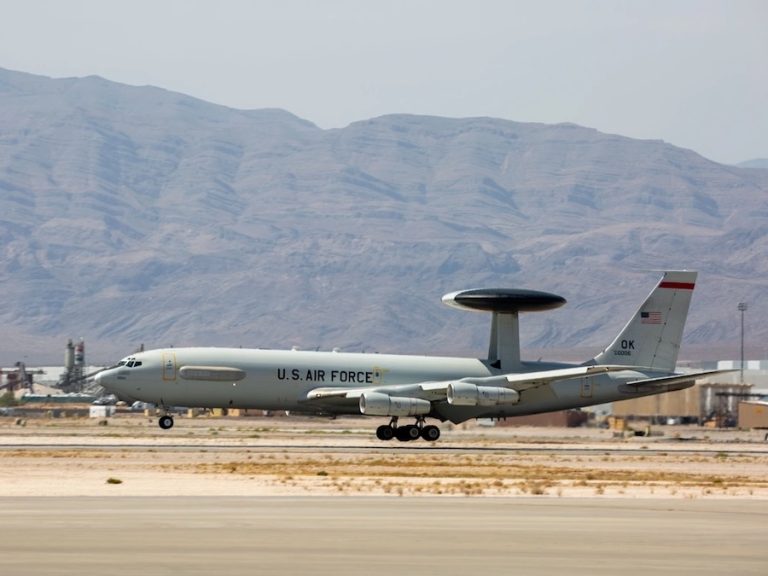
For more than four decades, the Boeing E-3A Sentry has been the symbol of NATO’s airborne early warning system. Based on the Boeing 707 platform and fitted with its distinctive rotating radar antenna above the fuselage, the aircraft served as flying reconnaissance, command and airspace control posts.
Operating from Geilenkirchen, the E-3A fleet supported NATO operations around the world. It also supported duties over the eastern flank, deterrence missions and the creation of a shared air picture.
The challenge is that the E-3A has become increasingly difficult and expensive to sustain. NATO still operates 14 aircraft of this type, but their remaining life and the logic of further modernisation are limited.
The Final Lifetime Extension Programme is intended to keep the fleet operational until around 2035. However, the programme does not solve the basic issue that the Alliance needs a new generation of AEW&C capability rather than another upgrade of an aircraft rooted in the Cold War era.
Until recently, Boeing’s E-7 Wedgetail appeared to be the natural choice. The aircraft is based on the Boeing 737 platform and carries the MESA radar, offering significant command capabilities for air operations.
In 2023, NATO identified the E-7 as a future element of its surveillance and control system. That direction weakened after the United States decided to abandon its own Wedgetail procurement plan, according to the supplied input.
For European Allies, that meant the loss of economies of scale, shared logistics and a stable financial basis for the programme. The shift away from the E-7 was therefore not only a decision to select a different aircraft, but also a response to the fact that the main potential user had begun questioning the programme.
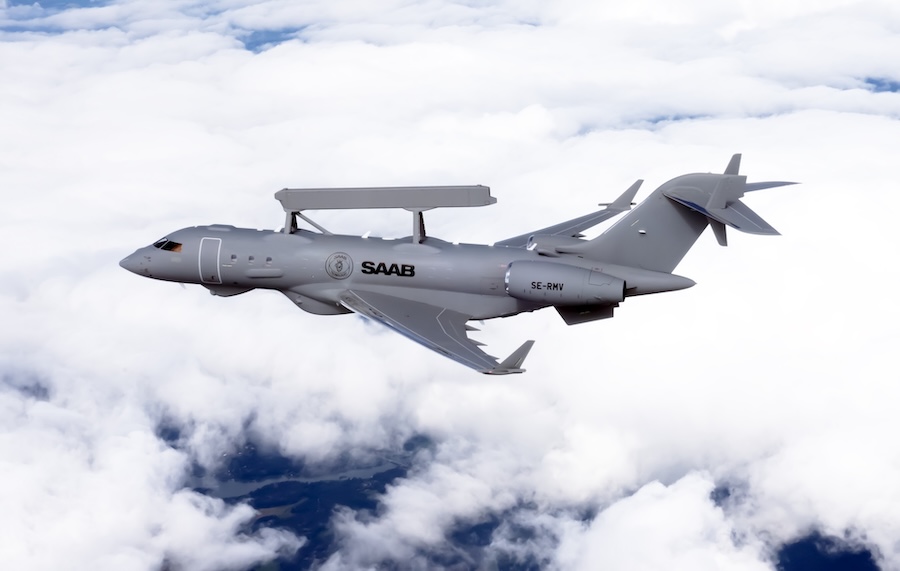
The Saab GlobalEye is sometimes described in shorthand as an AWACS aircraft, but that is technically an oversimplification. Saab has combined AEW&C and ISR functions on a relatively small platform.
The aircraft is based on the Bombardier Global 6000/6500 business jet. The platform offers higher altitude, shorter redeployment time and more than 12 hours of flight endurance.
Compared with earlier regional platforms such as the Saab 340 or Saab 2000, this represents a different scale of operation. GlobalEye is designed to provide surveillance and command functions across several operational environments.
Its main sensor is the Erieye ER radar operating in the S-band and mounted in an approximately 10-metre antenna above the fuselage. The radar is an AESA system using gallium nitride transmit-receive modules.
Gallium nitride improves the energy efficiency of the system. Saab says Erieye ER increases detection range by about 70% compared with earlier Erieye variants, while the instrumental range of the system exceeds 350 nautical miles, or about 650 km.
The most important factor is not only the theoretical range. An AESA radar can shape its beam electronically and concentrate energy in sectors of particular interest.
In practical terms, this improves tracking of low-flying, small and low-observable targets. It also supports operation in environments with jamming and strong reflections from land or sea surfaces.
That capability is important in a conflict environment where cruise missiles, drones, very low-flying weapons and targets operating at the edge of a traditional radar picture are becoming more significant. The system is therefore relevant to the changing nature of NATO air surveillance requirements.
Erieye ER is not the only sensor that can be carried by GlobalEye. The platform can also be fitted with the Leonardo Seaspray 7500E radar operating in the X-band and intended primarily for maritime and land surface surveillance.
Through SAR and GMTI modes, that radar can detect objects, produce radar imagery and track moving ground targets. In the maritime domain, the ability to detect small vessels is important, and Saab says the system can detect objects as small as periscopes.
GlobalEye can also carry electro-optical sensors, IFF identification systems, AIS receivers and electronic support and intelligence systems. As a result, it is not only an aircraft looking into the air, but a tool for building a common operational picture across several domains at the same time.
The platform can track aircraft, helicopters, cruise missiles, drones, surface vessels, moving land targets and hostile electromagnetic emissions. This makes the aircraft a surveillance and command system rather than a single-role radar platform.
Communications are as important as the sensor layer. The aircraft includes encrypted radios, satellite communications and data links including Link 11, Link 16 and Link 22.
A standard GlobalEye crew consists of two pilots and several mission system operators. The operators work at mission consoles and manage the aircraft’s surveillance, command and data-sharing functions.
The E-7 Wedgetail remains an advanced AEW&C platform used or ordered by countries with extensive air operations experience. The lack of a NATO choice for the E-7, according to the supplied input, does not result from the aircraft’s technical limitations but from uncertainty created by U.S. decisions.
When the United States reduced its own Wedgetail procurement plans, European partners lost the foundation on which earlier logic for a common order had been built. Later attempts to restore funding in Congress did not change the fundamental fact that NATO needed a solution less dependent on changing decisions in Washington.
In this sense, the reported choice of GlobalEye is a technical decision with a clear political and industrial dimension. It does not mean NATO is breaking with American technology, which would be too far-reaching a conclusion.
It does mean that Europe and trusted partners from other countries are beginning to play a larger role in one of the most specialised areas of military capability. Saab would provide the mission system, radar and integration, Bombardier would provide the aircraft platform, and European users would gain greater influence over schedule, configuration and further capability development.
The reported decision also fits a broader shift in NATO’s approach to airborne early warning. Instead of replacing one aircraft with a direct successor, the Alliance would be moving towards a multi-domain surveillance and command architecture suited to future air, maritime and land threats.
The future capability would be expected to support NATO deterrence, air policing and wider shared situational awareness. If confirmed, the GlobalEye choice would define the next phase of the Alliance’s airborne surveillance and control capability after the E-3A Sentry era.