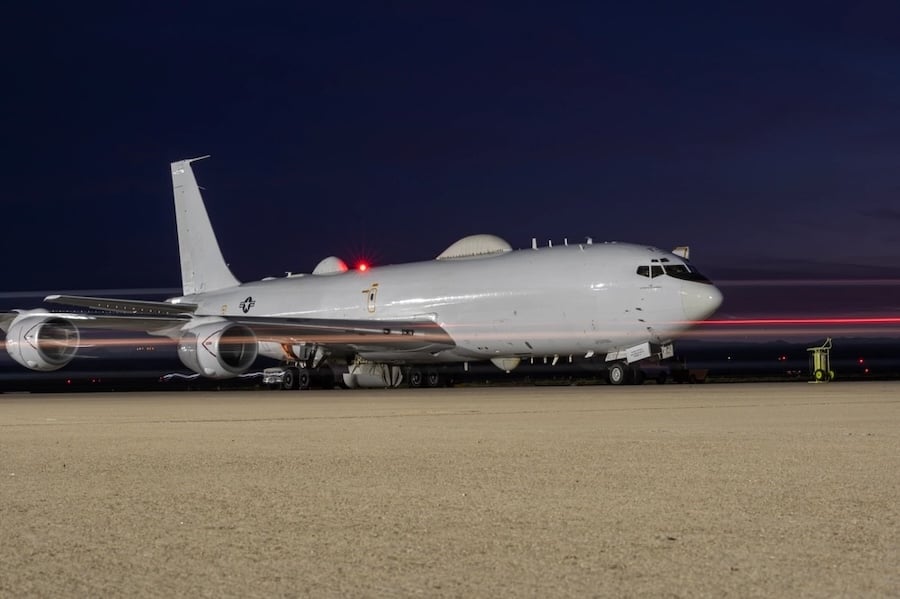
The E-6B Mercury carried the Airborne Launch Control System team from the 625th Strategic Operations Squadron. Its role was to verify the secondary capability that allows missiles to receive commands if ground-based launch control centers are damaged or unable to respond.
Navy personnel from Fleet Air Reconnaissance Squadron FOUR managed the aircraft’s flight profile and endurance while the Air Force team directed the test sequence. The aircraft’s positioning supported command links across Malmstrom’s dispersed launch control centers and launch facilities.
“From the airborne engineering seat, our focus is making sure every test objective is achieved safely and with high fidelity,” said Capt. Noah Woods, the airborne test conductor. “We work in lockstep with the Navy aircrew to keep the aircraft positioned exactly where it needs to be to maintain clean command links across the wing’s dispersed launch control centers and launch facilities, all while maintaining constant communication with our test partners on the ground.”
The E-6B Mercury operated through Great Falls International Airport because Malmstrom’s airfield supports helicopter operations and cannot accommodate fixed-wing aircraft. That arrangement required interagency coordination before the test flights.
The Simulated Electronic Launch-Minuteman event is conducted twice annually and evaluates selected missiles in their deployed environment through issuance of the first-stage ignition signal. Ground support included Malmstrom’s 341st Missile Wing and the 576th Flight Test Squadron from Vandenberg Space Force Base, California.
“This exercise demonstrates the continued readiness, professionalism, and integrated teamwork required to sustain the Minuteman III weapon system,” said Lt. Col. Chad Redwine, commander of the 625th Strategic Operations Squadron. The results inform readiness assessments as the Air Force maintains Minuteman III and prepares for Sentinel.
“Data gathered helps verify the performance of the Minuteman III system’s secondary launch capability,” Woods said. “The results support efforts to sustain a credible ICBM deterrent through the transition to the Sentinel weapon system, while reinforcing the resilience and responsiveness of our nation’s strategic posture.”
The Air Force continues repairing aging components and updating hardware to sustain Minuteman III operations. Planners are preparing to decommission older nodes in phases as Sentinel comes online, with the aim of maintaining continuous deterrence and limiting operational risk.