The discussions followed the Army’s May 2025 announcement of its Transformation Initiative, which included changes to program funding. “We worked with the Army leadership to propose some opportunities to get this capability qualified and delivered quicker and at lower cost,” said Paul Ferraro, GE Aerospace’s vice president and general manager of defense engines and services.
The T901 received its Preliminary Flight Rating in June 2026, clearing the engine for flights that count toward formal qualification. “The PFR is the Army’s formal acceptance that the T901 engine meets the requirements for flight testing,” Ferraro said.
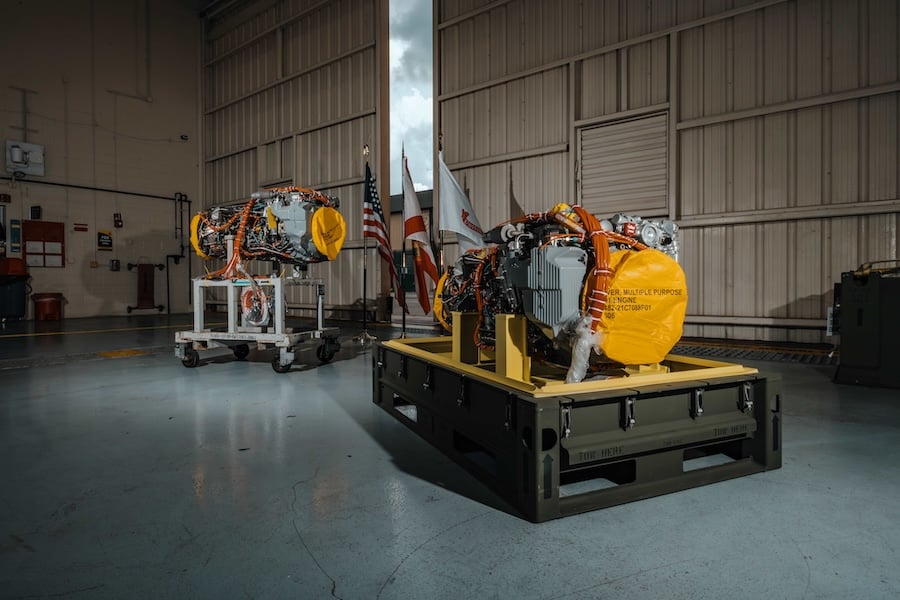
GE has delivered seven flight-test engines to the government and has been testing the T901 aboard a Black Hawk in Florida since 2025. The first forward flight came a few months after the engine’s first hover flight.
“We’ve validated the performance of the T901 and demonstrated all the engine’s key performance parameters,” said Breanne Escalante, GE Aerospace’s general manager of rotorcraft and turboprop engines. “We’ve done over 2,900 hours of factory-engine tests and achieved flight altitudes of 17,000 feet, and airspeeds of 150 knots.”
The Army selected the T901 in 2019, and GE says the engine delivers 50% more power than the T700 while using less fuel per unit of power. That would give Black Hawk and Apache crews more flexibility to carry heavier loads, fly farther between refueling stops or stay over a target longer.
The House and Senate voted in 2026 to provide $175 million for the Army’s Improved Turbine Engine Program, under which GE developed the T901. The House Armed Services Committee included another $63 million in a reconciliation package.
GE announced plans in 2025 to invest more than $200 million in U.S. plants that will help build the T901, followed by another $275 million for those sites in 2026. The company expects the Army to buy as many as 200 engines a year once the program is fully underway.
GE says it has invested more than $600 million in manufacturing for its defense programs over the past three years. “We’re proud of the confidence our customers and lawmakers have placed in us,” said Bill Morris, GE Aerospace’s executive director of government affairs and a former Army Black Hawk pilot.
Producing the T901 at scale will require advanced machinery and specialized tooling, GE says. The engine uses ceramic matrix composite parts that are stronger than metal at high temperatures and weigh about one-third as much as their metal counterparts, helping improve fuel efficiency.
GE also uses 3D printing to make some components in one piece, cutting the number of welds, brazed joints and bolts. The engine’s front frame, for example, is made as a single part instead of about 200 separate pieces.