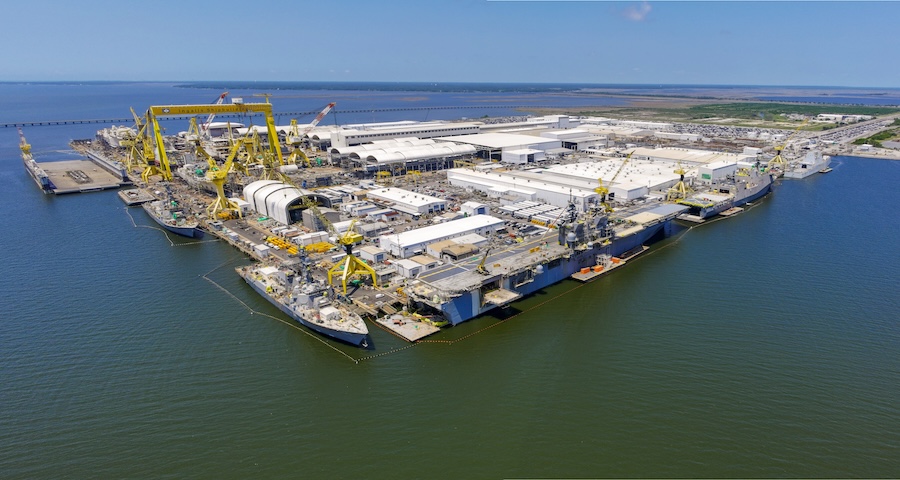
Under the agreement, Ingalls Shipbuilding will begin cutting and shaping raw materials to support future work on the main structural foundation of the first frigate. The company said the approach is intended to support a smoother transition from design to production at its shipyard and across the broader industrial base.
“We are proud of our past performance in engineering, design and production of warships that meet U.S. military standards, a performance that gave the Navy confidence to select the national security cutter as the basis for the next small surface combatant and to choose Ingalls as the program’s lead yard,” said Brian Blanchette, president of Ingalls Shipbuilding.
“We are excited to partner with the Navy to bring these preproduction steps under contract to accelerate delivery of the frigates that our warfighters need,” he added.
In December 2025, the U.S. Navy selected Ingalls Shipbuilding to design and build the future FF(X) frigates using the design of the Legend-class National Security Cutter. Ingalls previously delivered 10 of the vessels to the U.S. Coast Guard and said it plans to apply the same production sequence to the new frigate program.
The company said the new frigates will be built alongside existing production lines that support Arleigh Burke-class Flight III destroyers, America-class amphibious assault ships, San Antonio-class Flight II amphibious transport docks and modernization work for Zumwalt-class guided missile destroyers.
To address growing Navy demand and support next-generation ship construction, Ingalls said it has invested more than $1 billion in upgrading infrastructure, facilities and tools. HII said it is also working to expand U.S. shipbuilding capacity by increasing distributed shipbuilding partnerships, cooperating with international manufacturers and evaluating the addition of another U.S. shipyard.
The FF(X) program is part of the Navy’s future fleet strategy focused on smaller combat ships. The Navy said the vessels are intended to provide a more agile surface combatant platform that complements larger multi-mission warships and improves operational flexibility worldwide.


![Boeing, U.S. Navy Achieve Successful MQ-25A Test Flight Boeing [NYSE: BA] and the U.S. Navy have successfully completed the first test flight of an operational MQ-25A Stingray™. The milestone advances the Stingray closer to aircraft carrier operations and marks the beginning of a new era in naval aviation. During the two-hour flight, the unmanned aircraft successfully demonstrated its ability to autonomously taxi, take off, fly, land and respond to commands from the Unmanned Carrier Aviation Mission Control System MD-5 Ground Control Station (GCS). Boeing and U.S. Navy Air Vehicle Pilots facilitated the mission by sending the aircraft commands and then monitored its performance from the GCS at MidAmerica St. Louis Airport in Mascoutah, Ill., where the program is based. Once airborne, the Stingray executed a pre-determined mission plan that validated its flight controls, navigation, and safe integration with the GCS. "Today's successful flight builds on years of learning from our MQ-25A T1 prototype and represents a major maturation of the program," said Dan Gillian, vice president and general manager, Boeing Air Dominance. "The MQ-25A is the most complex autonomous system ever developed for the carrier environment, and this historic achievement advances us closer to safely integrating the Stingray into the carrier air wing." "The first flight of the MQ-25A is a landmark achievement for the Navy-Boeing team and a critical step toward the future of the carrier air wing," said Rear Adm. Tony Rossi, who oversees the Program Executive Office for Unmanned Aviation and Strike Weapons. "This flight demonstrates our progress in delivering a carrier-based refueling capability that will significantly extend the reach and lethality of our fleet." The MQ-25A is the Navy's gateway to integrating unmanned aircraft on the carrier deck, enabling manned-unmanned teaming. Its autonomous aerial refueling capability will significantly extend the operational range of the carrier air wing and allow F/A-18 Super Hornets currently performing the aerial refueling role to focus on their primary role as a multi-role strike fighter. The aircraft is the first of four Engineering Development Model aircraft that will be delivered to the Navy under the original $805M Engineering and Manufacturing Development contract. "Watching our first Navy aircraft complete an autonomous flight underscores what disciplined teamwork and rigorous testing deliver," said Troy Rutherford, vice president, Boeing MQ-25 program. "Today would not have been possible without the hard work and dedication of our Boeing, Navy, and industry team. Together, we are redefining the future of naval aviation and pushing the boundaries of what's possible with autonomy." Boeing and the Navy will conduct additional test flights out of MidAmerica St. Louis Airport to further validate the aircraft's flight controls and capabilities before transitioning to Naval Air Station Patuxent River, Maryland, to prepare for carrier qualifications.](https://defence-industry.eu/wp-content/uploads/2026/04/lockheed-martin-skunk-works-system-supports-first-mq-25a-flight-768x432.jpg)