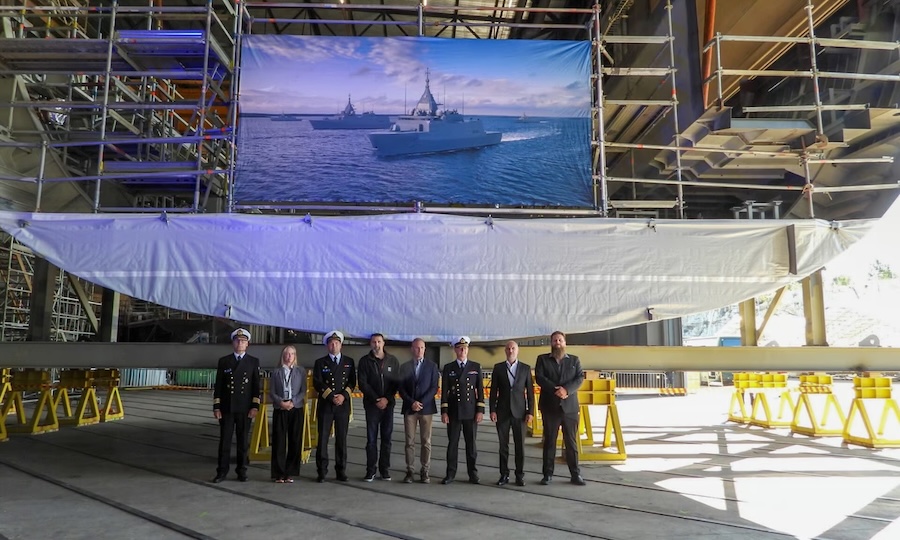
Production of the final ship began in January with steel cutting for its hull sections. During the ceremony, the keel block was placed on building supports and traditional lucky coins were positioned beneath it.
“Together with the coastal forces and unmanned systems of the future, the vessels under construction will constitute a significant maritime capability for our entire defence system,” said Commodore Janne Huusko, Chief of Staff of the Finnish Navy Command. The Navy said the keel-laying marked the concrete start of assembling the warship’s hull blocks.
RMC and its subsidiary RMC Defence Oy are building the four ships for the Finnish Navy. The first two were launched in May 2025 and May 2026 and are now undergoing outfitting, while the third hull is at an advanced stage of assembly.
The Pohjanmaa class is designed for year-round operations in the Baltic Sea’s demanding conditions. The vessels will conduct anti-surface, anti-submarine and air-defence missions, lay sea mines and secure sea lines of communication.
They will also support sustained naval presence, maritime surveillance and operations alongside allied forces. Their planned capabilities include land-attack missions, signals intelligence and real-time situational awareness.
“From the Navy’s perspective, these vessels will represent the naval presence and skills that will secure our liberty of action in any circumstances,” Huusko said. “However, the vessels’ capability will be complete only through the competence of their crews; we also recognise a need for a new kind of know-how and professional competence.”
Although classified as corvettes, the ships will displace about 4,300 tonnes and measure 117 metres in length. Each vessel will have a beam of 16.5 metres and a maximum draught of five metres.
A 29,000-kilowatt propulsion system will provide a maximum speed of 26 knots. The ships will have a range of about 3,500 nautical miles at 14 knots and will carry crews of 73.
The armament package will include a 57mm BAE Systems Bofors Mk 3 naval gun and a Lockheed Martin Mk 41 vertical launching system for RTX ESSM Block 2 missiles. The ships will also carry IAI Gabriel V anti-ship missiles, Saab Tp47 torpedoes and two 12.7mm Saab TrackFire weapon stations.
The four ice-capable vessels will replace seven ageing Finnish Navy ships. The programme is intended to strengthen Finland’s maritime defence in a changed regional security environment.
“The industrial operating methods developed during the construction programme are now particularly evident in the efficiency of steel production and hull assembly,” RMC Chief Executive Mika Nieminen said. “Serial construction allows us to use the expertise gained from earlier vessels and advance production systematically and to a high standard.”
“The project is making tangible and rapid progress, and it has strengthened our position as a unique builder of ice-going warships,” Nieminen said. “We will also offer this expertise to partner countries in the future.”
The Squadron 2020 programme is expected to generate about 3,600 person-years of direct employment in Finland. RMC’s workload increased further in late 2025 after it signed a contract to build two icebreakers for the United States Coast Guard.
The corvette and icebreaker programmes will overlap, supporting employment at the shipyard and across its subcontracting network. The icebreaker project is expected to generate about 2,000 person-years of direct employment and approximately 5,000 person-years in total.