The armed forces of NATO’s European member states are currently seeking to boost their military training capabilities to prepare troops for warfare in rapidly evolving battlefield conditions. As a result, the ability to effectively train large military units in a multi-domain environment has become a highly valued asset within the Alliance.
One country seeking to strengthen its position as a key pillar of security on NATO’s eastern flank is Romania. Bucharest aims to improve its military capabilities, train troops more effectively, and prepare soldiers for the conditions of the modern battlefield.
As Defence Industry Europe learned during this year’s BSDA exhibition in Bucharest, Romania’s Ministry of National Defence plans to establish a new training centre in the Transylvania region. The aim is to create a highly realistic environment capable of hosting a wide range of exercise scenarios and supporting modern military training requirements. According to a senior defence source within Romania’s Ministry of National Defence, cooperation with Swedish industry is among the options being evaluated.
This is not surprising. Sweden, as NATO’s newest member state, is actively shaping the Alliance’s eastern flank defence policy. Moreover, Stockholm sees Bucharest as a reliable and solid partner in the field of regional defence. The Swedish Armed Forces have extensive expertise in the total defence concept and maritime warfare. Just as the Baltic Sea is one of the main operational areas for the Swedish military, the Black Sea is of crucial importance to Romania.
The core of Saab’s proposal for the Romanian Army is a complete laser-based live training system. The system is a de facto standard and is already in operation with many NATO nations, including Poland, Norway, the Netherlands, and the United States.
“Our solution would give the Romanian Armed Forces a comprehensive training capability and the ability to conduct advanced national exercises,” Urban Hallqvist, Director Marketing and Sales Eastern Europe at Saab, told Defence Industry Europe.
“We are ready to fully equip the new training centre and provide our customer with professional support and training services. The key features of the GAMER training system are its high level of realism and accuracy, as well as the ability to monitor training results in real time.”
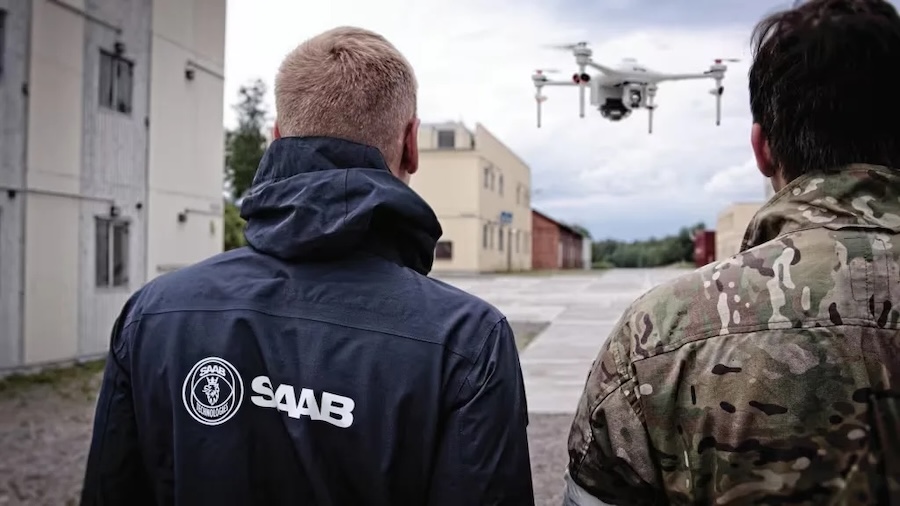
During the BSDA exhibition in Bucharest, Saab showcased its proven indoor training systems for infantry weapons such as the NLAW anti-tank weapon and the multi-role Carl-Gustaf M4. The company also presented an important innovation developed to improve training for the modern battlefield: a drone equipped with training sensors. This solution was created to give soldiers the opportunity to train and master their skills in countering unmanned aerial vehicles.
“Drones have become a daily reality on the battlefield. The proliferation of unmanned systems means that all soldiers must have the skills to counter them. Our solutions provide troops with this opportunity. Importantly, we have developed a sensor suite for drones that allows soldiers to monitor their shots. However, our sensors can also be integrated with other drones preferred by the customer and provided by local industry,” said Urban Hallqvist from Saab.
He admitted that the introduction of the SAFE defence procurement financing mechanism has changed the European defence market, including in Romania. However, Saab remains ready to enter industrial cooperation with Romanian entities in the training domain and in other areas as well.
Saab’s live training systems are renowned for their realism and interoperability, allowing soldiers and commanders to train in a simulated environment that closely mirrors real-world conditions. This immersive experience enhances situational awareness, decision-making skills, and overall operational readiness.
According to Urban Hallqvist, the GAMER system has the advantage of a scalable and configurable architecture. This means users can gradually expand the system according to their specific training needs or current financial capabilities, while also selecting GAMER components in line with their own military training priorities.
“In terms of configurability, the GAMER system can be expanded from a kit for an individual soldier to a comprehensive training system, creating a fully instrumented Combat Training Centre. When designing GAMER, Saab focused on so-called capability expansion packages,” he said.
These packages include LVC Integration – Live, Virtual, and Constructive – covering game-based graphic engines and mixed-reality environments such as VBS, Steel Beasts, and Unity3D; an Urban Training Package for operations in built-up areas; Medical Training using handheld computers to simulate casualty assessment; CBRN virtual training for defence against the effects of weapons of mass destruction; and Combat Support, covering fire-support simulation with artillery, unmanned aerial systems, and related command systems.