The July trials brought together personnel from the Royal Australian Navy, Australia’s Defence Science and Technology Group and the U.S. Navy. They formed part of RIMPAC 26, which involved 34 nations and more than 25,000 personnel.
“RIMPAC gives us a valuable opportunity to bring together people and capabilities in a real-world environment,” said Directorate of Undersea Warfare and Data Commander Paul Clark. “Continually testing these capabilities helps us better understand how they operate in challenging conditions. We are able to accelerate their development through collaboration with AUKUS partners.”
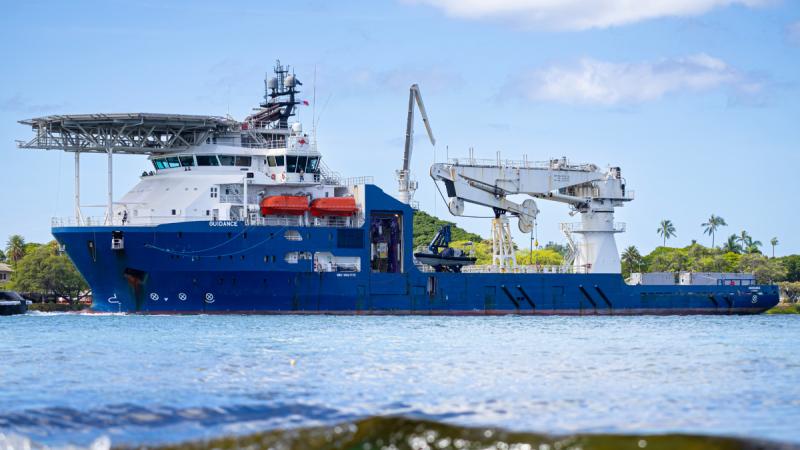
U.S. Navy subsea capabilities were deployed alongside Australian autonomous and remotely operated underwater vehicles from the Australian Defence Vessel *Guidance*. The vessel supports testing and deployment of robotic and autonomous systems, crewed and uncrewed underwater platforms and undersea surveillance systems.
Australia deployed a Kongsberg HUGIN Superior autonomous underwater vehicle alongside a Schilling work-class remotely operated vehicle. The systems carried out complex navigation and searched a section of the undersea domain within the exercise area.
The activity was designed to demonstrate how AUKUS partners are improving their ability to detect, deter and respond to maritime threats. It also tested how different systems can work together in missions involving the protection of critical seabed infrastructure.
Australia also deployed its Lightfish Seasat uncrewed surface vessel and the Rock Lobster deployable underwater acoustic communication relay system. The equipment was used to demonstrate interoperability between Australian and U.S. underwater acoustic communications technologies.
Rock Lobster was developed by L3 Harris in collaboration with the Royal Australian Navy and Defence Science and Technology Group. The RIMPAC trials built on earlier work conducted through the Maritime Big Play exercise and experimentation series.
“The ability for technologies and systems to operate together is fundamental to how we work alongside our partners in the future,” said Discipline Lead Maritime Robotic and Autonomous Systems Communications Justin Dinale. “RIMPAC allowed us to identify opportunities to improve our ability to communicate with our partners’ capabilities. We worked alongside our AUKUS and industry partners to increase the interoperability of our autonomous systems.”
Australia’s Department of Defence said the testing advances the development and integration of undersea warfare capabilities across the AUKUS partnership. The work is also intended to strengthen Australia’s ability to protect critical undersea infrastructure through interoperable autonomous, robotic and subsea systems.