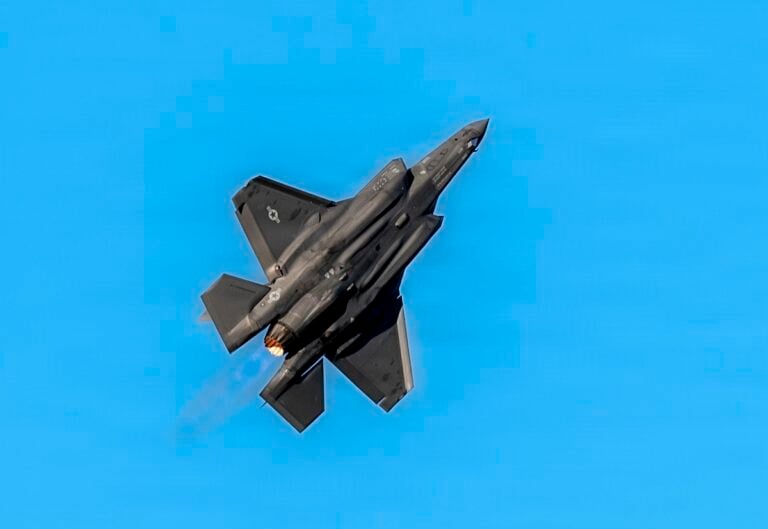
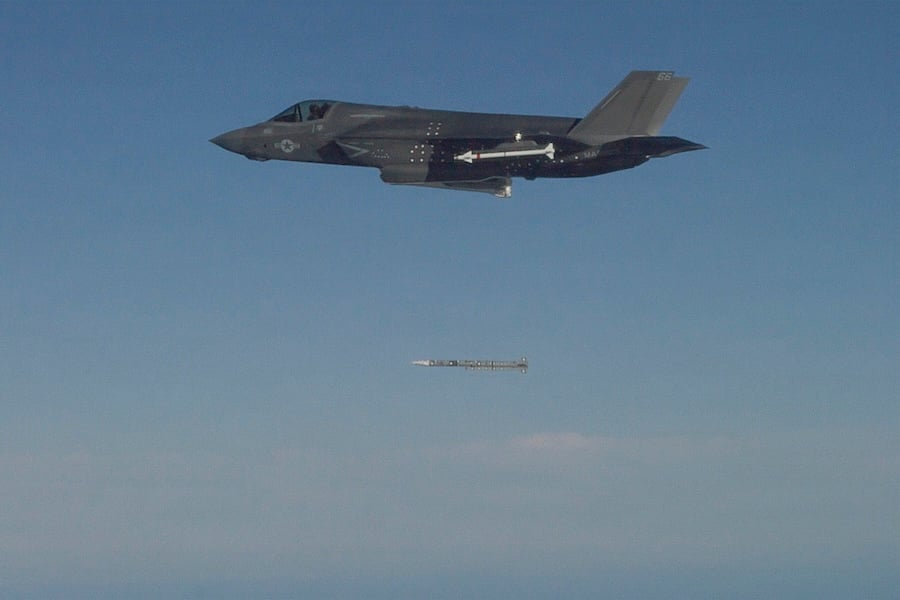
The missile cleared the aircraft safely in complex airflow, with its rocket motor unlit and its control surfaces inactive, the F-35 Joint Program Office said. Engineers will use the flight data to refine the digital models that predict how the missile separates from the jet.
MBDA said further trials over the coming months will check that the missile clears the aircraft safely across its operating envelope. The series will culminate in live firings to assess both separation and how the missile flies after release under different conditions.
A Royal Navy test pilot assigned to Britain’s Air and Space Warfare Centre and embedded with the F-35 Integrated Test Force flew the sortie. Royal Navy, Royal Air Force and Lockheed Martin personnel on the joint British-U.S. test team prepared and loaded the missile.
Expanding the arsenal. 🎯
An F-35B Lightning II, attached to the F-35 Integrated Test Force, releases a Meteor weapon test asset during a jettison flight trial at Naval Air Station Patuxent River, Maryland.
This milestone trial marks the first Meteor release from an internal weapons bay, verifying safe separation, validating aerodynamic models and advancing long-range strike capabilities.
Learn more about the Meteor milestone at:
https://t.co/zQqizQFEkG— F-35 Lightning II Joint Program Office (@theF35JPO) November 5, 2026
The British, U.S. and Italian defense ministries are supporting the integration work alongside Lockheed Martin, BAE Systems, MBDA and Northrop Grumman. The program is intended to give British and Italian F-35B crews another option for engaging crewed and autonomous aircraft beyond visual range.
Meteor is designed to engage airborne threats at extended ranges. Its propulsion system sustains thrust in flight rather than relying solely on an initial boost followed by a glide.