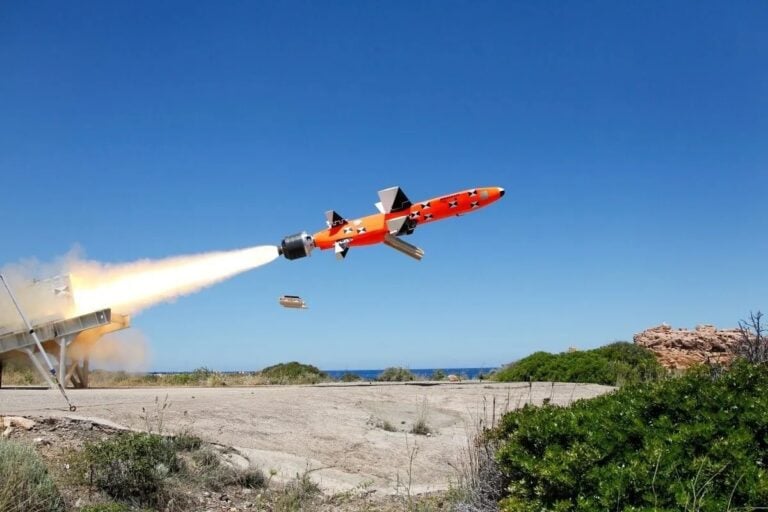
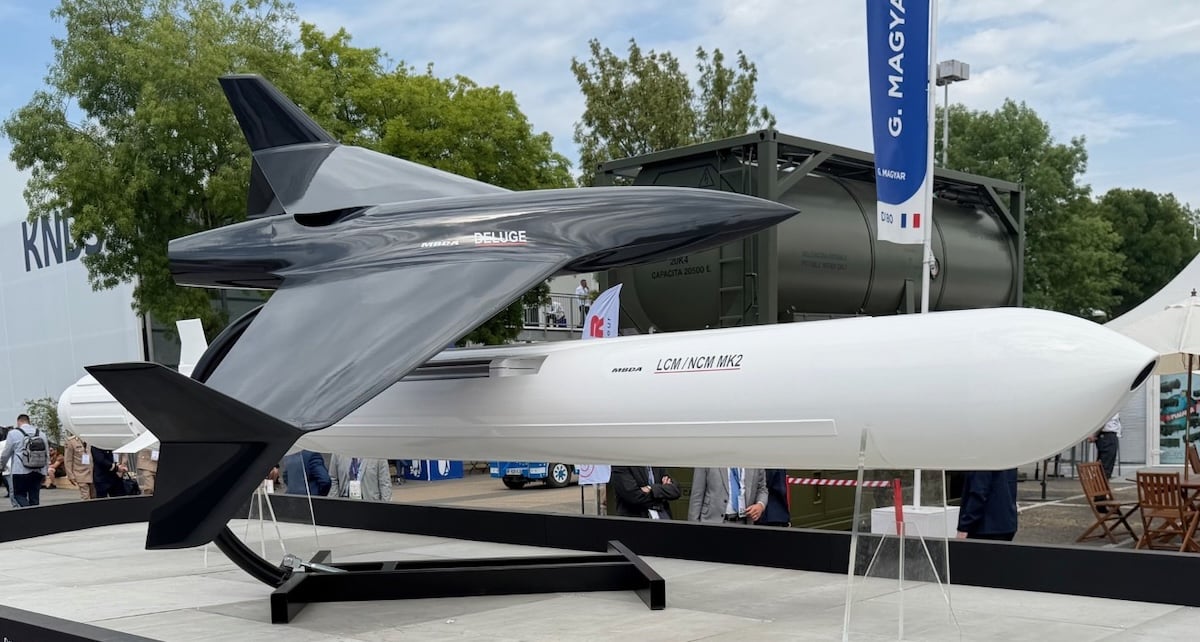
Deluge is intended to complement more complex weapons by allowing forces to attack defended targets in large numbers at a controlled cost. MBDA plans to produce the first batch for France’s Directorate General of Armaments, or DGA, in 2027.
Deluge has a three-metre wingspan, carries a 50-kilogram-class payload and uses a turbojet engine. MBDA lists a speed of approximately 400 kilometres per hour and a range of up to 500 kilometres.
The munition follows a mid-altitude flight path and navigates autonomously to predefined target coordinates. Launched from the ground in coordinated salvoes, it is designed to force repeated engagements and maintain pressure on enemy air defences.
MBDA describes Deluge as an attrition weapon that adds volume to long-range strikes alongside higher-end effectors. Its design also allows rapid updates and adaptations as battlefield requirements change.

The airframe is designed for manufacture and assembly using existing mass-production facilities. MBDA is working with civilian industries to support high output rather than relying solely on specialised defence manufacturing capacity.
Deluge uses a standard warhead and fuel to simplify compatibility and storage. NIOA said the design can use M795 casings of the type that its Rheinmetall NIOA Munitions joint venture will manufacture in Maryborough, Queensland.
The joint venture’s casing production is covered by a recently announced A$72 million Australian Government contract. That provides a potential link between existing Australian munitions investment and the proposed Deluge manufacturing work.
“NIOA is pleased to have signed this MOU with MBDA, further reinforcing the relationship between our companies that started with our cooperation on the Mistral VSHORAD system,” said NIOA Group chief executive Rob Nioa. “The Deluge One-Way Attack Munition is well adapted to the current and future low-cost mass effect requirements of the Australian Defence Force.”
Previously known as One Way Effector, Deluge completed its first prototype flight in September 2025. An initial live-firing test followed in November 2025.
Those milestones led to a first contract with the DGA, establishing a path to production. MBDA says its industrial approach is intended to support high-rate manufacturing and rapid introduction into operational units.
The Australian memorandum builds on an agreement signed by NIOA and MBDA in November 2025 to assess domestic warhead production for the Mistral missile family. The Deluge agreement concerns potential Australian manufacturing rather than a confirmed local production programme or an Australian Defence Force purchase.