Lockheed Martin is shifting away from logistics models based primarily on historic flight hours and static usage metrics. Its machine-learning models instead combine real-time consumption data, aircraft operating profiles, environmental conditions, degradation trends and projected mission demand.
The models also incorporate geopolitical risk indicators and projected sortie rates to forecast where demand for parts could increase. Lockheed Martin said the system continuously retrains as new telemetry becomes available, allowing supply forecasts to adjust to changes in the operational environment.
“AI gives us a decision advantage—the ability to process massive data streams, spot patterns, and recommend actions faster than humans alone could,” Smythe wrote. Lockheed Martin said it is combining that capability with its systems engineering expertise to produce more responsive military sustainment operations.
The company is also building a web-based Logistics Command and Control, or LogC2, dashboard that combines sensor feeds, forecasts and contract execution data. Its AI functions include anomaly detection, recommendations for stock replenishment and simulations that allow planners to assess how surge operations or emerging threats could affect spare-parts availability.
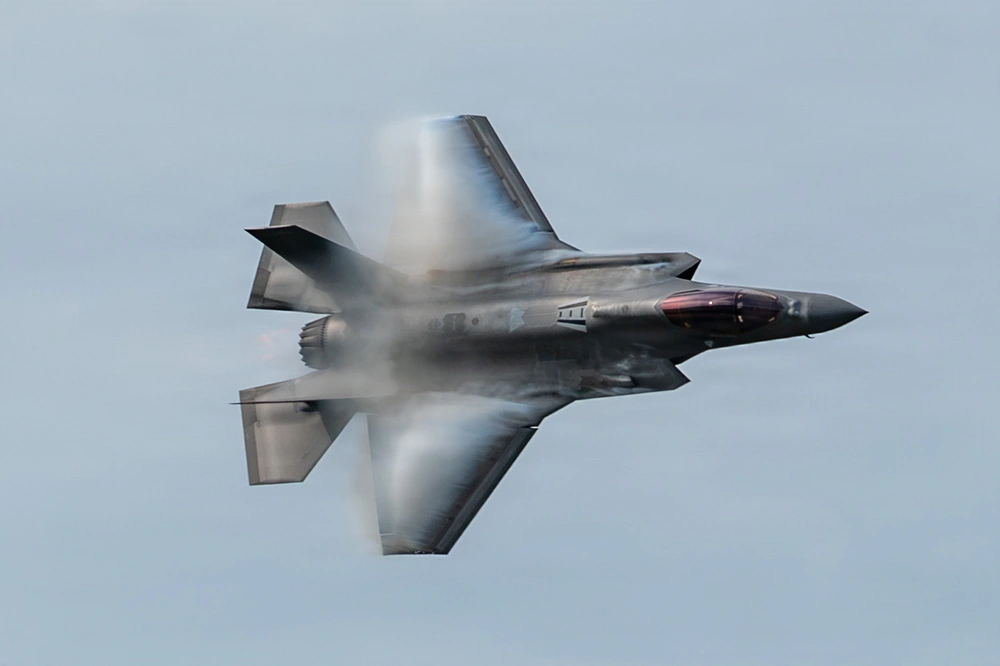
The LogC2 dashboard is already live for the F-35 programme, providing information on parts health, forecast confidence intervals and actionable logistics orders. Extensions are under way for the F-22, F-16 and C-130, with Lockheed Martin seeking to establish a common AI-enabled logistics picture across multiple U.S. Air Force platforms.
Predictive maintenance is another element of the company’s strategy, with deep-learning models analysing engine vibration, temperature and fuel-flow data. Lockheed Martin said the technology can predict component failure up to 72 hours in advance, allowing replacement parts to be positioned before a failure occurs.
The company is also developing autonomous logistics tools for warehouses and supply networks, including vision-based robots that can conduct inventory counts, identify damage and reallocate stock. AI-driven digital twins are being used to test repair processes, additive-manufactured components and software upgrades before deployment to operational aircraft.
Lockheed Martin does not intend to develop every AI capability internally and said it will work with outside companies where technologies complement its sustainment architecture. Smythe cited exploratory work with Rune Technologies to integrate its Adaptive Logistics Intelligent Decision System, or ALIDS, as an example of that approach.
“Let me be very clear, AI does not replace the warfighter; it protects and empowers them. Period.” Smythe said automation is intended to shift routine diagnostic and logistics work away from service members while preserving human authority over operational decisions.
“The technology is designed to be transparent, providing clear recommendations while leaving final authority in the hands of combatant commanders,” Smythe wrote. Lockheed Martin said its approach includes human-in-the-loop validation, traceable model provenance and continuous bias and safety testing.
The company sees AI, digital twins and autonomous logistics as tools for reducing manual bottlenecks and shortening the time required to introduce new capabilities into military sustainment networks. Its approach links real-time aircraft data with forecasting, maintenance and supply decisions while retaining human oversight of operational outcomes.
Source: Lockheed Martin.