The suite supports one-way and bidirectional transfers of sensor, intelligence, video and mission data. It is intended to connect lower- and higher-classification environments while preserving separation between their security domains.
“XTS Tactical solutions allows mission-critical information to move securely across security boundaries at the tactical edge while protecting the networks behind them. The technology is backed by decades of cross domain experience and provides a family of solutions designed to support different operational environments and mission needs,” said Craig Sweet, program manager for Defence Sustainment Solutions.
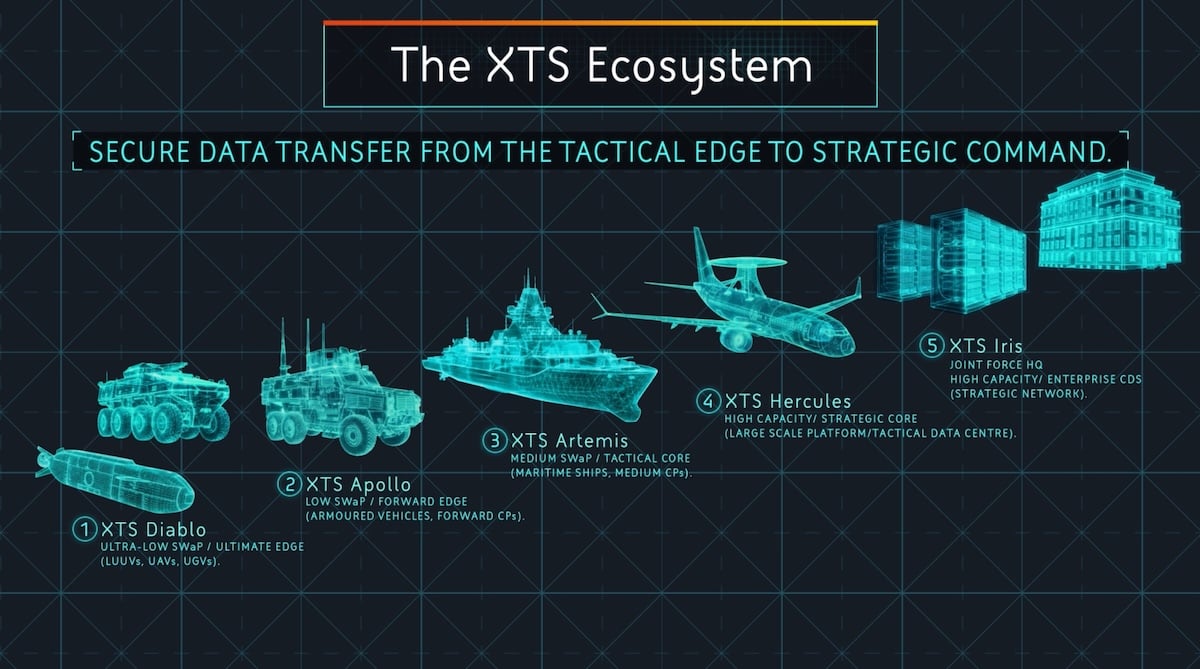
The family includes XTS Diablo, XTS Apollo, XTS Artemis and XTS Hercules, all supported by Interactive Link Tactical software. Each addresses different requirements for computing capacity, deployment format and operating environment.
XTS Diablo is the compact option, with a small form factor and low size, weight and power requirements for tactical and platform use. XTS Apollo is a ruggedized, higher-throughput system intended for command posts and medium-to-large platforms.
XTS Artemis offers substantial computing capacity in a rack- or case-deployable format for larger platforms, including maritime and airborne applications. XTS Hercules is a ruggedized bidirectional system designed to provide computing capability comparable to a small data center at the tactical edge.
Cross-domain solutions combine hardware, software and assurance controls to regulate information exchange between networks governed by different security policies. Their purpose is to reduce the risks associated with sharing data while maintaining security and operational effectiveness.
BAE Systems says the suite addresses the need to share information rapidly as military operations become more dependent on data. XTS Tactical forms part of its wider XTS Ecosystem of technologies for controlled information sharing.
The announcement describes the products’ intended applications but does not give numerical throughput, size, weight or power specifications. It also provides no security certification details or test results, leaving the release without the technical evidence needed to assess the company’s stated performance and protection benefits.