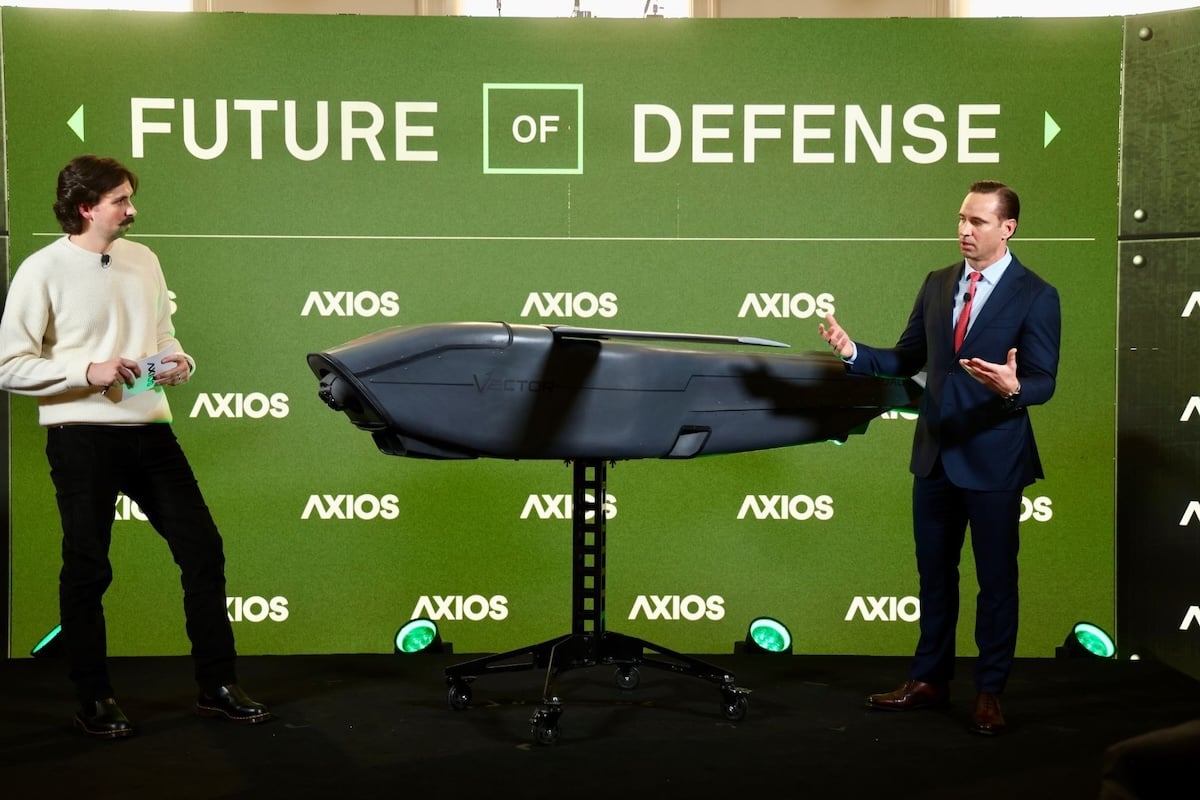
Announced at the Axios Future of Defense Summit, BOMBARD combines pulse-jet propulsion with a modular design for different mission requirements. Vector says the project draws on military feedback, observations from Ukraine and experience manufacturing smaller drones.
The company is positioning BOMBARD as an affordable strike system that can be produced in large numbers. It did not disclose a unit price, production target or delivery timetable, leaving the cost and scale of those plans unspecified.
BOMBARD uses what Vector describes as a fuel-agnostic pulse-jet propulsion architecture with minimal moving parts. The company says the approach is intended to simplify domestic manufacturing and reduce sustainment requirements.
Its published specifications include a cruise speed of 235 mph and a maximum takeoff weight of 281 pounds. Payload capacity is listed at 50 kg, or 110 pounds, although the announcement did not specify the payload or flight conditions associated with the maximum range.
Vector lists autonomous flight from launch through terminal engagement, GPS-denied navigation, Open C2 integration and a modular payload interface among the system’s features. Further engineering validation and flight testing are planned as the design matures.
The company says it incorporated manufacturing lessons from producing drones for the Defense Innovation Unit’s Drone Dominance Program FPV initiative. Its objective is to apply that experience to a larger, jet-powered platform designed for long-range attacks.
“Modern warfare is evolving at an extraordinary pace, and the technology available to our warfighters needs to evolve just as quickly,” said Andy Yakulis, Vector’s CEO and co-founder. “Our teams are close to the fight, working alongside military personnel and understanding what capabilities they need next.”
“When we identify an emerging requirement, we move quickly to develop it, build it here in the US, get it into the hands of the warfighter, and then we continue the loop by continuously incorporating feedback to iterate. BOMBARD is a direct result of that approach and our company ethos.”
Vector links the project to the growing use of long-range, jet-powered attack drones by Ukrainian and Russian forces. The company argues that the speed and range of these systems challenge existing air defenses and demonstrate a need for larger attritable platforms alongside small FPV drones.
Under Vector’s SR2Vector joint venture, BOMBARD will be manufactured locally in Saudi Arabia and marketed as SKYWASP, the company said. The venture, based in North Riyadh, is expected to support production and serve what Vector describes as an established sales pipeline in the kingdom.
The announcement did not identify customers, order quantities or a start date for Saudi manufacturing. BOMBARD’s immediate development work remains focused on engineering validation and flight testing, ahead of the production ambitions outlined by the company.