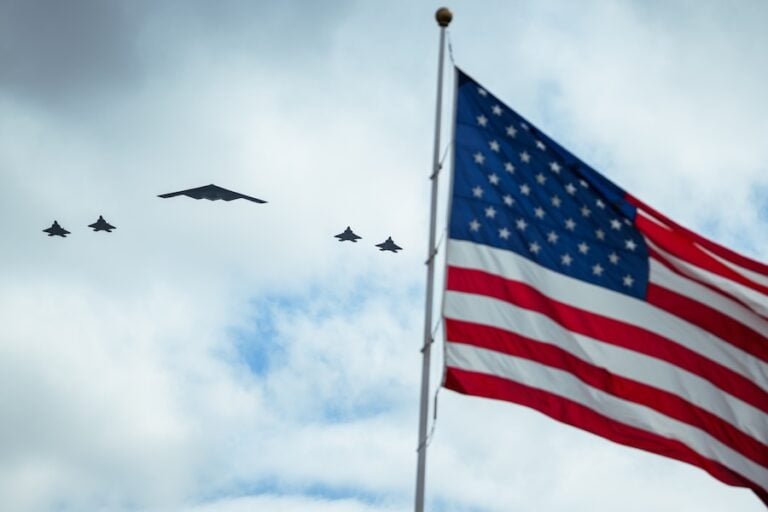

Six bombers struck Fordow and one attacked Natanz in the first combat use of the GBU-57 penetrator. Submarine-launched Tomahawk cruise missiles hit Isfahan, the third nuclear site targeted that night.
The B-2’s role rested on its ability to carry two 30,000-pound weapons designed for deeply buried, reinforced facilities. The aircraft also provides nuclear deterrence through its ability to penetrate defended airspace, giving the small fleet both conventional and nuclear missions.
Northrop Grumman built 21 B-2s, with 20 remaining in use according to the account. The magazine identifies the Spirit as the only aircraft capable of carrying the Massive Ordnance Penetrator, making its availability central to the strike plan.
Six B-2s had deployed to Diego Garcia in March 2025 for operations against the Houthis. Their return to Whiteman Air Force Base in May allowed maintenance and preparations for the Iran operation.
The weapons and targeting work drew on approximately 15 years of intelligence analysis, development and testing focused on Fordow. Chairman of the Joint Chiefs of Staff Gen. Dan Caine said analysts had studied its “air vents, electrical systems, environmental control systems, and all the equipment going in or out.”
The attack plan sought to exploit ventilation shafts leading to the underground enrichment facilities, with bomb settings tailored to precise depths and coordinated detonations. When Iran attempted to cover the shafts with concrete shortly before the operation, planners revised the sequence so the opening attack would break the cap.
The first B-2 reached its attack point at 2:10 a.m. local time, with subsequent aircraft releasing their weapons at short intervals. The second bomber was prepared to change its weapons’ settings and repeat the cap-breaking task if the lead aircraft failed.
“Everything had to go right at the right time, in the right order, for everything to work out,” said a participating pilot identified in the article by the pseudonym Charlie. “You could be plus or minus 15 seconds.”
The MOP has been developed in several variants to achieve different effects and communicates with the bomber in flight. That connection registers location and altitude information and allows minor changes to the mission plan to be passed to the weapon.
Precision also depended on coordinating GPS support with the time of release. Then-Chief of Space Operations Gen. B Chance Saltzman said the mission required satellite navigation support to be integrated around that moment to obtain the greatest possible accuracy.
About 125 aircraft supported the operation, including F-22s, F-35s, F-16s, A-10s, E-11A communications aircraft and tankers. Only some accompanied the B-2s into Iranian airspace.
U.S. planning covered measures to degrade or destroy Iranian integrated air defenses, as well as routes, weather, winds and weapons assignments. Israeli operations beginning on June 13 had eliminated many threats considered during American preparations, prompting further changes to the plan.
Additional B-2s flew visibly westward to divert attention toward a possible deployment through the Pacific. The strike formation instead headed east from Whiteman, while radio silence limited communications during the flight.
The lead crew made one radio call before entering Iran and a second after leaving its airspace. Although crews received warnings during their withdrawal, after-action reviews indicated that Iranian forces did not fire at the B-2s.
KC-135 and KC-46 tankers supported aircraft on the outward and return flights. Refueling capacity also helped determine the size and composition of the fighter force available to support the bombers.
“The first thing I worry about when something like a Midnight Hammer starts to take shape is what’s the tanker force looking like,” Lt. Gen. Jason R. Armagost said at a January 2026 Airpower Forum. “It’s not an easy thing.”
Maj. Claire Randolph, chief of Weapons and Tactics at Air Forces Central and a planner for the supporting fighters, called tankers “the limiting factor.” “It’s not sexy, it’s not a weapon, and it’s not a fighter and it’s not a bomber—the tankers are often really left out of this conversation,” she said.
The bombers climbed as fuel was consumed and descended to rendezvous with tankers, with their heavy weapons loads influencing the flight profile. Crews had to accommodate weather avoidance, air traffic and variations in refueling time while preserving the attack schedule.
“The higher you get, the less maneuverable you are,” said a pilot identified as Mike, whose aircraft struck Natanz. At that aircraft’s attack altitude, the autopilot did not engage for the final maneuver, requiring the crew to fly manually and adjust its timing.
The 14 pilots came equally from the active-duty 509th Bomb Wing and the Missouri Air National Guard’s 131st Bomb Wing, and all were Air Force Weapons School graduates. The long flight required repeated preparation for refueling, weapons employment and aircraft-system checks.
Contingency planning covered aircraft losses and the possibility of Iranian retaliation after the strike. Rescue arrangements were prepared, and supporting fighters needed alternative destinations if ballistic missile attacks made their regional bases unavailable.
The magazine reported after-action assessments that the strikes destroyed much of Iran’s capacity to enrich nuclear material to weapons-grade, while noting that the precise extent of damage remained uncertain. David Albright, president of the Institute for Science and International Security and a former United Nations weapons inspector, assessed that Iran would face years of difficulty rebuilding anything close to its previous capability.
“The centrifuge program, as it was, no longer exists. And what we’re essentially discussing are remnants,” Albright said.