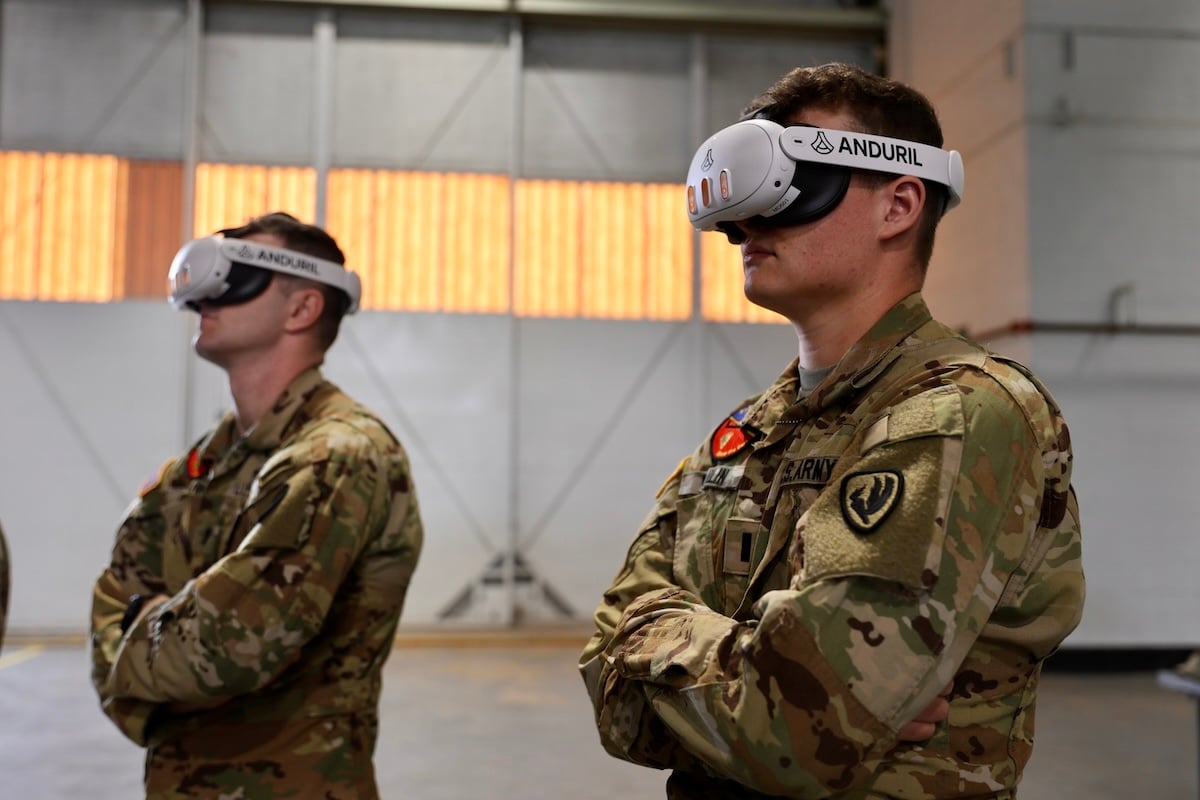
The event was requested by Maj. Gen. Phillip C. Baker, commanding general of the Army Aviation Center of Excellence and Fort Rucker. The Army said it was intended to introduce developing operational concepts and encourage discussion, rather than signal a procurement, fielding or endorsement decision.
Glenn Rizzi, Anduril’s program manager for maneuver dominance and a retired Army aviator, introduced the virtual experience and discussed how emerging technology could change aviation operations. “How we fought in my day is not going to be how you fight in your day,” he told the students.
Students first examined unmanned aircraft systems and an optionally piloted helicopter concept. The demonstration explored how such systems might extend the reach of aviation formations, provide mission support and help crews manage workload in complex environments.
A hybrid-electric tiltrotor concept was also presented as an example of technology under development by industry. It formed part of the discussion about capabilities that could influence future autonomous aviation operations.
The second part of the demonstration placed students in a three-dimensional battlefield environment, using a virtual display comparable to a military sand table. It illustrated how air, ground and space-based capabilities could exchange information across a formation.
Crewed aircraft, unmanned aerial systems, ground robots, artillery, rockets and communications networks featured in the simulation. Students discussed how aviation units might operate within that interconnected force while maintaining effective command and control.
“I thought the sand table was definitely the coolest part,” said 1st Lt. Colby Clark, who is in the AH-64 Apache academics phase of flight training. He said the three-dimensional simulation helped explain how unmanned systems could be incorporated into mission planning and support crewed operations.
Fellow Apache student 1st Lt. Patrick Mullin said the demonstration exposed students to technology and concepts they might encounter in operational units. He said future aviators needed opportunities to understand emerging capabilities and the considerations involved in employing them.
“I think it’s valuable for sure. I wish we got more of this,” Mullin said.
Mullin also stressed the need to understand how autonomous systems would be controlled, integrated into planning and used responsibly, particularly when decisions could involve lethal force. The Army said future use would require continued experimentation, testing, airworthiness assessment, doctrine development and integration with its command-and-control processes.
The Aviation Center of Excellence is preparing leaders to assess, employ and manage emerging technologies as the Army examines future aviation capabilities. The demonstration gave students an opportunity to consider those concepts within the service’s wider requirements, testing, doctrine and leader development processes.