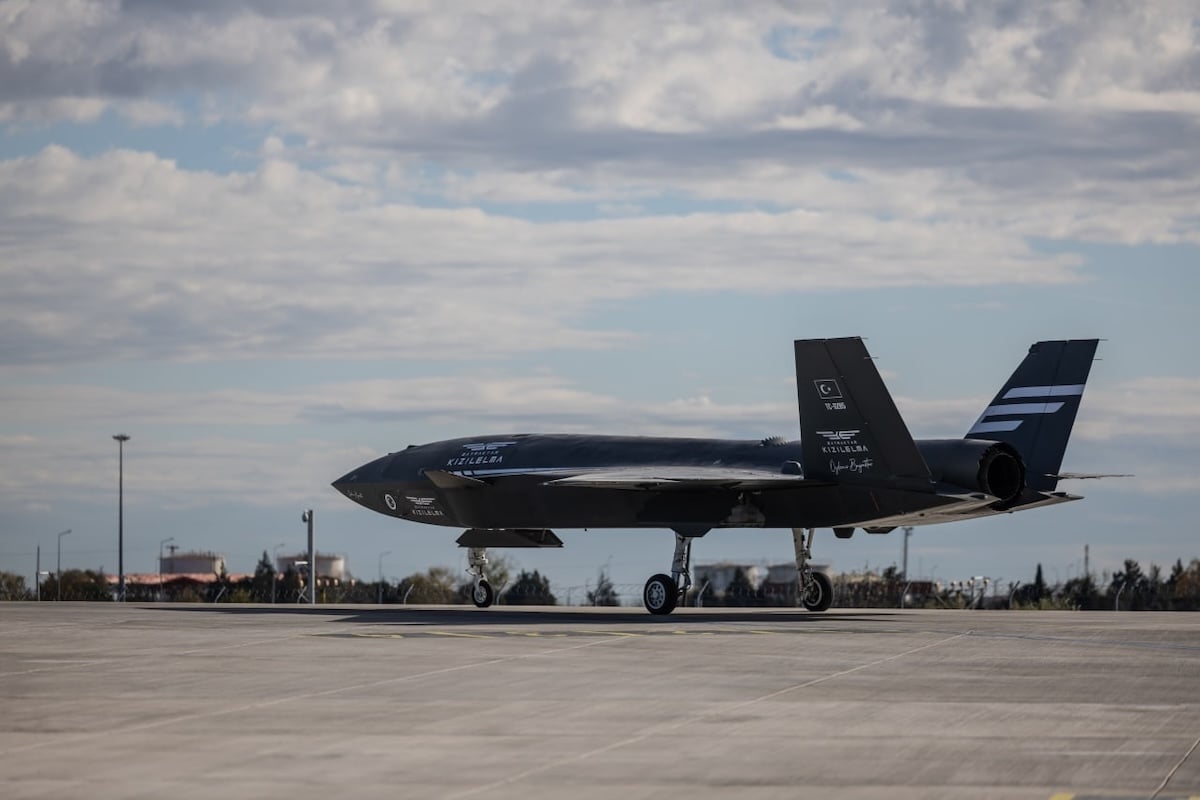
The programme has accumulated 600 test and training sorties since the aircraft’s first flight in December 2022. Baykar described the delivery as the first time a country had inducted an unmanned fighter jet into its military inventory.
Kizilelma’s air-to-air testing included the destruction of a jet-powered unmanned target off Sinop on 29 November 2025. The aircraft detected and designated the target with Aselsan’s MURAD AESA radar before firing a GÖKDOĞAN beyond-visual-range missile developed by TÜBİTAK SAGE.
Baykar said the engagement was the first in which an unmanned fighter jet struck a jet-powered aerial target with a beyond-visual-range air-to-air missile. Earlier tests included initial firings of TOLUN and TEBER-82 munitions on 8 October 2025, followed by integration of the TOYGUN Electro-Optical Targeting System on 17 November.
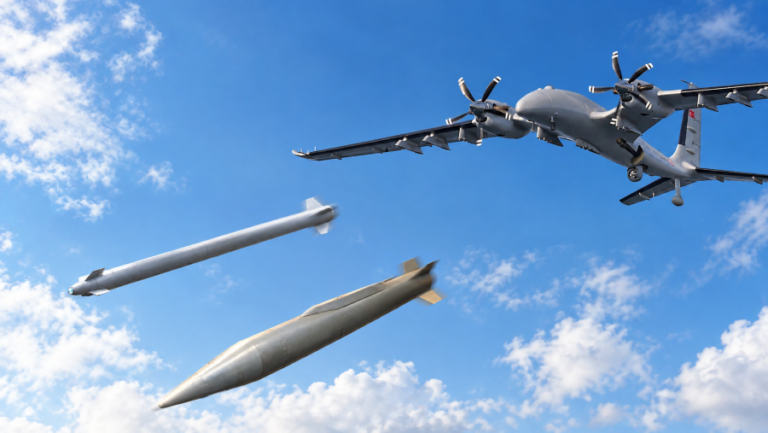
On 13 July 2026, production aircraft S2 launched Roketsan’s JET-230 supersonic air-to-ground missile. Baykar said the weapon scored a direct hit.
The aircraft then released TEBER-82 and TOLUN munitions from its internal weapons bay during trials on 25 and 28 July, with both types hitting their designated targets. Carrying weapons inside the fuselage helps reduce radar cross-section and supports the aircraft’s low-observability design.
The wider planned weapons range includes air-to-air missiles, inertial navigation/GPS-guided and laser-guided bombs, cruise missiles and other long-range weapons. The aircraft also carries a multifunction AESA radar, electro-optical systems and an infrared search-and-track system for passive detection and tracking.
Kizilelma’s autonomous flight trials have tested cooperation both between unmanned aircraft and with a pilot in a crewed aircraft. On 27 December 2025, two Kizilelma jets flew in close formation using intelligent fleet autonomy, which Baykar said demonstrated swarm autonomy.
In trials with Leonardo’s M-346 in 2026, Kizilelma flew autonomously in formation and accepted instructions from the M-346 pilot. It changed position, separated and rejoined the formation, demonstrating functions relevant to a future loyal-wingman role alongside crewed combat aircraft.
Earlier demonstrations included close formation flight with Baykar’s AKINCI unmanned combat aerial vehicle on 24 April 2023. Baykar described that flight as a world first for two unmanned aircraft, and Kizilelma subsequently appeared alongside SOLOTÜRK and Turkish Stars crewed display aircraft at TEKNOFEST Istanbul from 27 April to 1 May that year.
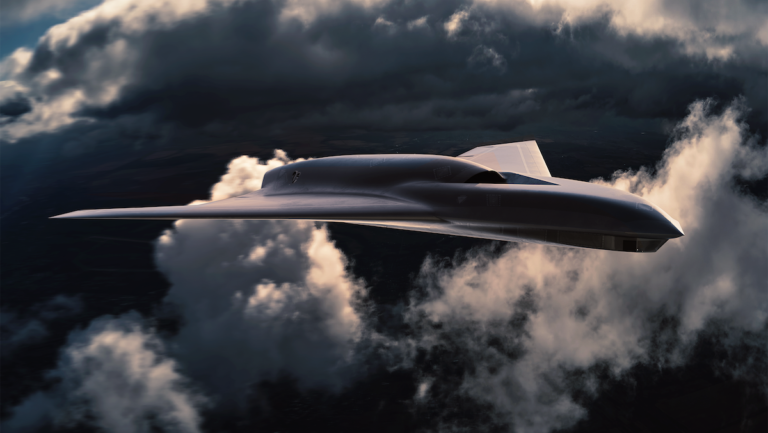
The single-engine aircraft has swept wings and forward canard control surfaces, with a length of about 14.5 metres, a wingspan of 10 metres and a height of 3.5 metres. Maximum take-off weight is 8,500 kg, while the payload capacity for weapons and mission equipment is up to 1,500 kg.
Baykar’s figures give a maximum speed of Mach 0.9 and a cruising speed of Mach 0.6. Operational altitude is 25,000 feet, approximately 7,620 metres, and maximum altitude is 40,000 feet, or about 12,200 metres.
Endurance exceeds three hours, with a stated combat radius of 500 nautical miles, approximately 926 km. Communications include line-of-sight and beyond-line-of-sight links.
Aircraft built to date use Ukrainian Ivchenko-Progress engines, including the afterburning AI-322F. Turkish manufacturer TEI is developing the TF6000 to reduce the programme’s dependence on foreign suppliers, but that engine had not been fitted to Kizilelma as of November 2026.
The programme began in 2021 under the designation MIUS, and Baykar published conceptual designs on 20 July that year. The aircraft entered the production line on 12 March 2022, with the first prototype presented in November.
Its maiden flight on 14 December 2022 came ahead of Baykar’s announced target of 2023. The first production aircraft, S1, flew in late January 2026.
Baykar said it had financed Kizilelma entirely from its own resources, as it had its other projects. The company recorded a record $2.2 billion in exports in 2025 and said exports had generated 90% of its revenue in recent years.
The manufacturer said it remained the world’s largest UAV exporter in 2025 and had led the global unmanned combat aircraft market for three years. It also ranked among Türkiye’s ten largest exporters across all sectors in 2023, 2024 and 2025 and received the Champions of Export Award.
Citing Türkiye’s Defence Industry Agency and Turkish Exporters Assembly, Baykar said it led the country’s defence and aviation exports in each year from 2021 to 2024. It accounted for one-third of the sector’s exports in 2023 and one-quarter in 2024.
Baykar has signed export contracts with 40 countries across its aircraft programmes. The customer totals include 37 countries for the Bayraktar TB2 and 16 for AKINCI, with some countries purchasing both.