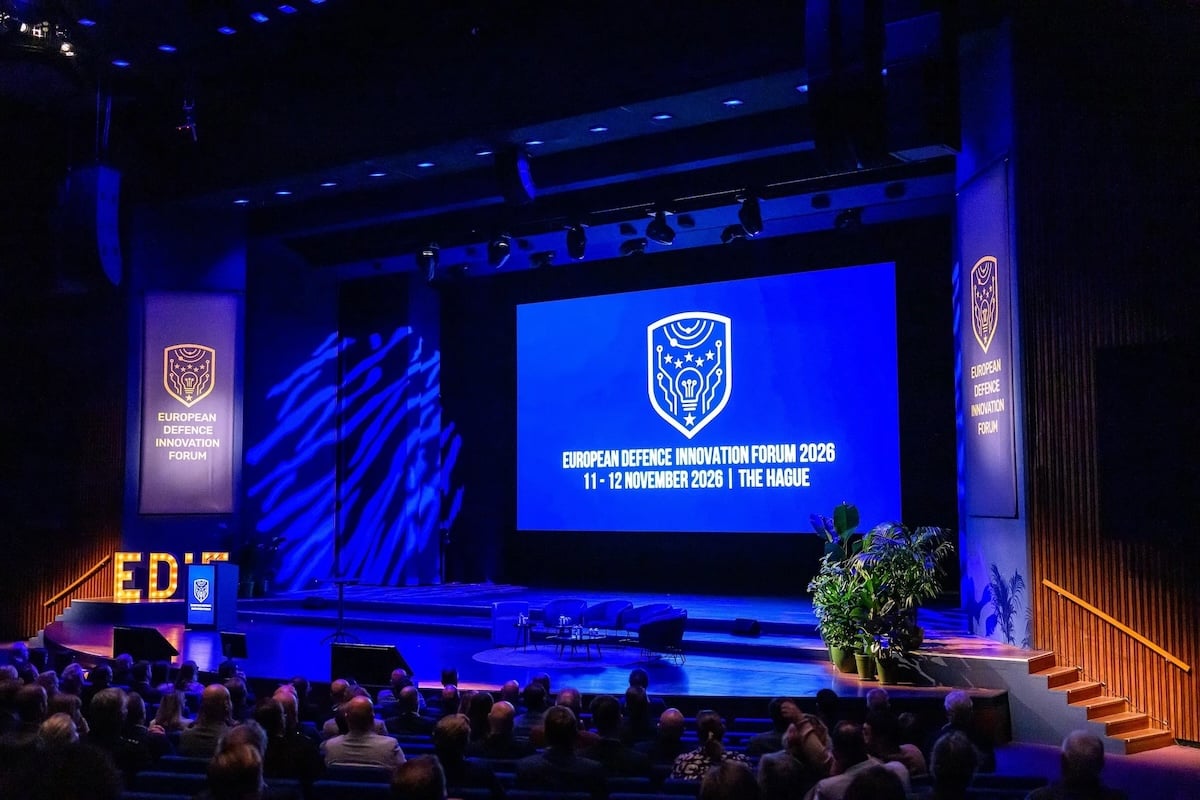
The forum brought together government officials, military representatives, manufacturers, technology developers and investors from Ukraine, the Netherlands, the United Kingdom, Latvia and other NATO and partner countries. More than 60 companies exhibited at the World Forum, showing uncrewed systems, counter-drone technology, artificial intelligence and electronic warfare products.
“This year, EDIF brought together around 1,500 participants from different countries, creating opportunities for decision-makers, defence manufacturers and military end-users to engage directly and build new partnerships,” said Nataliya Nakonechna, the forum’s co-founder. She said companies were already looking to expand their presence at the next edition in 2027.
“We must innovate more quickly and scale up the European defence industry together,” Dutch Defence Minister Dilan Yeşilgöz-Zegerius said in her opening address. She called for fewer bureaucratic barriers, urged European countries to learn from Ukraine and said continued support for Kyiv was “in our own strategic interest”.
Discussions covered how to shorten procurement timelines and turn military requirements into equipment that can reach users sooner. Participants also looked at how defence companies could expand through exports, joint ventures and joint production.
General Onno Eichelsheim, the Netherlands’ chief of defence, said equipment moves quickly from Ukrainian factories to the front and that the Netherlands and the rest of Europe have yet to match that pace. “We need a bigger, faster and more integrated European Defence industry – together with the Ukrainians,” he said.
Davyd Aloian, deputy secretary of Ukraine’s National Security and Defence Council, cited Dutch orders placed directly with Ukrainian manufacturers, support for the Drone Line initiative and joint production under Build with Ukraine. He said those arrangements help meet frontline needs, put existing production capacity to use and strengthen the industrial base in both countries.
“Our projected annual production capacity for 2026 stands at 55 billion dollars,” Aloian said. He argued that Europe needs affordable equipment it can produce and deploy in large numbers alongside advanced air defence systems, and cited the Drone Deal as a way to share Ukrainian experience and develop technology together.
DTDA and MilTech Latvia signed a memorandum of understanding covering defence and dual-use technologies, including uncrewed and autonomous systems for air, land and sea, as well as counter-drone systems. The agreement covers joint research, manufacturing, supply chains, testing and validation, and is intended to help member companies form consortia for European and NATO programmes and work together in third markets.
The two organisations also plan to hold joint industry events, share expertise and represent common industry interests. The organisers said they expected the agreement to strengthen industry ties across Northern Europe and the Baltic region, including cooperation with Ukraine.
Hospitainer, Intelic, Offroad Apps and DroneShield signed a memorandum of understanding to work on uncrewed ground vehicles for casualty evacuation. The companies plan to combine their technologies to move injured personnel safely in high-risk environments.
A separate memorandum between Guardian Dynamics, Demcon, Axient Systems and TNO covers development of WARDEN, a Dutch air defence missile, in cooperation with the Dutch Ministry of Defence and operational users. Guardian Dynamics will lead the programme as prime contractor and design authority, and the partners plan to draw on existing manufacturing capacity, including in the automotive sector, to increase output if demand grows.
Ten startups, two each from Ukraine, the Netherlands, the United Kingdom, Latvia and NATO DIANA, pitched on the forum’s main stage on 12 November. The jury included venture capital investors, and EDIF awarded cash prizes to support further development by the three winners.
Ukraine’s Modifire (MDS) took first place and €15,000. Spherical, a Dutch entrant representing NATO DIANA, received €10,000 for second place, while the Netherlands’ Estel Industries took third place and €5,000.