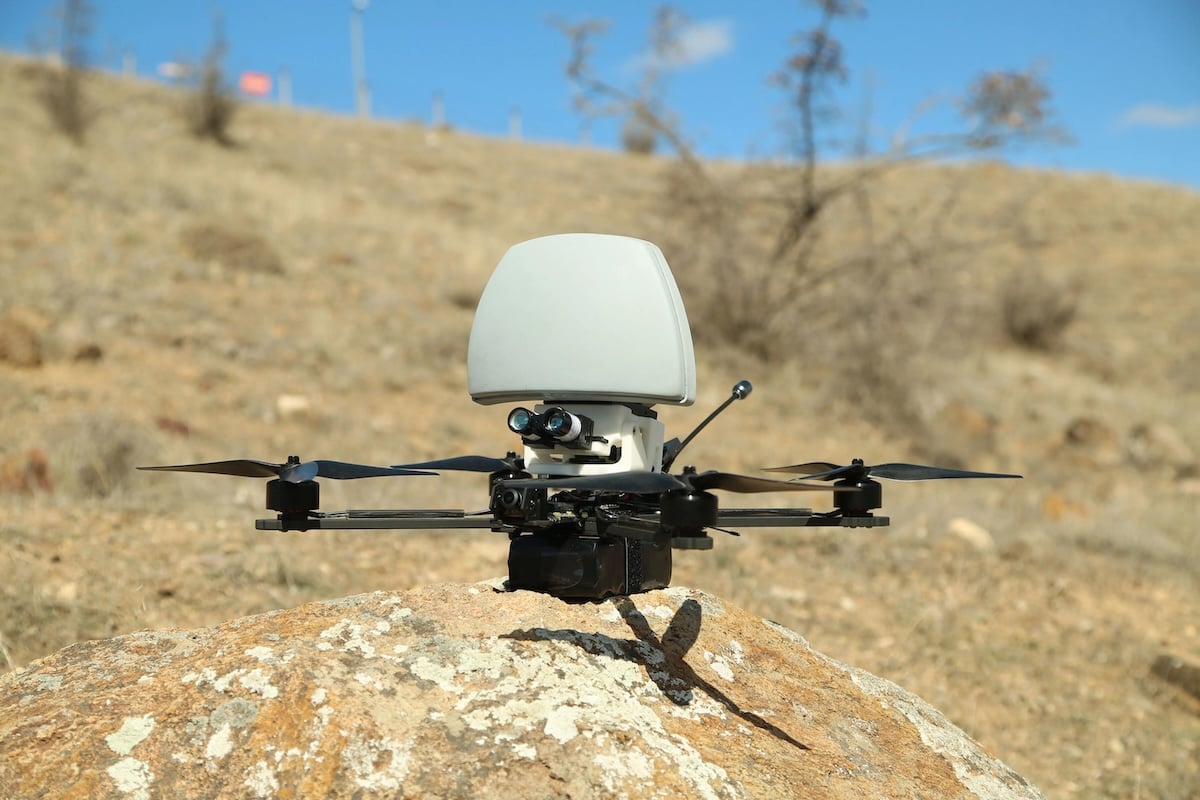
Previously introduced as KARGUFPV, the drone has been renamed STM ALKAN FPV. It combines operator-controlled flight with image processing that enables an autonomous terminal dive towards a target designated by the operator.
“We have also integrated STM’s autonomy and image-processing capabilities into ALKAN FPV, enabling the system to perform an autonomous terminal dive and precision strike once the operator designates the target. This reduces operator dependency while enhancing strike accuracy and mission effectiveness,” said STM General Manager Özgür Güleryüz.
ALKAN FPV is designed to engage fixed and moving targets with either an anti-personnel or armour-piercing warhead. STM describes it as highly manoeuvrable, capable of day-and-night operations and having a low radar cross-section.
Operators fly the aircraft using real-time camera images, with both radio-frequency communications and fibre-optic control available. STM says the cable option allows the drone to continue its mission without reliance on GPS or RF signals and without being affected by electromagnetic jamming.
The company lists a mission range of 10 kilometres and a maximum speed of 140 km/h. Its published specifications give a mission altitude of 500 metres and a maximum altitude of 5,500 metres above mean sea level.
Endurance is stated at more than 20 minutes in the one-way attack configuration. In observation configuration, without the munition and fuze, the drone can remain airborne for up to 44 minutes, according to STM.
ALKAN FPV uses the same munition and fuze systems as KARGU, STM’s rotary-wing loitering munition. The company says its anti-personnel and armour-piercing warheads are interchangeable between the two platforms without modification, allowing users to employ existing KARGU munitions with ALKAN FPV.
STM says the drone’s safety fuze complies with MIL-STD-331 and is intended to provide safety during transportation and mission execution. The system also has a distance-fuze sensor for automatic detonation at an adjustable distance.
“One of the key features that differentiates ALKAN FPV from conventional FPV systems is its advanced military safety fuze, developed to military standards. This provides a high level of safety throughout transportation and mission execution,” Güleryüz said.
The deliveries extend STM’s unmanned systems portfolio into FPV technology, drawing on its operational experience with other tactical drones. Güleryüz said the company was applying its engineering expertise in autonomy to the new product.
“To date, we have delivered systems such as KARGU, BOYGA, TOGAN and ALPAGU to the inventory of Turkish security forces and achieved exports to more than 15 countries across four continents. We are now bringing the operational experience gained in the field and our engineering expertise in autonomy to FPV technologies,” he said.
STM pointed to the Ukraine-Russia war as evidence of FPV drones’ role as relatively low-cost attack systems. Such aircraft give operators a live view from an onboard camera through goggles or a monitor, allowing them to guide the drone towards a target.