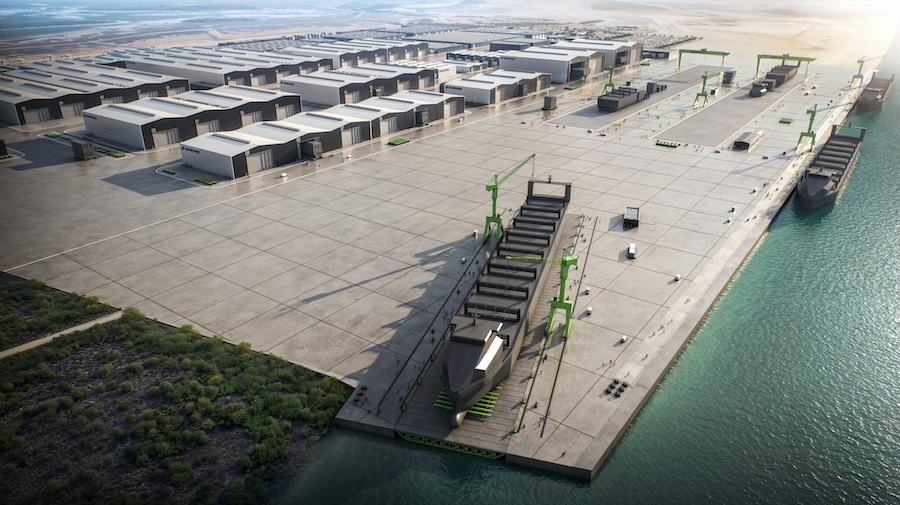
The scale of the undertaking is difficult to overstate for a region of South Texas that has long sat on the periphery of America’s industrial map. Saronic estimates the project will generate more than $160 billion in economic impact for Cameron County alone and $264.5 billion for the state as a whole, while creating up to 10,000 direct jobs — figures that would place Port Alpha among the largest economic development projects in modern Texas history.
Ground is expected to break in 2026, with the facility slated to begin operations in 2028. The timing is not incidental: the announcement lands against the backdrop of a Trump administration executive order on restoring American maritime dominance and subsequent legislative pushes, including the SHIPS for America Act and the Maritime Action Plan, both aimed at closing a widening shipbuilding gap with China and other rivals.
For Dino Mavrookas, Saronic’s co-founder and chief executive, the project is as much about national capability as corporate expansion. “America’s maritime future depends on our ability to build again,” he said. “Port Alpha is our commitment to that mission.”
Mavrookas described the facility as “built from the ground up to deliver ships at a speed and scale not seen since World War II,” and was careful to frame it as more than an infrastructure play. “This investment is about more than constructing a shipyard,” he said. “It is about rebuilding the industrial capacity, workforce, and manufacturing advantage required to ensure American maritime leadership for decades to come.” He credited Texas and Brownsville with providing what he called “the foundation to turn that vision into reality.”
The site selection followed a year-long search that weighed locations across the East, West and Gulf coasts, with Saronic ultimately settling on Brownsville after assessing workforce availability, infrastructure readiness, available land and room for future growth. The facility will initially occupy 835 acres at the Port of Brownsville, with an option to expand to nearly 4,400 acres should demand warrant it.
At full build-out, Port Alpha will be capable of producing vessels up to 850 feet in length, with the potential to eventually support ships exceeding 1,200 feet if the site expands as planned. Saronic points to the location’s deepwater channel access and multimodal logistics connections as key advantages that made Brownsville stand out from competing bids.
Texas Governor Greg Abbott, appearing at the announcement, did not undersell the moment. “Today marks history with the announcement of the most advanced shipyard in the entire world,” he said, noting that the facility would eventually employ roughly 10,000 workers.
Abbott put a figure on what that means for the state’s economy, saying Saronic would be “providing about $750 million in annual paychecks to Texans” once fully operational — a sum he called “game-changing for the population of Texas.” He added that, as governor, he was “proud that Saronic calls Texas home.”
The jobs created will span a wide skills range, from welders and machinists to robotics engineers and naval architects, according to the company. Saronic said it plans to partner with the State of Texas, Cameron County and regional educational institutions to build out training and apprenticeship pipelines aimed at sustaining the workforce over the long term.
Port Alpha is not Saronic’s first foray into physical shipbuilding infrastructure. The company acquired a shipyard in Franklin, Louisiana in early 2025 and has since committed $300 million to expand it by 300,000 square feet, a facility currently producing its 180-foot Marauder autonomous vessel.
Taken together, the two sites amount to a multi-billion-dollar private capital bet on rebuilding an American shipbuilding base that has atrophied for decades — one Saronic frames not merely as a business expansion, but as a contribution to national industrial resilience as construction moves forward with federal, state and local partners.