Under the 2022 Ammunition Plant Modernization Plan, monthly production was expected to rise from 14,000 rounds to 100,000 rounds by October 2025. The United States invested about $4.5 billion toward that expansion, but output had reached only about 36,000 rounds a month by March 2026.
That figure equals roughly 432,000 rounds a year, little more than one-third of the planned level. The finding was included in the Office of Inspector General’s July 9 report, “Evaluation of the DoW’s Capability and Capacity to Produce 155-Millimeter Artillery Ammunition.”
The report identified metal projectile parts as the main production bottleneck. In practical terms, U.S. industry has struggled to produce enough qualified shell bodies or bring alternative manufacturing methods online quickly enough.
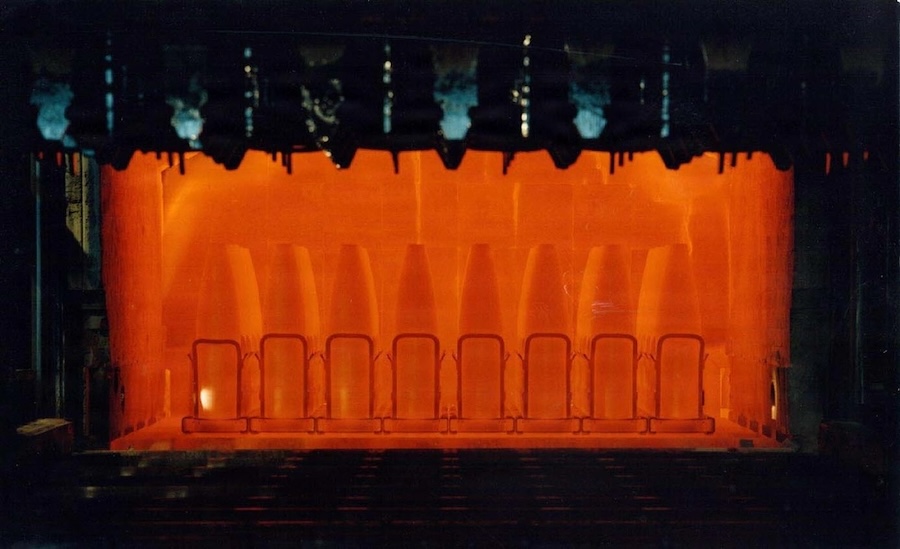
The most visible problem is at the Universal Artillery Projectile Lines facility in Mesquite, Texas. According to the report, the plant did not deliver on schedule any metal projectile part that met the technical requirements attached to the order.
The Mesquite plant opened in 2024 after construction and equipment costs of $469 million to U.S. taxpayers. The federally owned facility is operated by General Dynamics Ordnance and Tactical Systems and was intended to be a highly automated, digitized and modern production site.
To accelerate output, the facility was expected to produce bodies for the M107 projectile, a nearly 70-year-old design, rather than the newer longer-range M795 round. That effort has not succeeded as planned, forcing plants in Scranton, Wilkes-Barre and Ingersoll, Canada, to take on more of the work.
Those facilities have not yet closed the production gap. The United States now aims to reach about 71,000 rounds a month in September and 140,000 rounds a month, or 1.68 million a year, by December 2027.
That next phase is expected to rely partly on two new ammunition plants in Camden and Parsons and the modernized Iowa Army Ammunition Plant. The targets would put U.S. production above the original 100,000-round monthly goal, but only if the industrial base can overcome the shell-body bottleneck.
The production lag comes after a major drawdown in U.S. 155 mm ammunition stocks. The report’s authors estimated the reduction at more than 3.6 million rounds, including more than 3 million sent to Ukraine.
A further 111,637 rounds were used for U.S. military training, while 217,857 rounds were delivered to foreign customers through Foreign Military Sales. Those figures show how operational demand, allied support and export commitments have strained a production base still trying to scale.
The report recommended a review of the contract for construction of the Mesquite facility and contracts tied to ammunition production. Its findings point to a central problem for U.S. defense planning: new money and new factories have not yet translated into the ammunition output needed for sustained artillery demand.