The U.S. Air Force said the exercise validated its ability to project decisive military power. It combined advanced fighter and bomber operations with rapidly deployable command-and-control frameworks.
This year’s exercise tested participants’ ability to move from defensive postures to offensive strikes in a contested environment. The Air Force said the training was intended to ensure U.S. forces remain ready to defeat threats against the homeland and global American interests.
“This exercise was able to provide challenging and realistic training across the force.” said U.S. Air Force Lt. Col. Lance “Nuke” Ferguson, AK26 lead planner, USAFE-AFAFRICA Warfare Center. “We were able to replicate much of what is being faced in operational environments, planning through execution, to ensure those potentially called upon in the future can effectively continue to defend our interests wherever needed.”
Fourth- and fifth-generation combat aircraft integration was central to Astral Knight 2026. F-35A Lightning IIs and F-15E Strike Eagles from the 48th Fighter Wing launched from RAF Lakenheath, England.
The aircraft intercepted simulated adversary jets and cruise missiles during high-end defensive combat air missions. After air superiority was established, the fighters transitioned to offensive combat air operations.
Those missions included fighter sweeps, high-value asset escort, suppression of enemy air defenses and deep air interdiction. The targets were simulated land-based threats.
“I’m incredibly proud of the level of learning that was achieved by the multitude of different players in Astral Knight 2026,” said U.S. Air Force Capt. William “Tusk” Mueser, AK26 project lead for the 48th FW. “Despite the limited resources available, we were able to combine nearly a dozen squadrons to create world-class training opportunities to test out new capabilities, enhance interoperability, and refine tactics, techniques and procedures to make us a more lethal fighting force for the fight of both today and tomorrow.”
U.S. Air Force B-1B Lancers and B-52 Stratofortress aircraft integrated directly with fighter formations. The bombers provided offensive combat air support during the exercise.
The Air Force said bomber-fighter integration strengthened global deterrence. It said the training demonstrated the service’s ability to strike at a time and place of its choosing.
U.S. Air Force KC-135 Stratotankers from the 100th Air Refueling Wing at RAF Mildenhall, England, supported the high-tempo operations. The tankers provided aerial refueling needed to extend the combat fleet’s reach and endurance.
The 606th Air Control Squadron from Aviano Air Base, Italy, coordinated between air and ground forces. The squadron is the U.S. Air Force’s only overseas Control and Reporting Center and uses the call sign “Primo.”
The squadron exercised distributed command-and-control operations during Astral Knight 2026. It managed airspace and supported fighter targeting during the exercise.
“The overall objective for Astral Knight is for our controllers to get very valuable face-to-face time with the fighters, along with live control from a simulated deployed environment,” said U.S. Air Force Capt. Christopher Callari, 606th ACS air battle manager.”
The 606th Air Control Squadron also integrated with two U.S. Marine Corps air controllers. They came from Marine Air Control Squadron 2, Air Defense Company Alpha and Bravo, at Cherry Point, North Carolina.
The Marines embedded with 606th crews during planning and live operations. The work was intended to build communication processes needed to control operational areas in a real-world joint fight.
“We’re performing the same functions and honing towards perfection in the way that we’re performing those functions between the Air Force and the Marine Corps,” said U.S. Marine Corps 1st Lt. Barrett Pierce, an air command and control officer assigned to Air Defense Company Alpha MACS-2. “So ultimately we’re able to support whatever mission is going on in the sky, no matter who’s sitting as the controller.”
The 19th Electronic Warfare Squadron, based at Polygone, Bann, Germany, supported the exercise by simulating a contested electromagnetic environment. The unit provided realistic electronic warfare threat training.
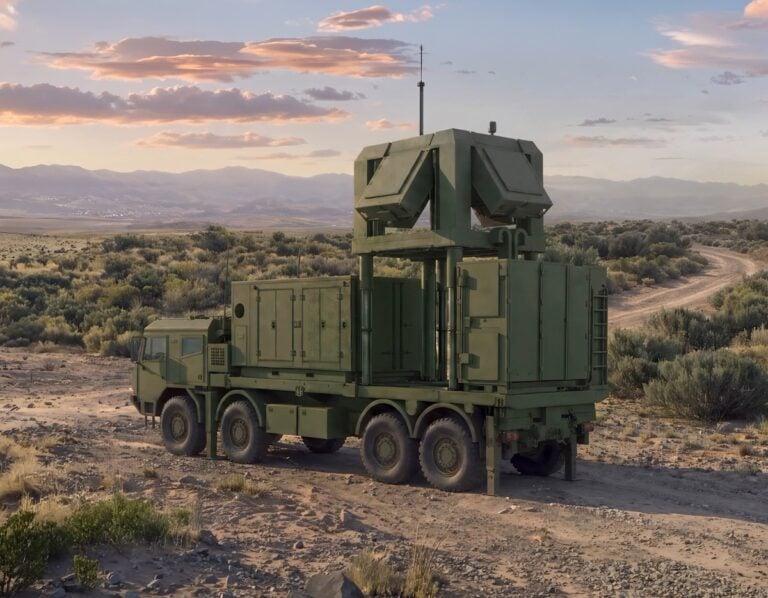
The squadron deployed land-based emitters to simulate dynamic adversary surface-to-air missile systems. The Air Force said the mobility of modern surface-to-air missile systems forced pilots and ground controllers to adapt their strategies.
“The most important reason for having surface to air threat emitters within the fight is going to be replicating the scenario that pilots are going to face in actual combat so they can take appropriate action.” said U.S. Air Force Lt. Col. Timothy Killham, local missions officer, 19th EWS.
The Air Force said Astral Knight 2026 combined integrated fourth- and fifth-generation aircraft, joint command and control and realistic threat replication. It said the exercise showed how U.S. Air Force units project power and defend against conventional and asymmetric threats in a complex global security environment.