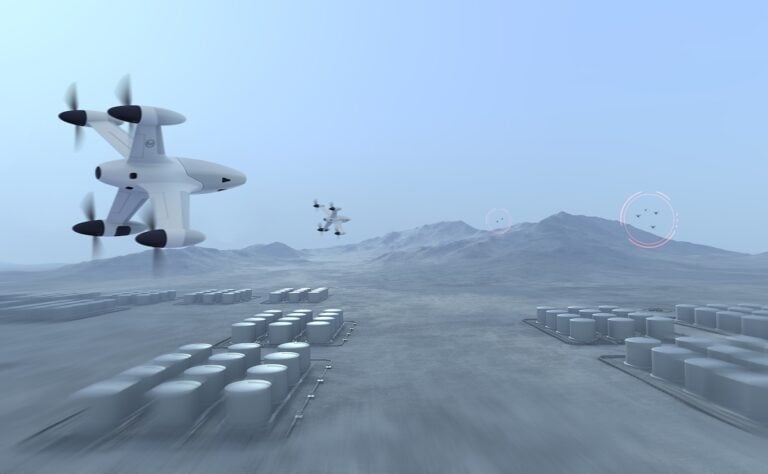


The company said mission autonomy is distinct from flight autonomy. Flight autonomy manages safety-critical functions such as takeoff, level flight, waypoint navigation and landing, while mission autonomy enables robotic aircraft to work together to execute complex missions.
Anduril said these two technologies are reflected in its work on the Collaborative Combat Aircraft program. Since April 2024, its YFQ-44A air vehicle team has developed, tested and built prototype CCA aircraft together with the flight autonomy software needed to keep them airborne.
A separate Anduril team has worked to turn the company’s Lattice software baseline into a mission autonomy software stack for CCA missions. The company said it invested its own funds to build the capability.
Under the new contract, Anduril will expand and refine Lattice for Mission Autonomy. The work will build on capabilities already demonstrated across multiple Lattice-powered flights of Increment 1 CCA.
The company said it will fly regularly and test the software across the full system envelope and CCA mission profile. It also plans tests in which operational users directly oversee Lattice-powered mission autonomy flights.
Anduril said those tests are intended to build trust with end users. The company described that trust as critical to fielding CCA rapidly and at scale.
The company said its route to the contract was not linear. It said it identified problems in its initial approach, rebuilt its mission autonomy work and learned from both contract wins and losses.
Anduril said its selection validates the Air Force’s emphasis on constant competition and modularity. It also cited the Autonomy Government Reference Architecture, known as A-GRA, as a standard intended to ensure compatibility between autonomy software and aircraft hardware.
The company said Lattice for Mission Autonomy is fully A-GRA compliant. That means it can be integrated with Increment 1 CCA and with current and future A-GRA-compliant aircraft.
Anduril said it has worked on sophisticated mission autonomy since its early years. It said its experience with systems including Sentry towers, air defense systems and launched effects helped build the understanding needed for CCA mission autonomy.
By early 2025, the company said it had invested in simulation infrastructure, surrogate flights and algorithm research and development. It also worked on formation flight, airspace management, tactics and other elements needed for operationally relevant CCA missions.
Anduril said it still needed to improve and accelerate its testing approach. It also needed to better explain why its software took specific actions during tests and ensure that the system behaved in ways that felt natural to uniformed pilots.
The company said this led to a foundational rebuild of its mission autonomy product for air dominance. It expanded its core engineering team and added software, simulation, user interface and infrastructure engineers.
Anduril said it also added former fighter pilots and weapons school instructors with hundreds of years of combined operational experience. The company said this team worked on the technical and operational aspects of the CCA mission set.
The company also invested in tooling and infrastructure, drawing lessons from more mature autonomy sectors such as commercial autonomous vehicles. It expanded high-fidelity, faster-than-real-time simulation capabilities and automated testing pipelines.
Anduril said this accelerated development and increased confidence in system performance before flight testing. It also said technical performance alone would not determine success because pilots must trust and understand their robotic wingmen.
The company worked with former operators to build mission planning, in-flight monitoring and post-mission debrief tools. These tools are intended to help human pilots understand why CCA aircraft make particular decisions.
Anduril said its internal rebuild moved in parallel with the Air Force’s CCA mission autonomy program, but not as part of it. The company said it learned in mid-2025 that it had not been selected for the next stage of prototyping.
The company said that loss accelerated its internal investment. After a year of focused work, its revised mission autonomy stack flew on YFQ-44A for the first time on February 24, 2026.
Lattice for Mission Autonomy flew on YFQ-44A again in March for a more complex mission. Anduril said the new Air Force selection validates the internal rebuild effort.
The company said it will now move from individual autonomy flights to regular mission planning, flying, debriefing and performance analysis across a fleet of aircraft. It said this next stage will uncover new challenges that it expects to address as the work continues.
Anduril said the Air Force’s modular architecture approach is helping create a wider ecosystem of autonomous aircraft. The company said A-GRA provides a foundation for autonomy software and aircraft hardware to evolve as mission needs change.