The first class comprises 10 warrant officers trained through a 19-week course at the U.S. Army John F. Kennedy Special Warfare Center and School. Their induction into the Special Forces branch was scheduled for October 2 at Fort Bragg, North Carolina.
The Army developed the specialty after examining lessons from recent conflicts. The use of low-cost unmanned systems and electronic warfare in Eastern Europe exposed the limits of relying on tactical operators alone.
Operating a system does not provide all the skills needed to adapt or protect it under attack. The Army established a separate career path for specialists who can integrate, program and sustain the equipment.
Chief Warrant Officer 5 Jerry Brown said the responsibility could not simply become another task within an Operational Detachment Alpha. Brown is the command chief warrant officer for 1st Special Forces Command (Airborne).
“What we’ve determined is it cannot be an additional task or an additional hat for someone on the ODA,” Brown said. “We determined an additional MOS with someone who could focus on that specific tech capability, whether it be ground, air, or just unmanned systems as a whole, is the better approach to infusing or integrating what will be required of us in the future fight.”
The course teaches students to establish resilient tactical mesh networks. It also trains them to create autonomous systems that do not depend on GPS or radio links.
Students learn to train artificial intelligence and machine learning models. Those skills allow them to field drones that navigate and strike targets using onboard sensors.
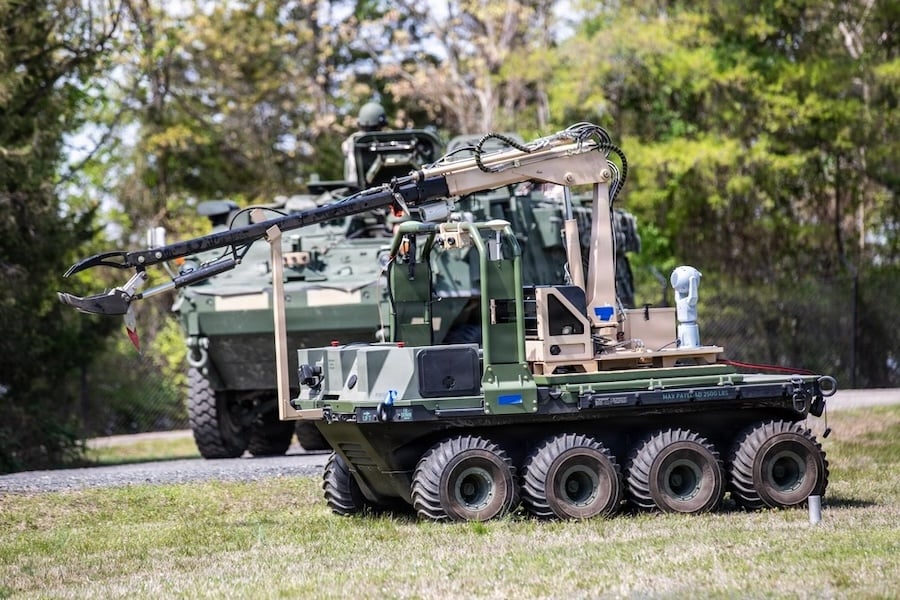
Graduates will serve as technical advisers to brigade and task force commanders. They will help plan and coordinate the use of robotic and autonomous systems.
Their responsibilities include finding vulnerabilities in friendly equipment and developing countermeasures against enemy electronic attacks. They will also build prototypes to address new battlefield problems.
The course culminates in a “Prototype Capstone” under tactical field conditions. Students must design, 3D-print and code a working solution to a problem from scratch.
The program is based within the Special Forces Warrant Officer Institute at the John F. Kennedy Special Warfare Center and School. Training takes place at Fort Bragg and Camp Mackall in North Carolina, and at Fort McClellan and Clark Range in Alabama.
Students spend 14 weeks studying computer networks, edge artificial intelligence, computer-aided design, additive fabrication and radio frequency systems. Two weeks of mission planning are followed by three weeks of field maneuver and culminating exercises.
Graduates will return to units across U.S. Army Special Operations Command. They will lead specialized robotics detachments and help integrate new technology into their formations.
Chief Warrant Officer 5 Gary Ostrander described robotics as an expanding requirement across the Army. He is the chief warrant officer of the Special Forces Branch and a key architect of the specialty.
“Robotics is no longer a niche capability, it is becoming a core requirement for Army formations,” Ostrander said. “The 390A Robotics Technician will provide the technical expertise needed to help commanders integrate, sustain, and employ robotic systems at scale, giving Soldiers across the Army a decisive advantage in increasingly complex operational environments.”
The Army publicly unveiled the specialty at the Maneuver Warfighter Conference on September 16. Vice Chief of Staff of the Army Gen. Christopher C. LaNeve presented it alongside changes to force structure and autonomous capabilities.
“The Army is implementing changes in force structures, adding a multi-domain task force equipped with autonomous long-range fires,” LaNeve said. “This is complemented by a new MOS, 390A Robotic Technician and autonomous systems technician.”
“These technical experts will help command teams understand integration across the force. We are scaling this across the Army.”