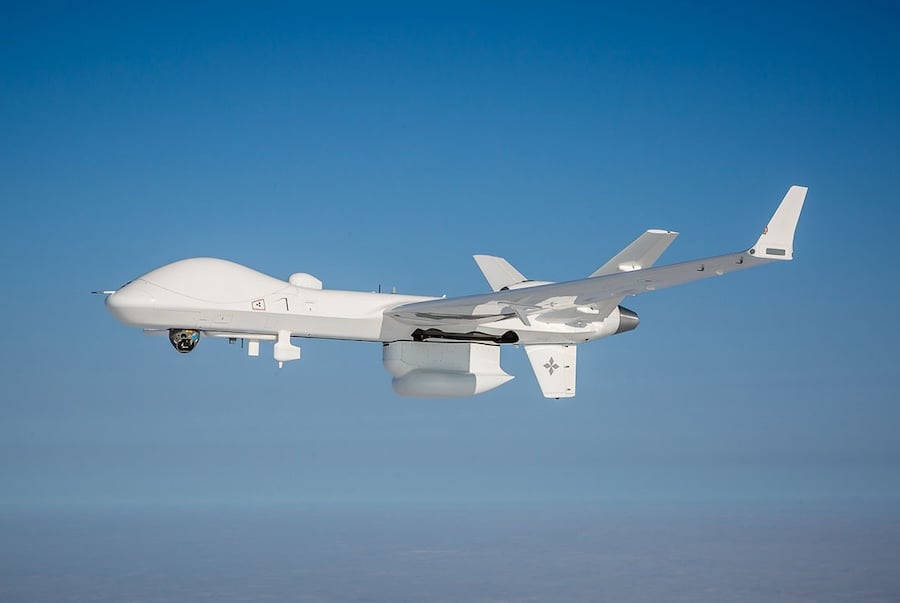
SeaGuardian is the maritime variant of GA-ASI’s MQ-9B uncrewed aircraft system. The Navy employs it under a Company-Owned, Company-Operated contract supporting the 7th Fleet assessment.
The aircraft was provided at the request of the Commander, Patrol and Reconnaissance Group for the Maritime Patrol and Reconnaissance Force’s Commander’s Operational Group. The gathering brings together senior leaders, tacticians and industry representatives to review naval aviation capabilities and fleet anti-submarine warfare procedures.
“We’re always thrilled to have our Navy customer showcase our SeaGuardian at these Navy Tactical Symposiums,” said Patrick Shortsleeve, GA-ASI’s vice president of DoD Strategic Development. “Whidbey Island is a great place to display SeaGuardian alongside the P-8A Poseidon for MPRF professionals to help illustrate that this future focused capability is here now and ready for employment.”
Whidbey Island has supported SeaGuardian operations during Navy activities including Northern Edge and Integrated Battle Problem. The aircraft has also participated in carrier pre-deployment workups and the base’s 2025 Open House.
MQ-9B SeaGuardian: endurance, sensors and anti-submarine configuration
SeaGuardian uses removable maritime sensors to configure the MQ-9B platform for surveillance and reconnaissance. GA-ASI says it is designed to fly beyond the horizon using satellite links for more than 30 hours, depending on configuration.
The aircraft is designed for all-weather operations and integration into civil airspace. Available equipment includes a centerline wide-area maritime radar, an automatic identification system, electronic support measures and a self-contained anti-submarine warfare mission kit.
For anti-submarine operations, its open architecture allows integration of sonobuoy management and dispensing systems. These enable operators to deploy, monitor and control sonobuoys from a single remotely piloted aircraft.
Four wing stations can accommodate up to four sonobuoy dispenser pods. The aircraft can carry and release up to 40 A-size or 80 G-size sonobuoys, according to GA-ASI.
The company lists a mission radius of 1,200 nautical miles in the standard maritime surveillance and anti-submarine configuration, with substantial time on station for submarine prosecution. It describes the system as a standalone capability or a complement to crewed aircraft through manned-unmanned teaming.
Other potential missions include anti-surface warfare, airborne mine countermeasures, long-range intelligence gathering and over-the-horizon targeting. SeaGuardian can also be configured for search and rescue, humanitarian assistance, disaster relief and law enforcement.