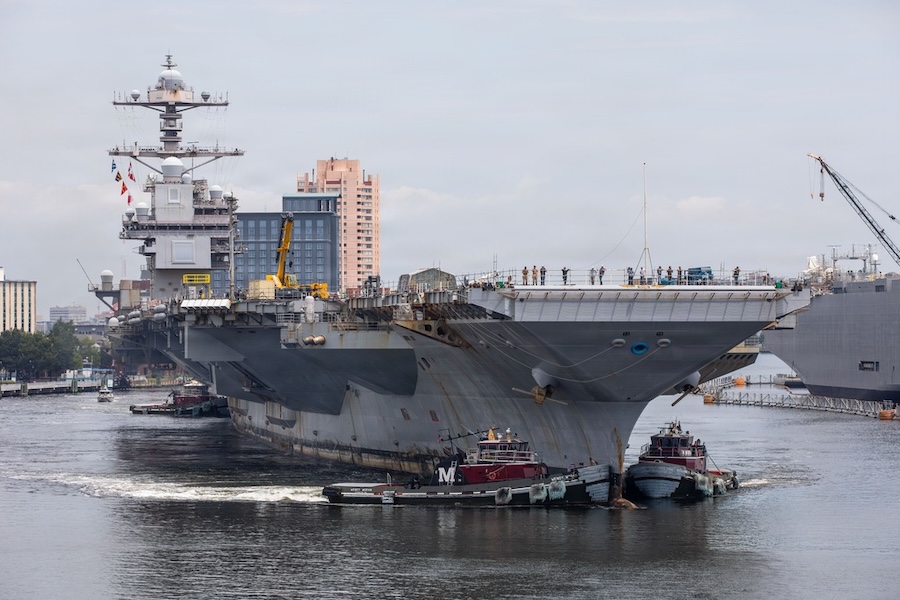
The availability follows the carrier’s 326-day deployment, which included operations in the Mediterranean, Caribbean and Red Seas. It is also Gerald R. Ford’s first regularly scheduled availability at a public shipyard.
A Planned Incremental Availability is a scheduled period for an aircraft carrier to undergo extensive maintenance, repairs and modernization. The work is intended to prepare the ship for future operational demands through a wide range of overhauls and inspections.
The Navy said a concurrent availability will also be conducted to restore spaces damaged during a fire aboard the deployed carrier in March 2026. The combined work will support the carrier’s return to fleet operations and future mission requirements.
Gerald R. Ford’s availability is part of the Navy’s maintenance continuum, which integrates operations and overhauls through smaller and more frequent availabilities. The approach is intended to complete needed work while increasing operational availability and improving warfighting readiness.
The continuum has already allowed shipyard personnel to conduct advance work while the carrier was at Naval Station Norfolk. That work included early testing, preparations for temporary service installation and jet blast deflector overhaul.
“The team is heavily leveraging the lessons of the new maintenance continuum,” said Project Superintendent George “BJ” Baker. “Specifically, we are utilizingpre- and post-Window of Opportunity (WOO) periodsto manage new work budgets. If late-stage new work poses a risk to our completion date, we have the framework to work those items post-availability. Capitalizing on these WOO periods is the single most important key to returning carriers to their strict [maintenance] timelines.”
Baker said the team has undergone “rigorous and highly collaborative” preparations to support timely completion. These included quarterly project planning reviews, specialized training on the new carrier class at Newport News Shipbuilding’s Virginia Advanced Shipbuilding and Carrier Integration Center, and peer reviews with the PCU John F. Kennedy team.
The project team will also use Norfolk Naval Shipyard’s Focus and Finish initiative as it overhauls the new type of carrier on a demanding timeline. The model starts availability jobs and drives them urgently to completion to reduce interruptions and delays.
“We are actively implementing theFocus and Finishexecution model to minimize multitasking, drive scheduling discipline, and rapidly close out work areas,” said Baker. “Every single shift matters. Our leadership team is focused on ensuring the entire shipyard and ship’s force community are completely bought into this ‘every day counts’ mindset.”
Gerald R. Ford’s arrival follows early Planned Incremental Availability completions for Nimitz-class aircraft carriers USS Dwight D. Eisenhower in April 2026 and USS George H.W. Bush in November 2024. The Navy said the shipyard is seeking to continue that record with the Ford-class carrier.
“USS Gerald R. Ford is positioned to become the third consecutive early finish of an aircraft carrier availability at America’s Shipyard,” said Shipyard Commander Rear Adm. Kavon Hakimzadeh. “Our project team is answering the call, and I look forward to many great successes over the next several months as we drive to completing the availability and maximizing Gerald R. Ford’s ability to meet its critical mission.”
USS Gerald R. Ford is the lead ship in the first newly designed aircraft carrier class in more than 40 years. The class is beginning the phased replacement of Nimitz-class aircraft carriers.
Norfolk Naval Shipyard is one of the largest, most historic and most multifaceted shipyards in the United States. Its mission is to repair, modernize and inactivate Navy warships and training platforms to maximize readiness and availability for fleet tasking.