
The contracts were signed on 28 May in Ożarów Mazowiecki by WB Group President Piotr Wojciechowski and Major General Artur Kuptel, Head of the Armament Agency of the Ministry of National Defence, acting on behalf of the State Treasury. The procurement will be financed through the European Union’s SAFE instrument.
The signing ceremony was attended by Deputy Prime Minister and Minister of National Defence Władysław Kosiniak-Kamysz, Secretary of State at the Ministry of National Defence Paweł Bejda, Government Plenipotentiary for the Security Enhancement Instrument Magdalena Sobkowiak-Czarnecka, representatives of the Armament Agency and WB Group employees. The agreements cover hundreds of WARMATE loitering munition systems, nearly 200 FLYEYE unmanned reconnaissance systems and 12 battery-level fire units of the GLADIUS reconnaissance-strike unmanned system.
“The SAFE mechanism is based on joint procurement. In May, the phase of individual contracts – under which a single Member State, such as Poland, could purchase specific products – will come to an end. After that, we will enter a new chapter of international contracts. We have just returned from Canada, where the Canadian side declared its intention to procure drones from WB. Today, further declarations were made by additional partners from the European Union,” said Magdalena Sobkowiak-Czarnecka.
Kosiniak-Kamysz said WB Group had become an important representative of the Polish economy and defence industry abroad. “I am proud to be here, in a company that has become a flagship of the Polish economy, as we see every time we go abroad. We hear it every day from Polish soldiers. There is no better recommendation than that of a Polish soldier. If they speak highly of your equipment, the entire world will speak highly of it – and indeed, it already does,” he said after the signing.
Wojciechowski said the contracts were an important recognition of the company’s work and the operational value of its systems. “This event is of special significance to us. It is a great recognition of the work of our engineers, specialists, and all our employees. The Polish Armed Forces have decided to procure modern equipment that has been combat-proven and highly valued by its users. Moreover, we are committed to its further development to make it even more advanced and effective,” he said after the ceremony.
The company said the agreements will support further growth, expansion of production capacity and continued development of teams that have designed and developed unmanned systems in Poland for years. WB Group said contracts of this scale provide greater predictability for research and development investment and enable wider cooperation with domestic partners in the supply chain for advanced defence technologies.
“The security aspect is particularly important. By strengthening the nation’s defence capabilities, we enhance the security of all of us – our families, local communities, and the country as a whole. Contracts related to GLADIUS, FLYEYE, and WARMATE mean jobs for our colleagues in Skarżysko-Kamienna, Czechowice-Dziedzice, Gliwice, and Gdynia. They also create opportunities for smaller locations such as Lipka Krajenska. These funds will not remain solely within our company – they will flow into local economies, creating jobs, supporting local suppliers and entrepreneurs, and driving economic growth,” Wojciechowski added.
WB Group said its position is based on proprietary technologies, engineering expertise and scalable manufacturing capabilities. Combined with the new contracts, these strengths are expected to support further programmes for the Polish Armed Forces and wider cooperation with international partners, including the development of defence capabilities across NATO and the strengthening of the Alliance’s eastern flank.
The first contract covers the delivery of 12 battery-level fire units of the GLADIUS reconnaissance-strike unmanned system to the Polish Armed Forces by 2030. WB Group described GLADIUS as a highly advanced unmanned system, unique in Europe and developed partly on the basis of lessons from the war in Ukraine.
GLADIUS integrates reconnaissance, command and precision strike capabilities within a single network-centric architecture. Its advantage comes from the full integration of sensors, effectors and command-and-control systems, creating a find-identify-strike chain aligned with NATO and EU standards.
The GLADIUS battery modules are designed for precision target engagement and airborne intelligence, surveillance and reconnaissance missions. Imaging, radar and electronic reconnaissance tasks will be carried out using platforms including FT-5 reconnaissance unmanned aerial vehicles.
WB Group will deliver systems already known to the Polish Armed Forces as well as new effectors, including those developed under the GLADIUS 2 programme. These effectors are intended to engage selected high-value targets at distances of several hundred kilometres from the launch point.
All unmanned platforms within GLADIUS will be integrated with the TOPAZ battlefield management system, which is already in service with the Polish Armed Forces. Each battery module will include launchers, command vehicles, ammunition vehicles, technical support vehicles and a stock of strike unmanned aerial vehicles.
The second contract covers the delivery of 190 FLYEYE unmanned aerial systems. Most of the systems will go to operational forces and the Territorial Defence Forces, while the FLYEYE system developed in Gliwice will for the first time also be fielded by reconnaissance platoons of tank battalions.
FLYEYE systems are designed for airborne intelligence, surveillance and reconnaissance missions using electro-optical payloads capable of day-and-night observation and image recording. The system has been extensively tested by the Polish Armed Forces and used in combat conditions for more than a decade, including in Afghanistan and Ukraine.
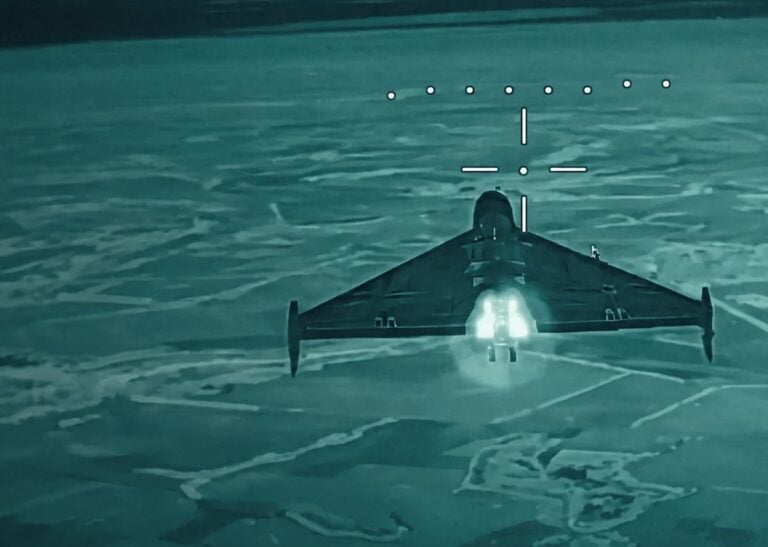
The third contract signed on 28 May concerns the delivery of more than 400 WARMATE loitering munition systems. WARMATE is designed to identify and engage targets, including lightly armoured vehicles and enemy infantry, depending on the warhead selected for the mission.
Within the Polish Armed Forces, WARMATE is used both as a man-portable system and as a vehicle-integrated solution. The system includes advanced control modules that automate most phases of flight and support the operator during target engagement.
Operations are conducted in real time using a live video feed. The operator retains full control of the system and can switch between a reusable reconnaissance mode and a one-way combat mode depending on mission requirements.