

The event was hosted by the NATO Center of Excellence for Cold Weather Operations (CEO-CWO) between February 17 and 26. HEIMDALL served as the validation phase for NATO’s Arctic experimentation arena, focusing on manned-unmanned teaming concepts and the integration of ISR data into the NATO Federated Mission Network and the Multi Domain Operation framework.
The exercise also provided an opportunity to assess the V-BAT’s ability to operate in extreme cold and maritime environments without any aircraft modifications. According to the company, the system’s performance was evaluated under operational conditions typical of Arctic missions.
Brandon Tseng, president and co-founder of Shield AI and a former Navy SEAL, said: “HEIMDALL was an excellent opportunity to prove V-BAT’s performance in real-world Arctic conditions. We launched from land and from smaller vessels, operated in harsh weather, and conducted surveillance across both maritime and land domains.”
He added: “V-BAT serves as a force multiplier in contested maritime environments by giving commanders reliable ISR wherever they operate. From the Caribbean to the high Arctic, V-BAT provides a dependable capability to support maritime and amphibious missions.”
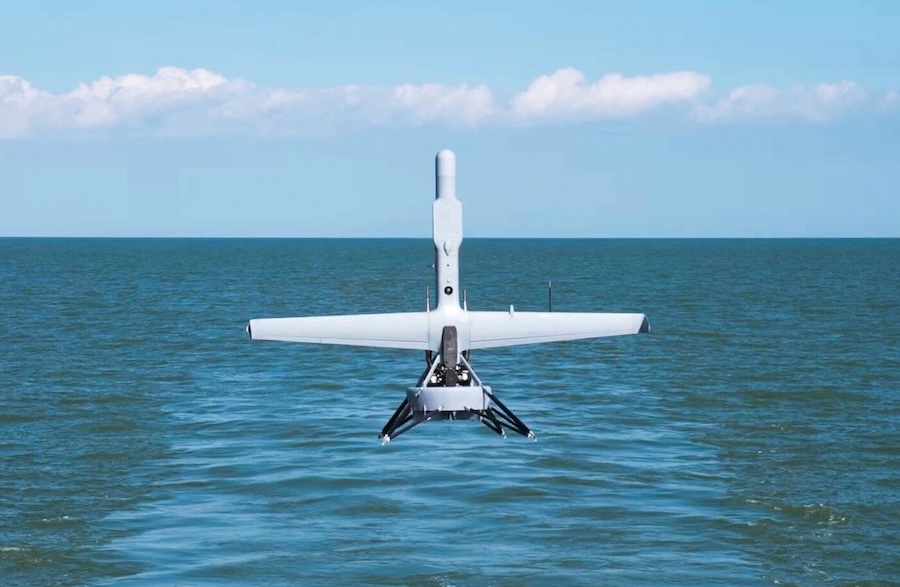
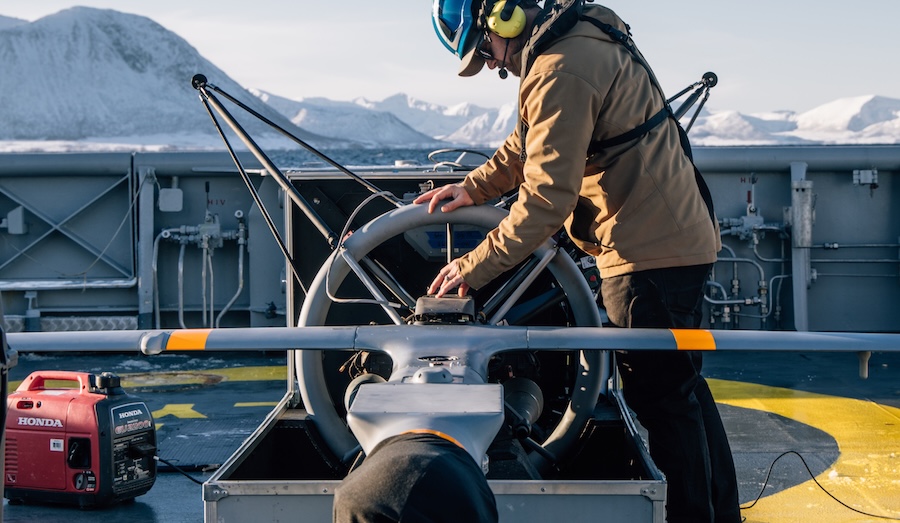
During the multinational exercise, the V-BAT operated as an integrated ISR node within a NATO-aligned multi-domain architecture in Arctic conditions. The aircraft carried out several ship-based vertical launch and landing operations from the Norwegian Coast Guard vessel KV Olav Tryggvason as well as land-based VTOL missions.
These flights demonstrated the aircraft’s ability to operate in Arctic winter conditions without configuration changes. Operations were conducted both during the day and at night using different sensor payloads.
The missions included electro-optic and infrared sensor systems as well as synthetic aperture radar. Communication between the V-BAT aircraft and forces at sea and on land was maintained across multiple frequency bands, while intelligence data generated by the system was fed directly into multinational command-and-control networks to support situational awareness.
Chris Brinkley, senior director of business development and strategy for Europe and Africa at Shield AI, noted the challenges associated with such operations. He said: “Cold weather operations can present a range of challenges to unmanned aircraft system (UAS) operators, including icing, condensation, and extreme weather conditions such as cold temperatures and high winds.”
He continued: “When moving into afloat maritime operations, these factors are significantly multiplied, making any flight operation more complex. Being able to work with customers such as the Norwegian Coast Guard and the Norwegian Armed Forces, who really know and understand cold weather operations, meant we were able to gain the best feedback on our platforms while utilizing a unique location.”
Brinkley also emphasized the opportunity to demonstrate the system’s operational readiness during the exercise. He said: “HEIMDALL allowed us to validate all the capabilities of the V-BAT to a range of stakeholders, without having to make any additional modifications to the aircraft – demonstrating a truly off-the-shelf capability.”
He added: “This also highlighted how users can be truly expeditionary with the V-BAT, as it can be maintained as an organic support asset that can be deployed anywhere around the globe.”
The V-BAT is a NATO Class I small vertical takeoff and landing unmanned aircraft system with a ducted-fan design, more than 12 hours of endurance, and a heavy-fuel engine. Designed, tested, and deployed for the electronic warfare battlefield, the aircraft provides ISR and targeting capabilities at lower cost and with a smaller logistical footprint than larger NATO Class II and Class III drones.
Its single-engine, enclosed-rotor configuration enables safe, unassisted launches and recoveries from ship decks, urban rooftops, and austere environments. These design features allow the platform to support operations in locations where traditional runway-based aircraft cannot operate.




![Destinus completes flight test of Ruta Block 2 validating new launch architecture for scalable long-range strike capability [VIDEO]](https://defence-industry.eu/wp-content/uploads/2026/04/destinus-completes-flight-test-of-ruta-block-2-validating-new-launch-architecture-for-scalable-long-range-strike-capability-video.jpeg)