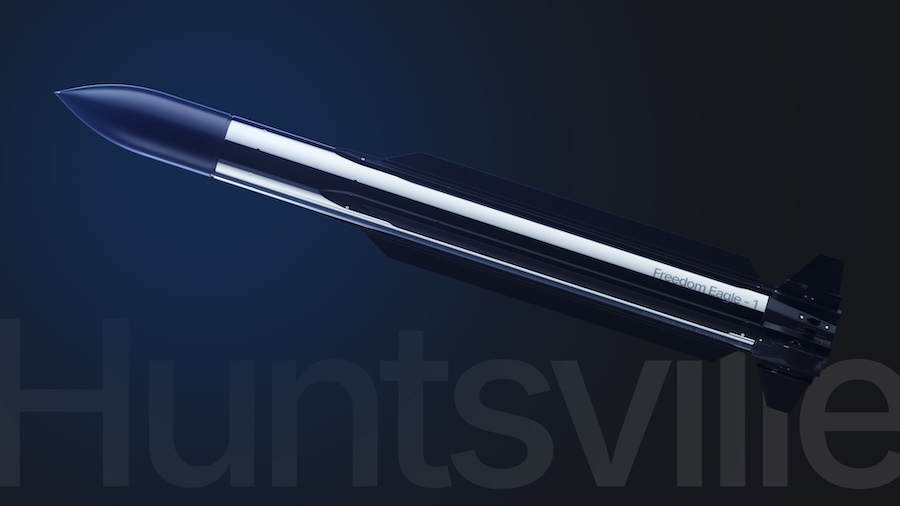
The investment is intended to increase quantities under Low-Rate Initial Production and accelerate future Full-Rate Production. AeroVironment said the expanded site will serve as the system-level integration, manufacturing and production hub for Freedom Eagle-1.
The expansion covers 24,000 square feet and is expected to support job growth in Huntsville. The company said it will help meet national security demand for subsonic missiles while strengthening cost-effective production capacity and supporting on-time delivery.
“Growing our presence in Huntsville places AV more firmly at the center of the Army’s air and missile defense ecosystem, enabling tighter integration, faster iteration, and more efficient production at scale,” said Wahid Nawabi, Chairman, President and Chief Executive Officer at AeroVironment.
“That proximity is critical as we begin production of Freedom Eagle-1, a system designed to deliver a scalable, cost-effective response to increasingly complex and high-volume aerial threats,” Nawabi said.
The investment follows AeroVironment’s recent selection and $95.9 million contract award under the U.S. Army’s NGCM and Long-Range Kinetic Interceptor programmes. The work is being executed through the U.S. Army Combat Capabilities Development Command Aviation & Missile Center and the Aviation & Missile Technology Consortium.
AeroVironment said the latest step marks the next phase in moving Freedom Eagle-1 from development to scaled production and operational fielding. The company is also involved in missile defence work at Redstone Arsenal in Huntsville.
In March, AeroVironment announced a $97 million contract to design and integrate prototype test environments for next-generation missile defence sensor testing at Redstone Arsenal. The federal centre hosts more than 70 organisations, including NASA, the FBI, the Missile Defense Agency, Army Program Acquisition Executive Fires and the future U.S. Space Command headquarters.
“This expansion is a critical step in scaling production of Freedom Eagle-1 and accelerating its delivery to the field,” said Jimmy Jenkins, Executive Vice President of AeroVironment’s Precision Strike and Defense Systems Group.
“By increasing manufacturing capacity, strengthening integration, and enabling production at volume, we’re delivering a cost-effective interceptor designed to counter increasingly complex and high-volume aerial threats,” Jenkins said.
Freedom Eagle-1 is designed as a low-cost, high-performance interceptor. It is intended to neutralise Group 2 and Group 3 unmanned aircraft systems while retaining residual capability against Group 1 UAS, fixed-wing aircraft and rotary-wing aircraft.
AeroVironment said the system provides increased lethality, extended range and rapid launch capability. It is intended to address the growing challenge of complex and high-volume aerial threats.
The system has achieved several development milestones. These include a successful live-fire demonstration of its dual-thrust solid rocket motor, controlled test vehicle launches and warhead testing.
AeroVironment said those milestones demonstrate technical maturity and reduced programme risk as Freedom Eagle-1 moves toward field deployment. The Huntsville expansion is intended to support that transition.
“As the nation’s defense and security demands increase, it is crucial that we meet capability needs, and there is no better place for AV’s expansion as Alabama continues to lead in defense manufacturing and innovation,” said Congressman Robert Aderholt.
The Huntsville project is part of AeroVironment’s wider effort to expand domestic manufacturing capacity. The company recently announced a $30 million expansion of its Albuquerque, New Mexico, campus, which is expected to generate more than $670 million in economic impact over the next decade, create more than 450 high-wage jobs and increase production of defence and space technologies.