
American Rheinmetall’s Team Lynx is competing against General Dynamics Land Systems in the XM30 program. The Army is evaluating two approaches to a next-generation vehicle for mechanized infantry formations.
Team Lynx said the Armored Multi-Purpose Vehicle remains well suited to protected support missions. Those roles include command, mortar operations, medical evacuation, medical treatment and general-purpose transport.
The company said Bradley’s replacement requires a different design from the outset. It must operate in direct contact with enemy forces and support dismounted infantry during close combat.
Team Lynx identified drones, precision fires and electronic warfare as growing battlefield threats. It also cited advanced anti-armor weapons and increasingly capable enemy combat vehicles.

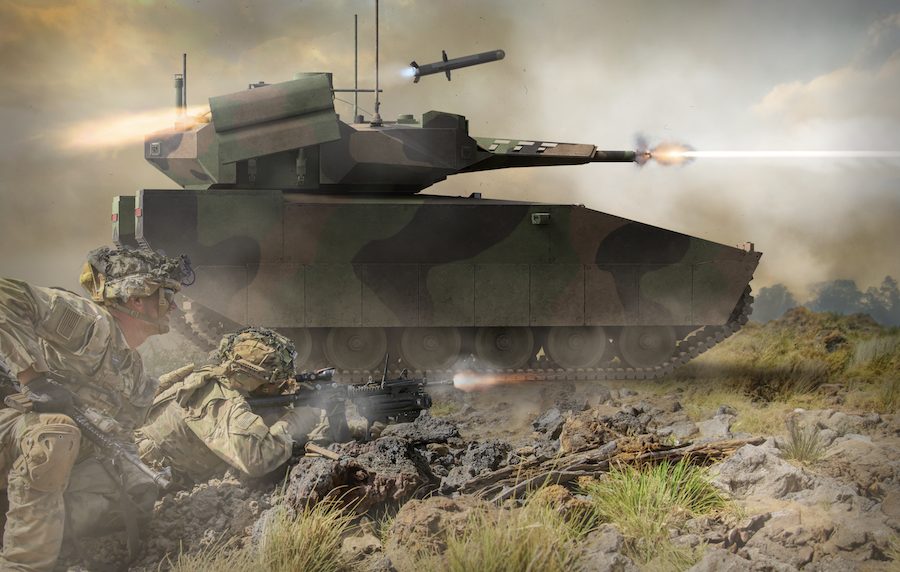
The proposed Lynx XM30 uses a two-soldier crew and carries six dismounted troops. American Rheinmetall said the infantry squad would share the crew’s digital operating picture before leaving the vehicle.
Its planned armament includes a U.S.-designed and manufactured uncrewed 50 mm turret. Team Lynx said the weapon would provide greater reach against armored vehicles, protected positions and anti-armor teams.
The uncrewed turret keeps the soldiers inside the protected hull. It also removes the internal turret basket found in conventional crewed designs.
American Rheinmetall said the vehicle combines modular armor with active and passive protection systems. Its internal layout separates personnel, ammunition, fuel and other potential hazards.
The Lynx XM30 is designed to keep pace with M1 Abrams tanks across difficult terrain. Team Lynx said its power capacity would support sensors, communications, counter-drone equipment and electronic warfare systems.
A modular open systems architecture is central to the proposal. American Rheinmetall said it would support faster integration of new software, weapons, sensors, autonomy and robotic capabilities.
The company contrasted that design with the space, weight, power and cooling limits created by repeated Bradley upgrades. It argued that an AMPV-based solution could encounter similar constraints earlier in its service life.
Army Soldier Touch Points have allowed crews, infantry troops, maintainers and commanders to influence the design. Their feedback has covered visibility, workload, maintenance access and dismount procedures.
American Rheinmetall leads a team that includes Textron Systems, Raytheon, L3Harris Technologies, Allison Transmission and Anduril. The partners contribute weapons, sensors, protection, mobility, artificial intelligence and digital integration technologies.
The vehicle is being produced and assembled across Team Lynx facilities in the United States. American Rheinmetall sites in Michigan support the program, while final assembly takes place in Slidell, Louisiana.
American Rheinmetall said the Lynx XM30 was designed for U.S. Army doctrine and operational requirements. Its proposal emphasizes domestic production, combat performance and capacity for long-term modernization.