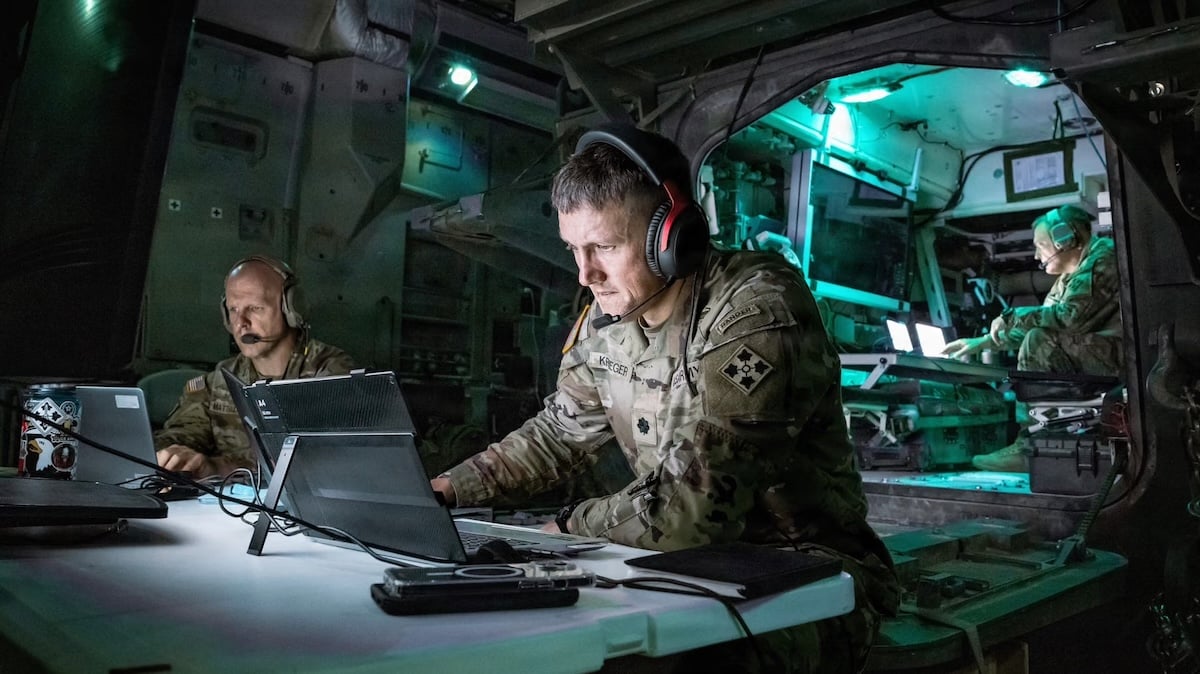
The five-year deal takes the Next-Generation Command and Control program, or NGC2, out of division-level prototyping and into operational use, starting with I Corps in the Pacific. Just $162.8 million is locked in for the base period; the rest depends on options.
What Anduril is delivering is the common data layer, the plumbing that lets sensors, weapons, vehicles and applications from different manufacturers talk to each other. Its Lattice software does that job.
The memo
The warning came from the Army’s chief technology officer and surfaced in media reports in October 2025. It said any authorized user could get into all applications and data, whatever their clearance or operational need, and that nobody was logging what they did.
Anduril said the memo was an outdated snapshot and that the problems had been fixed in the normal course of development. The Army said much the same, and Anduril’s contract announcement does not bring the episode up.
Twelve months of trials
The prototype took shape with the 4th Infantry Division under a $99.6 million agreement the Army continued in July 2025. Within weeks, Anduril says, its engineers were working next to soldiers in a run of exercises called Ivy Sting, fixing problems and rewriting software between each one.
By the Ivy Mass exercise, more than 2,500 end-user devices and a range of warfighting applications were running on a single data architecture, the company said. In about a year, by its account, NGC2 went from individual mission threads to a division-scale system covering fires, intelligence, sustainment, aviation and other missions.
Anduril puts the reduction in artillery fire timelines at 90 percent compared with legacy systems, and says airspace coordination and deconfliction got faster too. The Army also validated the network under degraded communications, the company said, showing that it kept working for soldiers who had lost their link to higher headquarters.
In June 2026, the Army settled on a common data baseline for NGC2 and put Anduril in charge of it. Lockheed Martin, which had been prototyping a different data layer design with the 25th Infantry Division, will now help implement Anduril’s baseline, according to trade press reports.
The Pacific is harder
Anduril itself calls the next step a significantly harder problem. I Corps commands four Army divisions in a theater where units can sit thousands of miles apart and have to coordinate with joint and allied forces over communications that are disrupted and intermittent.
The network has to tie those units together and still let decisions and operations go ahead when parts of it drop out, the company said. As of December 2025, according to trade press reporting, the architecture had not yet been stressed in an electromagnetic environment in a scenario-based event with soldiers on the move.
Who owns the stack?
Anduril argues that no single company should control every element of the Army’s command-and-control stack. A common data layer, it says, means new sensors, applications or weapons can be added without rebuilding the architecture underneath each time.
Reports in February indicated the Army was likely to end up with multiple vendors and technology stacks, with Anduril not serving as prime contractor for the whole portfolio. The service plans to field NGC2 to all 11 of its divisions within five years, at two to three a year, according to industry reports.