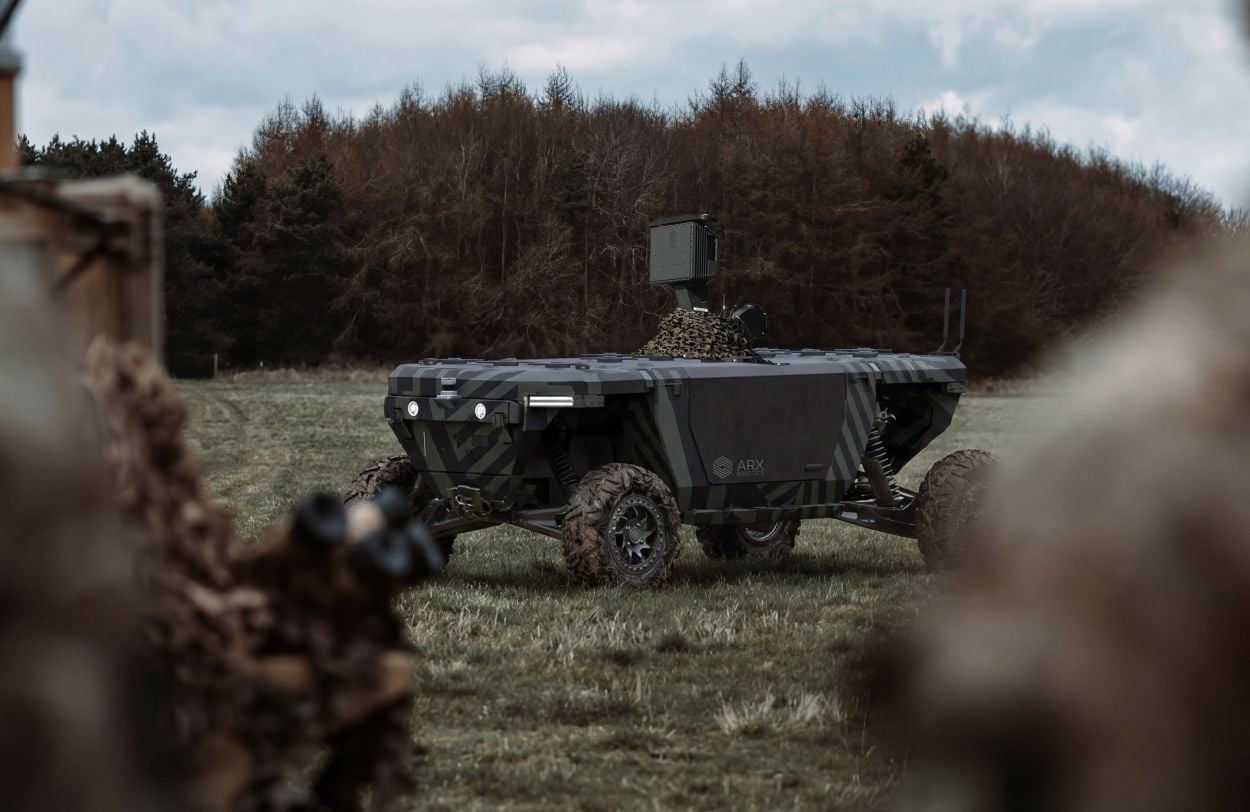
The companies will explore connecting Hector with Ajax through Generic Vehicle Architecture, allowing crews to task, monitor and employ autonomous platforms from the vehicle. Ajax’s sensing, processing and command-and-control capabilities are intended to support coordination of autonomous systems at the tactical edge.
The collaboration brings together GDLS-UK’s expertise in complex, digitally enabled armored land combat systems with ARX Robotics’ autonomous ground vehicles and software. The companies said the effort is intended to support British Army concepts that combine crewed, uncrewed and autonomous systems within a more integrated force.
“The British Army’s 20-40-40 vision is redefining how future combat power will be generated and applied, integrating crewed, uncrewed and autonomous systems into a single, connected force,” said Scott Milne, Vice-President and General Manager, General Dynamics Land Systems-UK. “Through our collaboration with ARX Robotics, we are exploring how Ajax can help realise that vision by combining its world-class sensing, processing and command-and-control capabilities with autonomous systems to extend battlefield reach, accelerate decision-making and deliver greater operational advantage.”
“At the heart of this opportunity is Ajax’s open digital architecture, which provides an adaptable and future-ready backbone for the rapid integration of autonomous platforms, advanced sensors and emerging mission applications,” Milne said. “This enables capability to evolve at the pace of technology, ensuring the British Army can continuously adapt, exploit innovation faster than its adversaries, and maintain a decisive battlefield advantage in an increasingly complex and contested operating environment.”
Alongside the capability work, ARX Robotics and GDLS-UK will examine how GDLS-UK’s manufacturing and integration facilities in South Wales could support production and scaling of autonomous land systems in Britain. The companies will consider final assembly and integration, manufacturing engineering, CNC machining and fabrication, UK supply-chain development, workforce growth and skills development, and through-life support and sustainment.
The work could draw on GDLS-UK’s existing nationwide industrial footprint and skilled workforce in South Wales while helping develop manufacturing capacity for a new generation of autonomous defense systems. The collaboration is also intended to support the UK’s aim of strengthening sovereign defense industrial capacity, accelerating the adoption of autonomous technologies and sustaining future land capabilities domestically.
“The British Army does not need to choose between its existing platforms and the new generation of autonomous systems,” said David Roberts, Chief Executive Officer, ARX Robotics UK. “The opportunity is to connect them so they fight as one integrated force with the right high-low mix.”
Roberts said the combination is intended to increase the utility of crewed platforms while limiting soldiers’ exposure to danger. “By combining Ajax with Hector autonomous wingmen, we can extend the reach and capability of crewed platforms while reducing the number of soldiers who need to be exposed to danger.”
“Just as importantly, this collaboration is about building the industrial capacity and skills base to produce and support these systems here in Britain,” Roberts said. “If the UK wants to field autonomy at meaningful scale, it needs the sovereign manufacturing capability to match.”