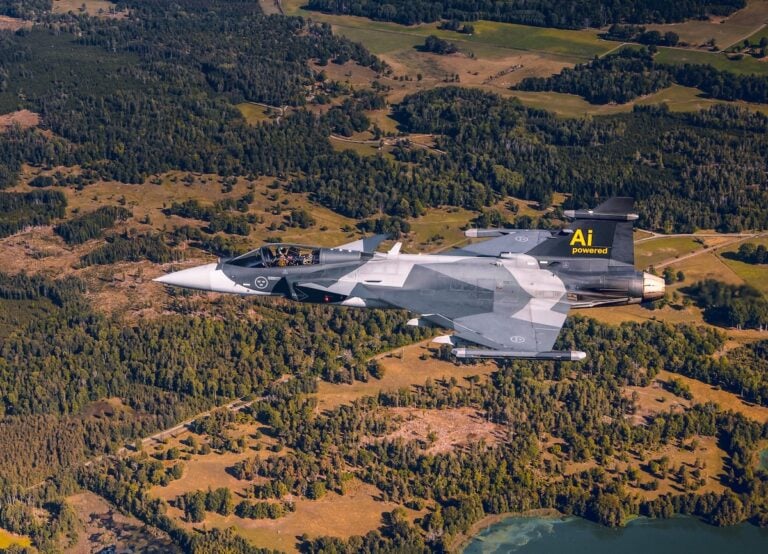
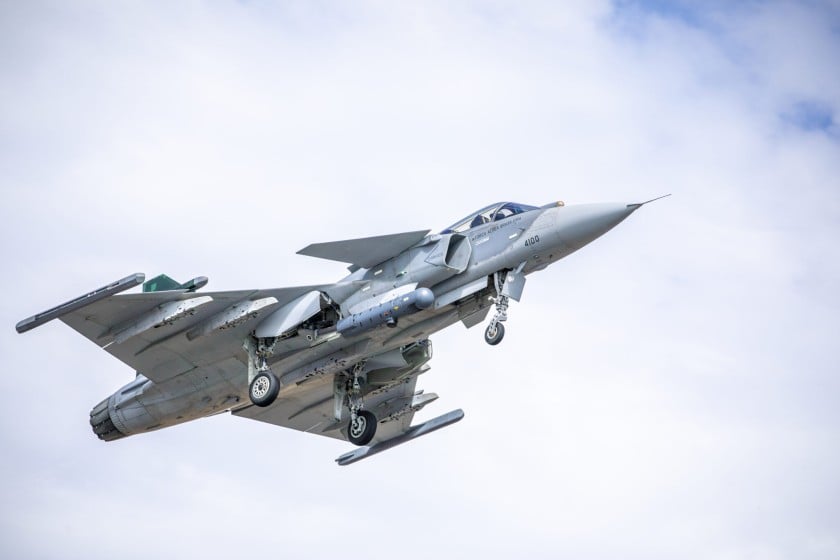
The flights took place from 6 to 8 October, with representatives from Saab and Rafael participating. The air force published photographs and video of the first flights with the pods on 29 October.
Litening supports the guidance of weapons against ground targets and passive observation of airspace. RecceLite is used exclusively for reconnaissance, with imagery available in real time to ground-based command and decision-making centres.
The latest Litening version, Litening 5, combines forward-looking infrared and short-wave infrared imaging equipment with a high-definition colour camera. Its capabilities include support for laser-, GPS- and electro-optically or infrared-guided air-to-surface weapons, moving-target designation, multiple-target tracking and automatic target recognition.
RecceLite combines an airborne sensor pod, a wideband digital data link and a ground processing station. It is designed for multispectral reconnaissance both outside and within the reach of opposing air defences.
The third-generation RecceLite XR offers a range exceeding 80 kilometres and sensors operating in visible, near-infrared, mid-wave infrared and short-wave infrared bands. Improved image resolution, real-time video, enhanced stabilisation and AI-assisted image processing support persistent surveillance over large areas.

The integration work accompanies the expansion of Brazil’s Gripen fleet, designated F-39 in national service. Saab has delivered 11 single-seat Gripen E aircraft, with further deliveries of that version due from the licensed assembly line at Embraer’s Gavião Peixoto facilities.
Two-seat Gripen F aircraft are being assembled in Sweden under Brazil’s initial order for 36 Gripen E/F fighters. The contract also includes an option for another 72 aircraft, while the fleet is intended to become a core element of Brazilian air power.