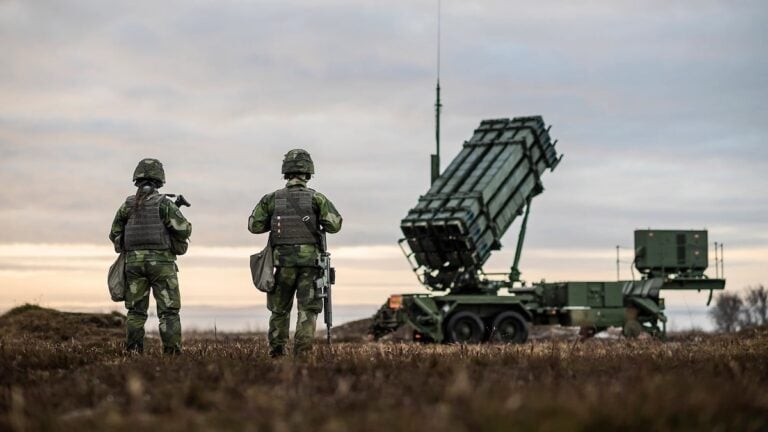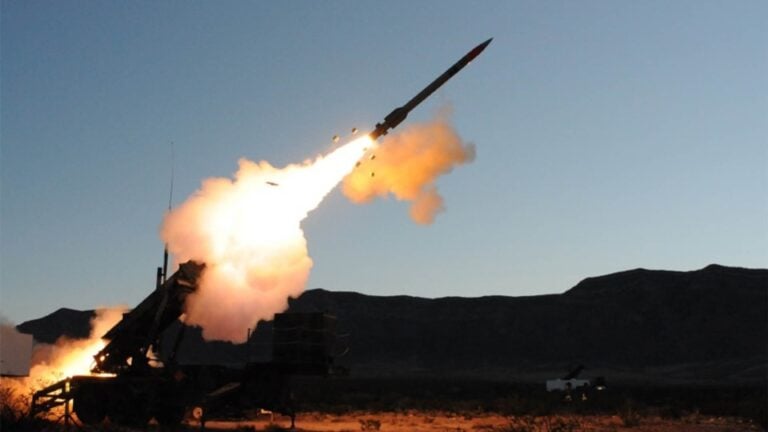


The exercise placed 2nd Squadron, 2nd Cavalry Regiment in the lead, with support from the 52nd Air Defense Artillery Brigade and the United Kingdom’s 3rd Parachute Regiment. The units tested more than 50 industry-provided technologies, including radars, radio-frequency defeat systems, kinetic interceptors, launched effects and unmanned ground vehicles.
“Right now, we are implementing these systems at the troop level, company level and squadron level,” said U.S. Army Staff Sgt. Mateus Nunes, an infantryman assigned to Echo Troop, 2nd Squadron, 2nd Cavalry Regiment. “We are just seeing how they work.”
The systems were connected through a combined U.S.-U.K. tactical data architecture and tested against a live opposing force. The Army said the goal was to assess how soldiers can operate against low-cost drones that are increasingly shaping modern battlefields.
Project Flytrap has developed through several stages over the past year. Iterations 2.0 through 4.0, conducted in Germany and Poland between May and August 2025, examined which counter-UAS systems were best suited to different command levels and helped standardise initial tactics for small-unit drone defence.
Flytrap 4.5, held at Putlos, Germany, in November 2025, tested newer industry technologies and improved individual operator skills. Flytrap 5.0 is the first version to integrate those capabilities at squadron scale.
“We are transforming to enable offensive maneuver in a drone and electronic-warfare saturated environment, and Flytrap is essential to making that happen,” said Gen. Christopher Donahue, commander of U.S. Army Europe and Africa.
“This effort is about getting technology into the hands of Soldiers, in the field, to figure out what works and what doesn’t. Then we share those lessons across the Army and the Joint Force, and with our Allies,” Donahue added.
Flytrap 5.0 is part of the Eastern Flank Deterrence Initiative, NATO’s land-domain warfighting concept. The initiative links digital architecture and operating systems across nations to improve detection, decision-making and strike coordination at speed and scale.
The Army said the approach includes using artificial intelligence to process data faster and connect units with effects more efficiently. It also focuses on reducing the cost of defeating drones by incorporating cheaper attritable systems.
“Success in Flytrap 5.0 is a little different than other exercises — in some ways failure is still success,” said Maj. Jared Whitaker, the V Corps technical integration and assessment lead for Project Flytrap.
“The industry who creates these systems can get immediate feedback, make hardware and technical changes rapidly — so that when those systems are fielded to Soldiers, they’ve already got a look by Soldiers and will perform significantly better than in the past,” Whitaker added.
The next stage, Project Flytrap 6.0, will expand the effort to the brigade level. V Corps said that phase will involve a larger number of platforms, soldiers and decisions, and is expected to help fully validate the counter-drone capability.