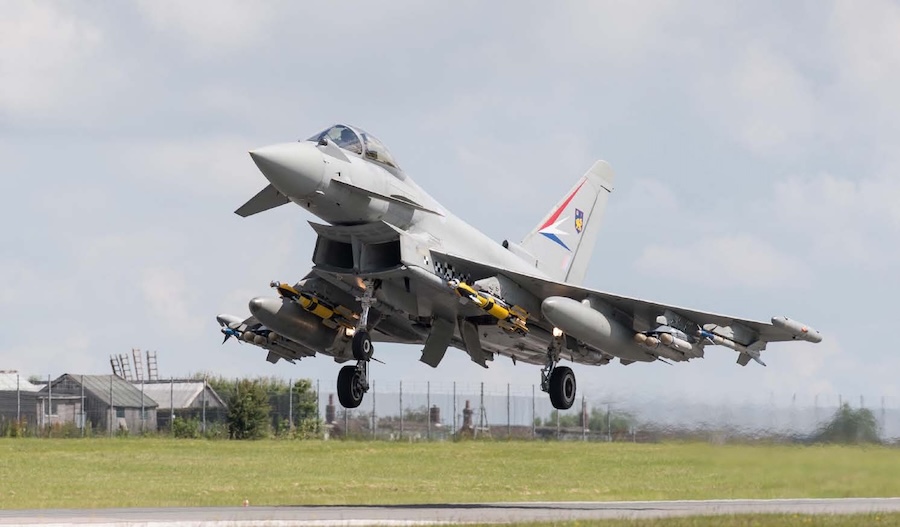
IPA6 is part of Eurofighter’s Instrumented Production Aircraft fleet, which uses modified Typhoons as airborne test laboratories for new systems and configurations. Dedicated instrumentation records pilot inputs, aircraft responses and system behaviour throughout each sortie, providing engineers with detailed evidence before new capabilities move towards operational use.
“Every IPA sortie is designed around a single notion: extract certainty from the unknown,” Eurofighter said. Real-time telemetry allows ground teams to monitor aircraft parameters during demanding flight profiles and assess information that cannot be continuously evaluated by the pilot in the cockpit.
That capability is particularly important during flight-control and air-to-air refuelling trials, where small changes in system behaviour can determine the outcome of a test. Engineers can monitor fuel pressures, valve behaviour and quantities while the aircraft is airborne, allowing the test team to assess performance as events unfold.
Flight testing follows extensive modelling and rig work, but Eurofighter said some events still have to be demonstrated on an aircraft under real operating conditions. Weapons separation is one such area, with high-speed cameras, aircraft and store markings, chase aircraft and weapon telemetry used to capture how a store behaves when released.
IPA6 played a direct role in the integration of Brimstone 2, becoming the first Typhoon to jettison and later fire the missile. Those trials collected aircraft data, missile telemetry and video so actual behaviour could be compared with engineering predictions and used to guide subsequent work.
The aircraft has also supported upgrades to Typhoon avionics and trials of helmet-mounted equipment, alongside complex aerial refuelling testing. Its 1,000 hours therefore represent development flying rather than routine operational activity, with individual sorties structured around specific capability or safety objectives.
“Typhoon is designed to deliver the opposite: Maximum performance, right up to the boundary,” Eurofighter said. The IPA fleet is intended to establish where those boundaries lie and provide the data needed to introduce new capabilities without compromising aircraft safety.
The milestone comes as Eurofighter continues to evolve Typhoon through new weapons, sensors, avionics and mission systems. IPA6 and the wider instrumented fleet provide the flight-test infrastructure needed to verify those changes before they can contribute to the capabilities of frontline aircraft.