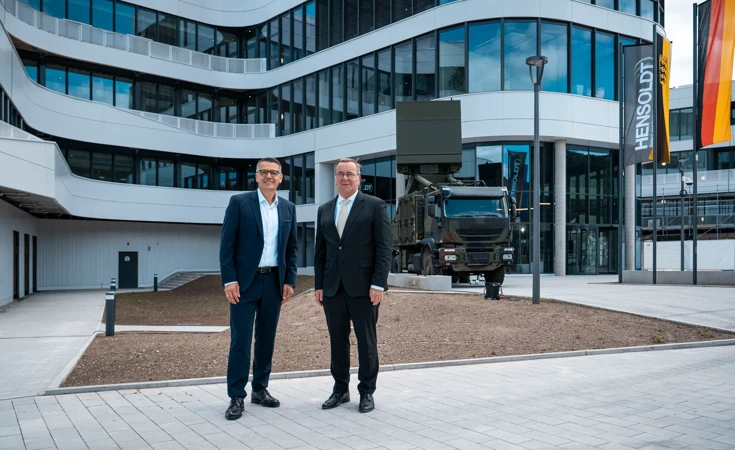

Dörre said Ukraine is now the world’s largest operator of HENSOLDT’s TRML-4D radar. That installed base should create a long-term pipeline for maintenance, upgrades and other support services, he said.
He also said Ukraine’s battlefield experience is shaping HENSOLDT’s development work. The company is seeking to combine its radar expertise with Ukrainian technologies developed under much faster operational innovation cycles.
That approach is central to FREYJA, a missile-defense initiative involving Ukrainian company Fire Point. Dörre said the planned system would combine combat-proven Ukrainian capabilities with HENSOLDT radar technology.
He described strong political and industrial momentum behind efforts to develop a European ballistic-missile defense capability for initial use in Ukraine. The first activities could begin in 2027, although Dörre said it was too early to estimate any revenue contribution.
The planned capability would involve radar systems already supplied to Ukraine and could later include more strategic, longer-range sensors. Dörre said HENSOLDT’s current production expansion is expected to become operational in early 2027, providing additional capacity to address potential demand.
Eurofighter radar programs represent another major growth area. Dörre said orders linked to the ECRS Mk1 rebaseline, Spain’s Halcón program and Turkey had generated about €580 million in booked orders.
He described ECRS Mk1 as the radar of choice for current Eurofighter opportunities and said HENSOLDT was ahead of competing systems in development maturity. However, he acknowledged that selections within the multinational Eurofighter program remain influenced by political and industrial considerations.
HENSOLDT is also pursuing radar opportunities in the maritime market following uncertainty surrounding Germany’s F126 frigate program. Dörre said the F126 development did not change the company’s broader naval strategy or the long-term demand outlook for naval sensors.
He pointed to the TRS-3D and TRS-4D radar family, which is installed across several German and international vessel classes. Dörre said the systems could benefit from efforts to harmonize radar equipment across the German Navy and from potential additional MEKO A-200 frigates.
Dörre said HENSOLDT remained focused on the second batch of German MEKO A-200 ships, despite a different sensor suite being selected for the initial vessels. He argued that fleet commonality, maintenance requirements and integration with future vessels could support the use of TRS-4D in later batches.
Space-based radar is emerging as another strategic area. Dörre said HENSOLDT is working with OHB, Helsing and Kongsberg on potential European intelligence, surveillance and reconnaissance constellations.
The company has a technology roadmap to adapt its PrecISR synthetic-aperture radar for space applications. Dörre said HENSOLDT could also contribute electro-optical, infrared, signals-intelligence and electromagnetic-warfare sensors to future satellite systems.
Across these programs, Dörre said the main constraint is shifting from defense budgets to industrial capacity and technological development. HENSOLDT has almost tripled weekly printed-circuit-board production since January, raising output from about 600 to roughly 1,500 populated boards as it prepares for higher sensor and radar demand.