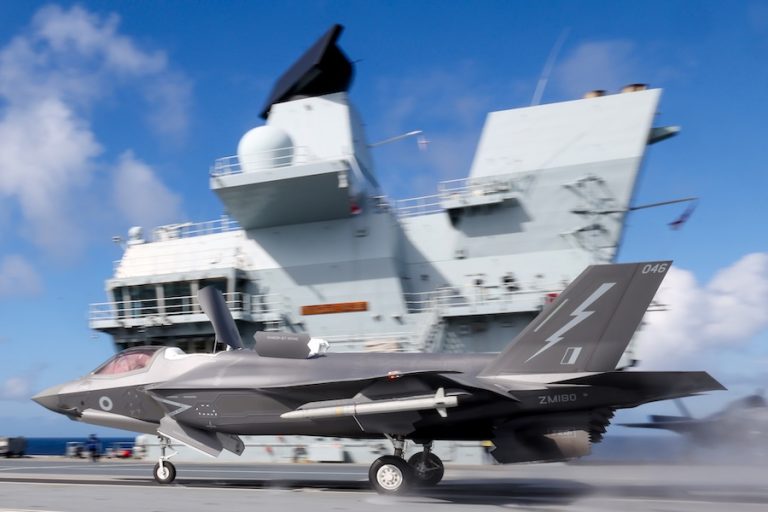

The United States remains the only country manufacturing fifth-generation, low-observable multirole fighters at industrial scale, a distinction that is expected to shape the outcome of air campaigns for years to come. That exclusivity carries strategic weight well beyond the cockpit: more than a dozen NATO members are on track to fly the same airframe, giving the alliance a shared technological backbone that reinforces interoperability and strengthens deterrence at a moment when unity among allied air forces has taken on renewed importance.
From data overload to split-second decisions
What sets the F-35A apart in practice is less the airframe itself than the sensor suite wired into it. Highly specialized systems can pinpoint targets well beyond visual range and then compress that information into a single, digestible picture for the pilot, a process known as sensor fusion that sharply improves situational awareness and shortens the time between detection and decision.
The effect is to turn the pilot from an operator juggling instruments into something closer to a battle manager, freed to focus on executing the mission rather than piecing together raw data. It’s this shift, more than any single weapon or maneuver, that gives the F-35A a meaningful edge over earlier-generation fighters in contested airspace.
The mission systems architecture
That capability rests on a tightly integrated mission architecture. At its core sits the AN/APG-81 Active Electronically Scanned Array radar, paired with the AN/AAQ-37 Electro-Optical Distributed Aperture System for all-around situational awareness, the AN/AAQ-40 Electro-Optical Targeting System for precision targeting, the AN/ASQ-242 Communications, Navigation and Identification suite, and the AN/ASQ-239 Barracuda electronic warfare and self-protection system.
Inside the cockpit
Inside the cockpit, the pilot’s primary interface is a 508 x 203 mm panoramic display built from two independent 254 x 203 mm screens for redundancy — if one fails, the other absorbs its functions, albeit with a reduced picture. That display, designated the Panoramic Cockpit Display, is paired with a Helmet Mounted Display System that effectively substitutes for the traditional head-up display found on older fighters, which the F-35A dispenses with entirely.
Flight controls follow the Hands on Throttle and Stick, or HOTAS, philosophy, positioning every avionics and weapons switch within reach of the stick and throttle so the pilot never needs to look away from the fight. In the event of an emergency, the pilot sits in a Martin-Baker Mk 16 ejection seat rated for zero-zero performance, meaning safe ejection is possible even at zero altitude and zero airspeed, backed by an onboard oxygen generation system with an emergency reserve.
The radar: tracking two dozen targets at once
The radar at the heart of the system, the AN/APG-81, packs 1,200 transmit-receive modules and can detect a target with a radar cross-section of one square meter at a range of 150 kilometers. It is fast enough to lock onto and continuously track up to 24 targets within ten seconds, generating firing solutions for as many as ten of them almost immediately afterward.
Beyond conventional air-to-air functions, the radar supports synthetic aperture imaging for stationary ground targets and inverse synthetic aperture tracking for objects in motion, and can switch between active and passive modes to trace hostile electronic emissions without revealing its own position. Critically, it can run air-to-air and air-to-ground or air-to-surface modes simultaneously, a flexibility that lets pilots manage multiple threat types without switching between separate systems.
Eliminating the blind spots
The aircraft’s distributed aperture system takes a different approach to awareness, using six cameras spread across the airframe to stitch together a full 360-degree spherical view in both visible and infrared light. That imagery, streamed directly to the pilot’s helmet, effectively eliminates the blind spots that have long constrained fighter pilots’ fields of view.
The same system doubles as an early-warning net, flagging approaching enemy aircraft and detecting missile launches across the surface-to-air, sea-to-air and air-to-air spectrum. It can also track ballistic missiles at ranges up to 1,300 kilometers and allows pilots to detect, track and, if necessary, engage aerial targets passively — without emitting a signal that would give away the aircraft’s position.
Targeting and communications
Mounted beneath the nose, the electro-optical targeting system pairs a day-and-night television camera capable of operating in near-total darkness with a thermal imager and a laser designator effective at ranges of several dozen kilometers. Together they let the F-35A track infrared signatures in the air, on land or at sea, and guide laser- and GPS-directed munitions onto targets from a standoff distance, while also giving pilots the resolution needed to visually identify hostile aircraft before closing to dangerous range.
Communications, meanwhile, run through the AN/ASQ-242 CNI suite, which folds together functions that older aircraft handled with separate boxes: tactical navigation, instrument landing guidance for poor weather, radar altimetry, identification, and dual-band radio, all linked to Link 16 and the newer Multifunction Advanced Data Link. The entire package is wired into an antenna array engineered to preserve the aircraft’s low-observable profile, and is reinforced by a laser inertial navigation system tied to a 24-channel GPS receiver hardened against jamming and spoofing.
Self-protection: the Barracuda system
Self-protection falls to the AN/ASQ-239 Barracuda system, which works alongside the main radar to detect, classify and, where possible, identify hostile electronic emissions using an onboard reference library. Deep integration between the two systems allows Barracuda to supplement the radar’s own tracking with passive detection, while separately warning the pilot of radar lock and managing countermeasures — jamming and decoy flares deployed through concealed panels in the lower rear fuselage — automatically or with minimal input.
Weapons load and range
For direct engagement, the F-35A carries a GAU-22/A Equalizer cannon in its left wing root, a 25mm rotary weapon firing 3,300 rounds per minute of armor-piercing, tungsten-cored ammunition at a muzzle velocity of 970 meters per second, with 180 rounds on hand. But the cannon is a secondary consideration next to the aircraft’s ten weapons stations — four internal, six external — capable of carrying up to 8,200 kilograms of ordnance across air, ground and maritime target sets.
Its two internal bays typically each carry one AIM-120 AMRAAM medium-range missile alongside either a second AMRAAM or a guided bomb of up to 1,135 kilograms, a configuration that preserves the aircraft’s stealth profile for contested environments. When operating in airspace where enemy defenses have already been suppressed, six additional external stations open up, including two wingtip mounts reserved for AIM-9X Sidewinder short-range missiles that fly on nearly every sortie without compromising the aircraft’s low-observable classification.
The remaining external stations can carry loads up to 2,270 kilograms, or be fitted instead with external fuel tanks that extend the aircraft’s range from 2,200 kilometers on internal fuel alone to 2,800 kilometers, with aerial refueling available for missions requiring greater endurance. Standard strike loadouts center on the 908-kilogram GBU-31 JDAM, though the F-35A can substitute eight GBU-39 Small Diameter Bombs with a range of roughly 110 kilometers, or switch to AGM-154 JSOW glide bombs and GBU-48 Enhanced Paveway II munitions, all guided by GPS with strike accuracy measured in single-digit meters.
An arsenal still expanding
Lockheed Martin’s current arsenal for the aircraft is, by design, a work in progress. Internal AMRAAM capacity is set to rise from four to six missiles, external stations will eventually support up to eight more, and the platform is due to receive longer-range strike options including the AGM-158A/B JASSM family, the AGM-158C LRASM anti-ship missile, and the AGM-88G AARGM-ER anti-radiation missile.
A newer variant, the AGM-88J SiAW, is being developed specifically to defeat air-defense networks and strike high-value targets such as command posts and GPS-jamming installations, using a combination of inertial navigation, GPS and active millimeter-wave radar with a 300-kilometer range. Norway, Australia and Canada are separately integrating their own F-35A fleets with the Joint Strike Missile for anti-ship and land-attack roles, while the broader bombing arsenal is set to expand with the GBU-54 Laser JDAM for all-weather precision strikes against moving targets.
The bottom line: survival through information
What ties all of this together is not any individual sensor or munition but the aircraft’s function as an airborne command node. By fusing stealth, advanced sensors and machine-assisted data processing, the F-35A operates as the eyes and ears of the modern battlefield, gathering and distributing intelligence to other units in real time.
That combination is designed to let pilots find and, if necessary, neutralize a threat before that threat is even aware it has been detected. It is this asymmetry, defense analysts argue, that gives the F-35A the strongest odds of survival of any fighter currently flying in contested skies — and explains why so many allied air forces have concluded the platform is one they cannot afford to be without.