

The logic behind the approach is straightforward even if the engineering is not. Aerial systems need a continuous stream of position and timing data from satellites to navigate accurately, and once that data stream is disrupted or corrupted, the threat effectively loses its sense of direction and can no longer reach its intended objective.
Boaz Levy, IAI’s Chairman of the Board, positioned the system as an extension of capabilities the company has spent decades refining rather than a departure from them. “IAI is a global leader in air defense solutions against evolving aerial threats, with decades of operational excellence, continuous innovation, and an uncompromising commitment to our ally’s security,” he said.
Levy framed the launch against a battlefield backdrop that increasingly rewards layered defenses over single-point solutions. “Today’s battlespace demands integrated, multi-layered defense capabilities that can address multiple threats,” he said, adding that “IAI is at the forefront of this mission, delivering advanced technologies that provide our customers with decisive operational advantage to safeguard both national security and civilian lives.”
For Guy Barlev, Executive Vice President and General Manager of IAI’s Space Missiles and Systems division, the case for HYPNOSIS rests on what it adds to defenses that already exist rather than what it replaces. “HYPNOSIS provides a critical and highly effective soft-kill defense layer, enabling nations to address the growing spectrum of GNSS-based aerial threats,” he said, calling it “a significant leap forward in protecting strategic assets.”
Barlev was explicit that the system is designed to work alongside, not instead of, traditional missile defenses. “When integrated with hard-kill defense systems, it further strengthens the multi-layered defense concept by adding an additional protection layer that is operationally effective and cost-efficient complementing existing kinetic interception systems,” he said.
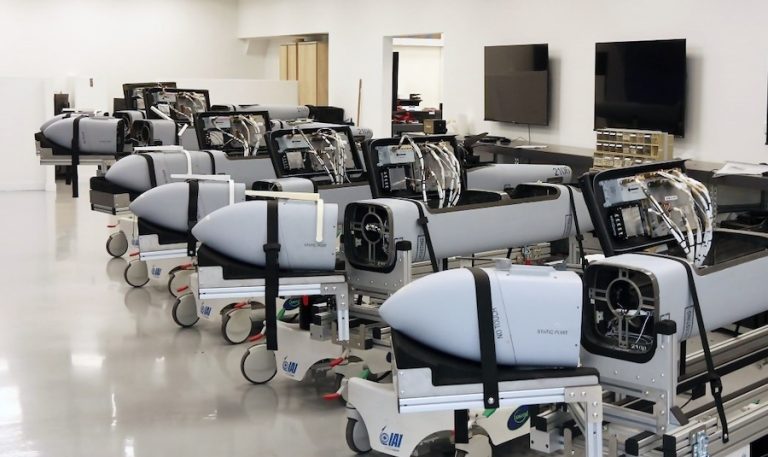
Mechanically, HYPNOSIS is built around a network of mobile jamming and spoofing stations that operate in coordination rather than in isolation, each one feeding into a central Command and Control center that handles real-time coordination, threat analysis and response. The stations are positioned strategically around the sites they are meant to protect, functioning as one component within a broader, multi-layered air defense architecture rather than a standalone shield.
The technology draws on IAI’s long operational track record in navigation warfare, combining jamming and spoofing techniques capable of disrupting satellite navigation systems, including more sophisticated variants that adversaries have increasingly turned to. Its unified command architecture is designed to integrate with hard-kill systems, allowing the two approaches to respond together as threats evolve in real time.
The system’s intended customers are those guarding high-value, fixed assets — strategic sites, energy infrastructure and air defense arrays among them, according to IAI. It is built specifically to handle coordinated attacks in which multiple threats approach simultaneously from different directions, a scenario that has become increasingly common as drone warfare has matured.
Perhaps most notably, HYPNOSIS is designed to run autonomously through its networked command center, without requiring an operator to intervene, a feature that speaks to the broader shift in air defense toward systems capable of responding at machine speed to threats that arrive faster than human decision-making can keep pace with.