The K-SWARM programme is aimed at designing and developing interoperability between crewed and uncrewed aircraft. Leonardo and Baykar said the trials assessed and validated collaborative and coordinated operations using advanced next-generation algorithms.
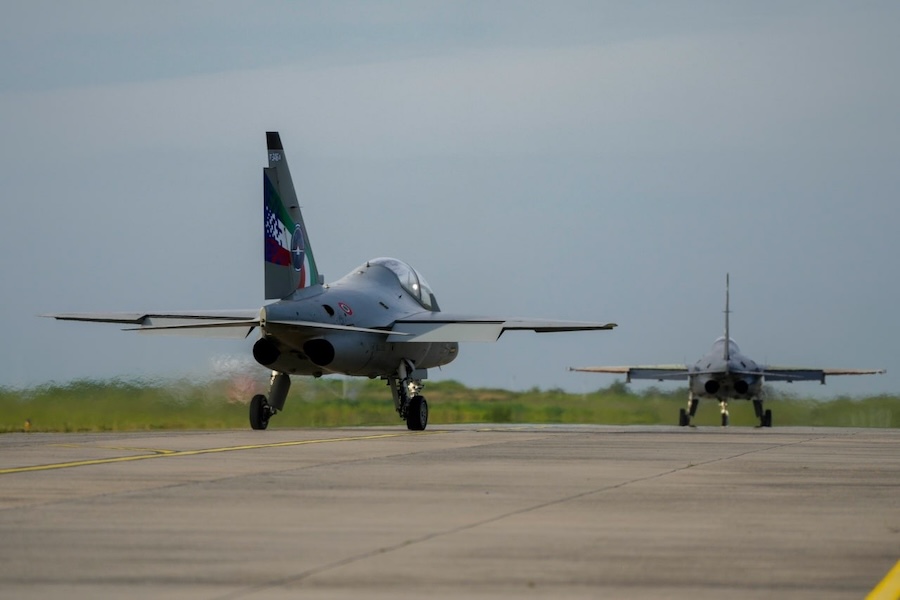
The testing took place in May at one of Baykar’s flight and test centres in Çorlu, Türkiye. The flight campaign involved a Leonardo-owned M-346 Fighter Attack Variant, an Italian Air Force T-346A acting as chase aircraft, and the Bayraktar KIZILELMA.
The companies said collaborative combat teaming is becoming a key enabler for future combat air systems. They also described crewed-uncrewed teaming as a core element in the evolution of current-generation fighters and future military capabilities.
The trials tested algorithms, tactics and procedures developed by Leonardo at its Avionic and Flight Control Innovation Labs and its product capability and concept laboratory, PC2LAB, in Turin. The work was linked with an M-346 Full Mission Simulator in Venegono, Italy.
Baykar integrated advanced smart fleet autonomy capabilities into the crewed-uncrewed teaming algorithms using software and hardware at its facilities. The companies said KIZILELMA’s advanced autonomy capabilities simplified the integration process and supported rapid deployment.
The M-346 and KIZILELMA formation flights helped validate advanced collaboration and coordination between different high-performance combat platforms. The programme also marked the transition from simulation to live operations.
An advanced radio frequency data exchange system enabled the synchronisation of all data shared between the M-346 and KIZILELMA platforms. The data exchange was protected by Leonardo’s GCC Tactical Platform, a proprietary cyber defence system that monitors and protects systems in real time.
During the campaign, KIZILELMA conducted autonomous taxiing and take-off before autonomously rejoining the M-346 Fighter Attack aircraft. This was carried out using Smart Fleet Autonomy algorithms developed by Baykar’s Hardware-in-the-Loop Laboratory.
After the rejoin, the M-346 was able to assume full control of the uncrewed aircraft. Using a newly developed fully integrated onboard avionics suite, M-346 pilots commanded different formations that KIZILELMA executed autonomously through a dedicated crewed-uncrewed computing system.
Different manoeuvres and formations were tested during the flight campaign. These included position changes, separations and rejoins, with KIZILELMA responding accurately to commands from the M-346.
The activities in Çorlu followed extensive preparation by Leonardo and Baykar teams over several months. The work involved pilots and technicians and covered system integration, testing scenarios, algorithm validation and safe management of the trials.
The data and analysis collected during the first phase will help define the next steps in the K-SWARM programme. The programme will move towards more complex operations requiring greater situational awareness and assets working together towards shared mission objectives.
Leonardo and Baykar said the refinement of artificial intelligence technology, algorithms and collaborative procedures would allow uncrewed systems to shift gradually from remote piloting to greater autonomy. The goal is to reduce pilot workload and increase mission efficiency while maintaining full control and decision-making.
Further tests are planned in the coming months with increased complexity and additional functions. The companies said the first phase demonstrated their partnership and their respective technology and industrial capabilities in modern combat air operations.