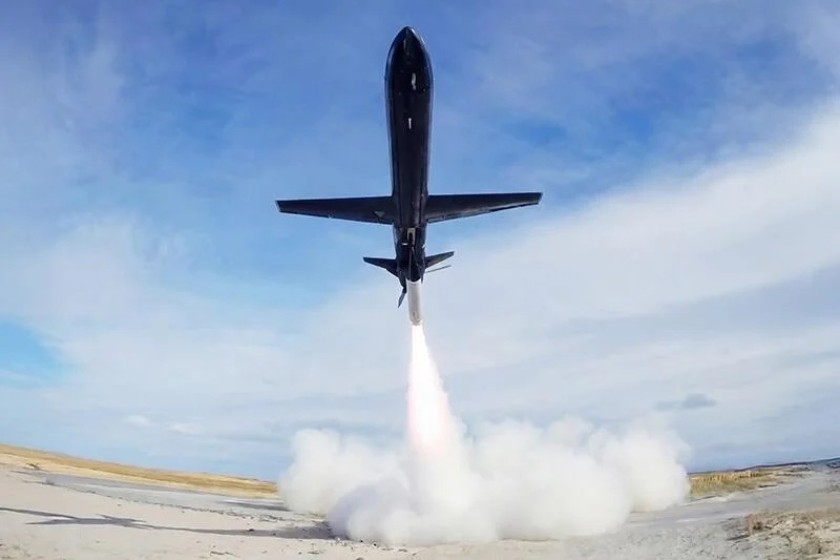
Project Brakestop was launched by the Ministry of Defence’s Taskforce Kindred in November 2024. It challenged UK industry to develop a low-cost, ground-launched strike weapon able to hit targets more than 500km away while carrying a 225kg warhead.
The programme was designed to use the speed, innovation and expertise of British industry to deliver a new capability at a pace rarely seen in defence. Follow-on contracts worth around £15 million each have now been awarded to three companies.
The requirements for the new system included a range of at least 500km and a speed of more than 600km/h. The Ministry of Defence also sought a unit cost of around £400,000 excluding the warhead, and the ability to produce at least 20 weapons a month within months of a production order.
The competition received 27 bids from industry after it opened. Ministry of Defence experts carried out detailed technical assessments and held competitive “Dragon’s Den” style pitches in February 2025.
Six British companies were then awarded contracts worth around £5 million each. They were required to design and build prototype weapons for testing in seven months.
Minister for the Armed Forces Louise Sandher-Jones MP said: “The UK stands shoulder-to-shoulder with Ukraine, and we will continue to provide the support it needs to defend itself against Russian aggression.” “Project Brakestop shows what happens when we combine that commitment with the talent and ingenuity of British industry.”
“In less than a year, UK companies have taken an ambitious concept from the drawing board to flight testing, delivering a new generation of capability at remarkable speed.” “This is a clear demonstration that Britain has the industrial strength, innovation and determination to meet the challenges of modern warfare and support our allies.”
By December 2025, three suppliers remained in the programme and moved forward to flight testing. They were MBDA UK, MGI Engineering and Rotron Aerospace.
MBDA UK is a long-standing strategic partner of the UK and produces systems including Storm Shadow. MGI Engineering is a UK small and medium-sized enterprise with more than 25 years of success in Formula 1, while Brakestop is its first defence contract.
Rotron Aerospace is a UK small and medium-sized enterprise with a strong history of working with the Ministry of Defence. Its previous work includes the Dismounted Soldier Close Combat and Defence programme.
Each of the three systems was tested at the Ministry of Defence Hebrides Range. The range is a specialist trials site managed by QinetiQ through the Long-Term Partnering Agreement.
The announcement followed a week of UK commitments to Ukraine. At the G7, the Prime Minister announced a further £210 million of UK Export Finance support for Ukraine’s nuclear power plants and 70 new sanctions targeting Russia’s shadow fleet, military procurement supply chains and illicit finance networks.
The Defence Secretary also announced that the UK would provide 150,000 Ukrainian-produced drones and more than 350 air defence missiles and radars. These will be funded from the Extraordinary Revenue Acceleration loan.
The Ministry of Defence said Project Brakestop demonstrated the ability of UK industry to rapidly develop and test complex long-range strike systems. It added that the 225kg warhead the systems must be able to carry had already been successfully developed and tested by another UK company.
The next phase of Project Brakestop is now under way. Phase 2 contracts worth around £15 million have been awarded to multiple suppliers to further develop and produce 15 improved effectors each, alongside launchers and support vehicles.
Further testing will take place in the UK in the coming months. Additional trials overseas are then planned, including in Ukraine.
Project Brakestop has been delivered by a combined Ministry of Defence team. The team includes the National Armaments group, Material and Dstl, 744 Naval Air Squadron, Air and Space Warfare Centre Air Wing, 11 Explosive Ordnance Disposal Regiment and Taskforce Kindred, alongside QinetiQ.