“Space is essential to our modern way of life — and the ability to operate in this domain with agility and resilience will define the future. At Northrop Grumman, we’re shaping that future,” Chief Executive Officer Kathy Warden said.
“Building on more than a decade of experience as the first — and only — company to provide satellite life extension services, our recently launched Mission Robotic Vehicle and Mission Extension Pods represent the next evolution of capabilities that will help ensure America’s advantage in space for decades to come.” The new spacecraft extend Northrop Grumman’s work beyond its first generation of satellite life-extension vehicles.
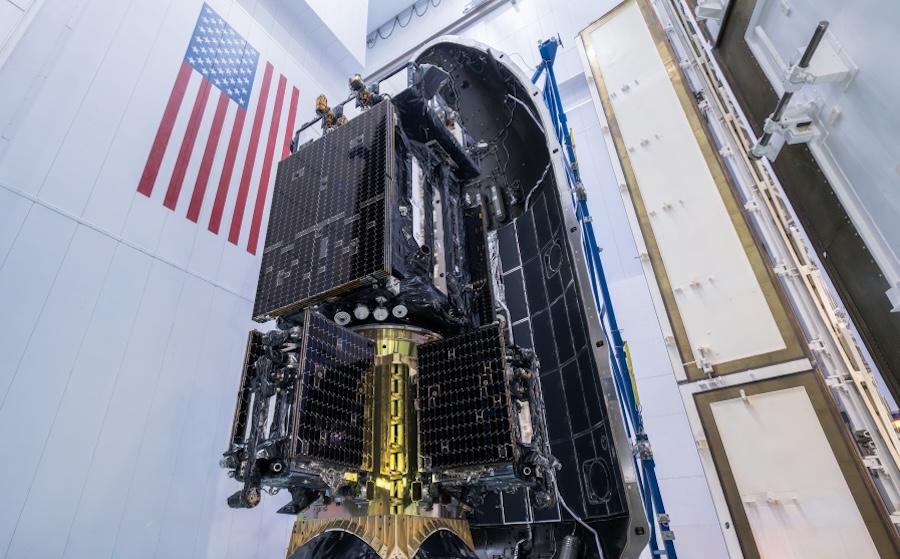
Developed through company investment and a partnership with the Defense Advanced Research Projects Agency, the Mission Robotic Vehicle provides an autonomous, multifunction platform for operating in orbit. Its robotics payload, developed by the U.S. Naval Research Laboratory, includes two fully articulated arms and specialized tools.
The vehicle is designed to inspect, relocate and repair satellites, remove debris, install upgrades, conduct experiments and support assembly in space. Northrop Grumman plans to draw on its experience in rendezvous, proximity operations and docking to connect the vehicle safely with customer spacecraft.
The Mission Extension Pods provide supplemental propulsion, allowing satellites to maneuver and remain in service for longer. Smaller and more affordable than the company’s Mission Extension Vehicles, the pods are designed for rapid deployment across a wider range of satellites.
The robotic vehicle also carries the first Passive Refueling Module, a U.S. Space Force-approved standard interface for docking and refueling. That capability is intended to support sustained maneuvering after on-orbit refueling, while the vehicle’s processing systems are designed to enable future AI-powered operations.
Northrop Grumman’s two Mission Extension Vehicles have already docked with three commercial communications satellites in geosynchronous orbit. Together, the spacecraft have delivered more than 10 years of mission-extension services, making Northrop Grumman the first and only company to extend the operational lives of commercial satellites running low on fuel.
The MRV, MEPs and earlier MEVs draw on Northrop Grumman’s U.S. manufacturing base and its experience in satellite servicing. Company-built thermal-control equipment and electronics protect and operate the robotic arms, while additional electronics support the vehicle’s electric-propulsion thrusters and orbital maneuvering.