The value of the contract and the number of systems to be delivered were not disclosed. Origin Robotics said the agreement, originally secured in December 2025, creates a long-term procurement route for Latvia while also allowing other European countries to join through government-to-government cooperation.
The framework is intended to support faster procurement of counter-UAS systems at a time of rising concern over low-cost drones and loitering munitions. The company said conflicts in Ukraine and the Middle East have exposed gaps in air defence and increased demand for cost-effective interception systems.
Under the arrangement, allied countries can join the existing agreement instead of launching separate national procurement procedures. Contracts signed through the framework are also eligible for SAFE financing, which may reduce barriers for EU member states seeking to strengthen counter-drone capabilities.
Agris Kipurs, chief executive and co-founder of Origin Robotics, said: “What makes this agreement truly significant is its structure. It gives Latvia the security of procuring BLAZE capability for multiple years ahead, with no new lead times and no procurement gaps.”
“Both sides can renegotiate the technical specification each year. That means Latvia will always be receiving the latest version of BLAZE. And because the framework is open to other nations, allies can join without starting their procurement from zero. This is a fundamentally different approach to defence procurement, and we believe it is the right model for a technology that evolves as fast as autonomous aerial systems,” Kipurs added.
Origin Robotics said the agreement differs from traditional defence contracts, which usually lock in a technical specification at the time of signing. The company said annual renegotiation of technical specifications will allow deliveries to reflect current developments in artificial intelligence, computer vision and sensor integration.
BLAZE is designed, developed and manufactured entirely in Latvia, qualifying it as a European-origin system under EU SAFE criteria. The company said the use of SAFE funding reflects the system’s compliance with European defence-industrial requirements and the growing urgency of counter-UAS needs along NATO’s eastern flank.
Latvia was the first European country to order and receive BLAZE systems, followed by Estonia and Belgium. Origin Robotics said the three countries are the first in Europe to field a fully autonomous, warhead-equipped drone interceptor.
The company said several additional allied countries are also procuring BLAZE, with further announcements expected later. The system was launched in May 2025 and is described as the first NATO-codified autonomous interceptor drone equipped with a STANAG-compliant warhead module.
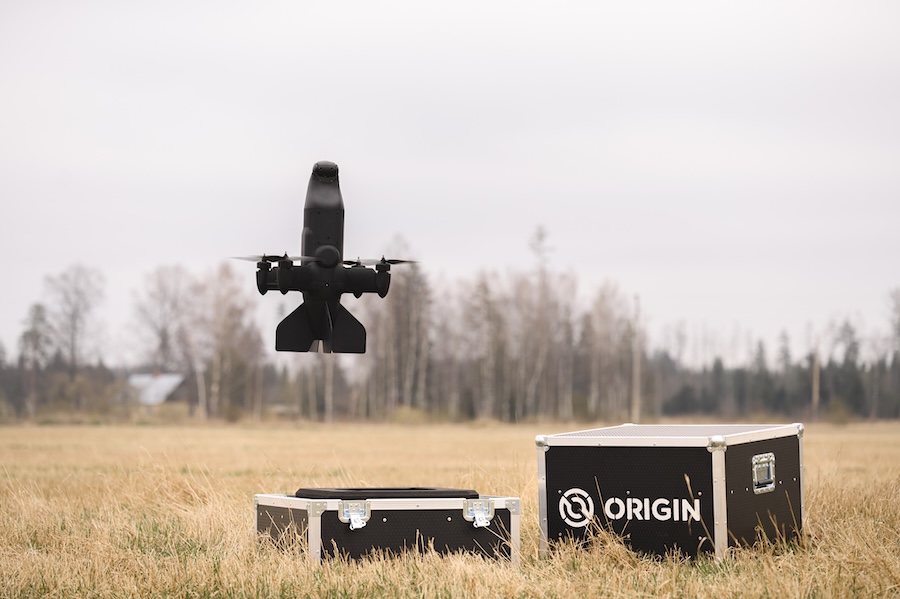
BLAZE combines radar-based detection, AI-powered computer vision and operator-supervised autonomy to counter fast-moving aerial threats, including hostile UAVs and loitering munitions. The system is man-portable, deployable in under five minutes and designed for high-intensity operational use.