
Collins Aerospace will provide its HammerSpear M Code receiver for the production lot. Raytheon said the technology will strengthen GPS protection when satellite-navigation signals are jammed or otherwise disrupted.
The wider electronics update is also intended to replace obsolete components and modernize the weapon’s internal package. Raytheon said the changes will improve system resilience, interoperability and long-term readiness for U.S. and allied forces.
StormBreaker is a compact, winged munition designed to strike fixed and moving targets in poor visibility. It can autonomously detect and classify targets through darkness, bad weather, smoke and dust.
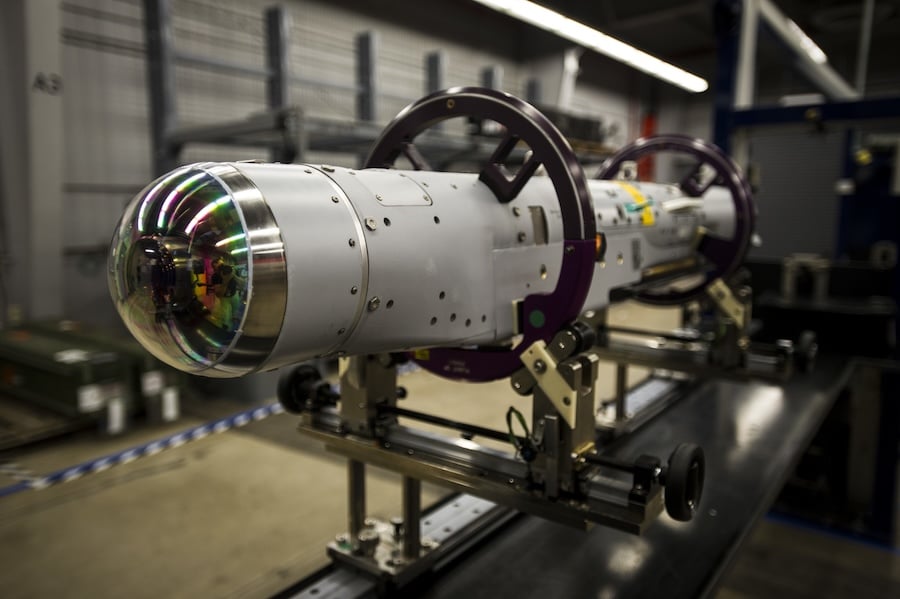
The weapon uses a tri-mode seeker combining millimeter-wave radar, imaging infrared and semi-active laser guidance. Its three sensing modes share targeting information, allowing the munition to operate under different weather, visibility and targeting conditions.
Millimeter-wave radar provides detection and tracking through adverse weather, while imaging infrared supports target discrimination. The semi-active laser mode allows StormBreaker to follow a designator operated from an aircraft or from the ground.
StormBreaker has a range of more than 45 miles against mobile targets. Its small size allows aircraft to carry more weapons, reducing the number of jets needed to engage a given number of targets compared with larger munitions.
The weapon is approved for operational use on the U.S. Air Force’s F-15E. The U.S. Air Force and U.S. Navy have also begun integration work on the F-35 Joint Strike Fighter and F/A-18E/F Super Hornet.