
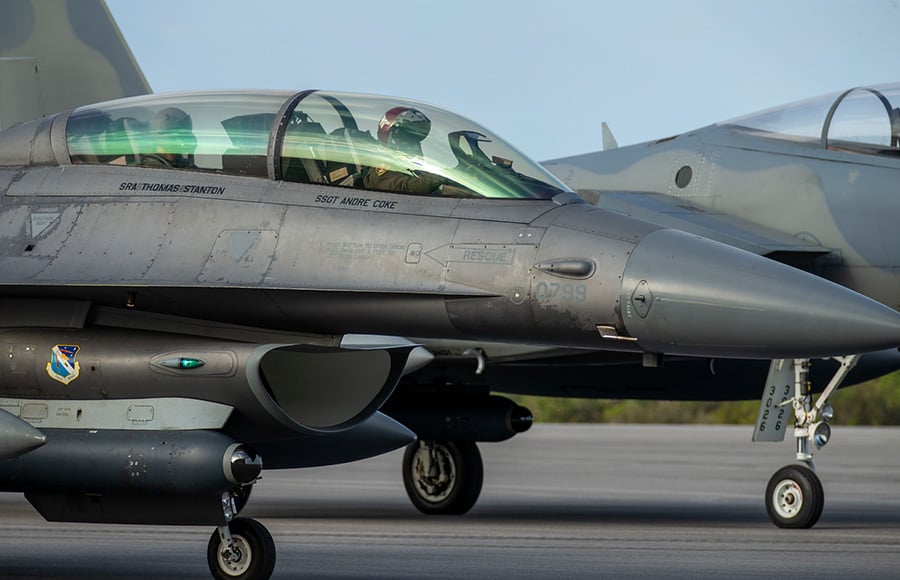
The flight was conducted from Morris Air National Guard Base in Tucson, Arizona, with the Air National Guard and the Air Force Reserve Test Center, known as AATC. Both aircraft carried Legion pods equipped with a pre-production version of HiveLink, a data link developed by L3Harris.
The pods connected through HiveLink and used their shared data to refine target tracks. Lockheed Martin said the networked capability gives pilots faster and more accurate situational awareness in radar-denied and contested environments.
Legion, previously known as IRST21, is a passive infrared search-and-track system. Unlike radar, the sensor does not need to emit a signal to detect and track airborne targets.
Connecting two pods allows the system to establish range to multiple targets almost immediately. Lockheed Martin said this gives aircrews rapid “depth perception” and helps them prioritize the most relevant contacts.
“Working side by side with the Air National Guard and AATC, we are turning proven infrared search-and-track into a networked, passive capability that is ready now,” said Cristin Stengel, program director for Lockheed Martin Legion. “With Legion’s pod-to-pod data link and open architecture, we’re providing aircrews faster, more accurate targeting in the most contested airspaces.”
The capability was developed with the Air National Guard and AATC to reduce pilot workload and shorten target-engagement timelines. Direct communication between the pods is also intended to preserve aircraft bandwidth for other mission requirements.
Lockheed Martin is continuing F-16 flight testing under a contract with the Air National Guard. The next phase will assess the system’s performance, transportability and ability to operate with other platforms and networks.
Planned work includes integrating software-defined radios and multi-waveform gateways. The company also intends to expand Legion’s role in missions involving cooperation between crewed and uncrewed aircraft.
HiveLink provides line-of-sight and beyond-line-of-sight connectivity for contested and denied environments. The L3Harris system combines mesh networking, Common Data Link interoperability and exportable waveform flexibility for platforms with size, weight and power limitations.
Legion is already in production and fielded for the U.S. Air Force in a podded configuration. The system supports interoperability between F-15 and F-16 aircraft and can be transferred to other fighters, non-fighter aircraft and uncrewed platforms.
The sensor builds on Lockheed Martin infrared search-and-track systems that have accumulated more than 300,000 flight hours on F-14 and F-15 aircraft. Its open architecture allows threat data to be fused with other sensor information and distributed across the battlespace in support of Joint All-Domain Operations.