
The company said $1 billion in shared investment by F-16 operators has funded development, laboratory work, flight testing and production. That spending could allow the U.S. Air Force and National Guard to join the program without bearing the initial costs.
“The $1 billion shared investment by countries operating F-16s means the U.S. Air Force and National Guard could benefit from joining the program,” said Chris Aebli, President, Communications & Spectrum Dominance, L3Harris. “The foreign investment is funding development, lab testing, flight testing and current production of Viper Shield systems, which presents the United States with a savings opportunity to avoid upfront costs.”
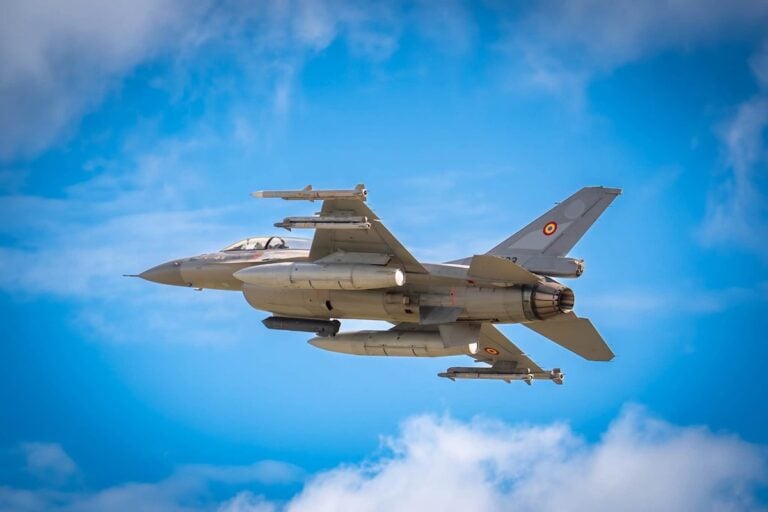
Viper Shield is designed to detect, identify and counter electronic threats against the aircraft. It can operate as an internally integrated system or be carried in an external pod, and L3Harris has assembled its first pod using production-standard equipment.
L3Harris said Viper Shield is the only F-16 electronic warfare system currently in production. The company is ramping towards full-rate manufacturing to meet the existing order book.
Designed for new Block 70/72 aircraft, Viper Shield is fully interoperable with the APG-83 Active Electronically Scanned Array radar. The system is also compatible with every earlier F-16 block.
Its all-digital, software-defined architecture uses commercial off-the-shelf technology to reduce size and weight. The design is also intended to simplify upgrades as electronic threats and operational requirements change.
L3Harris said additional partner nations would be able to draw on an active production line, established quality controls and a supply chain prepared for large-scale manufacturing. The completed initial systems mark the first step in fulfilling the 233-unit order book.