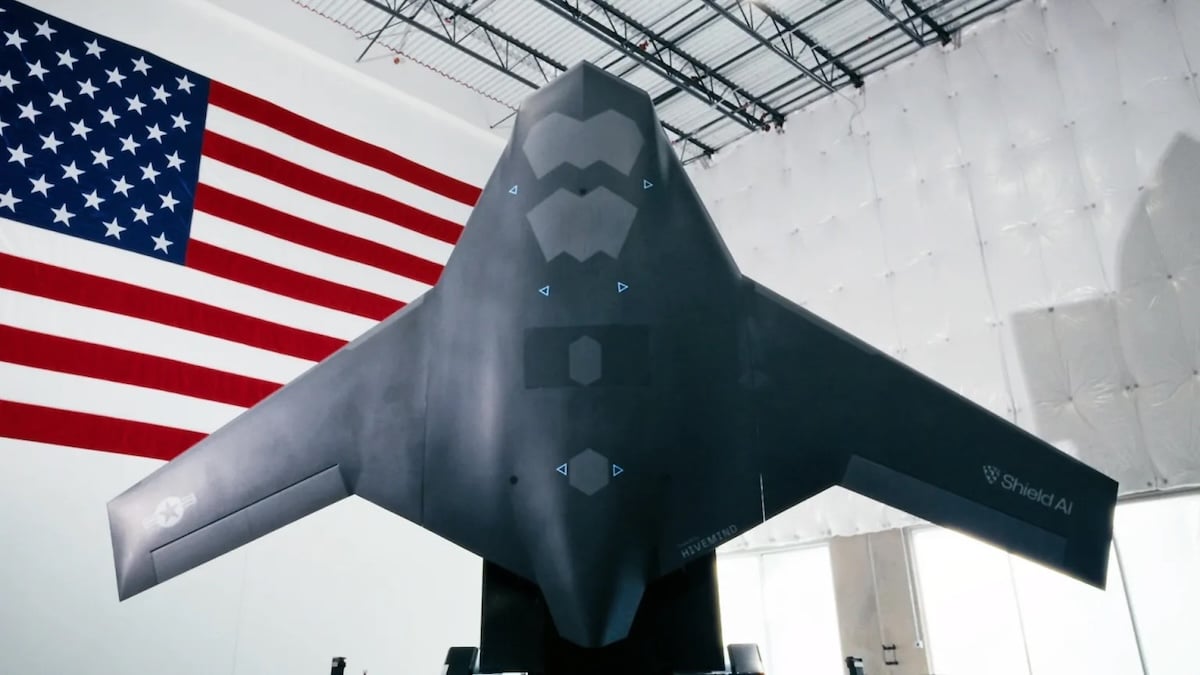
The jet, which is designed to take off and land vertically, will be produced in Des Moines, Washington, just south of Seattle. Flight testing and long-term sustainment will sit at Newton City-County Airport in Kansas.
Shield AI calls the Kansas and Washington sites X-Forge 2 and X-Forge 3. They join X-Forge 1, its prototyping site in Frisco, Texas, and between them the three are meant to take X-BAT from prototype to delivery and support it through the life of the fleet.
No X-BAT will reach a customer without passing through Newton first. Each aircraft will complete production acceptance testing there, and customers will carry out their own acceptance flights at the site.
Newton will also support development flight testing and serve as the fleet’s center for maintenance, repair and overhaul. Mayor Rich Stinnett said the city’s role had expanded beyond the flight test facility to cover that work for the entire fleet.
Shield AI committed to Newton in 2025, when it first showed the X-BAT design in public, and has been standing up the site since. It leases hangar and office space and about 10 acres at the airport, and is working with the city and Harvey County on a larger hangar and a bigger footprint.
Work in Washington is at an earlier stage. The Des Moines lease is signed, the site is being built out and hiring for the program has moved to the region.
It is the company’s first site in the Puget Sound area, and Shield AI expects to expand there as production rates climb. The company said it looked at several regions and chose Washington for its workforce.
King County has more than 45,000 aerospace workers at more than 400 companies, and the state’s supplier base runs past 1,500 firms, Shield AI said. South-central Kansas has built aircraft since the 1920s and trains workers through institutions including Wichita State University and WSU Tech.
“Both these regions were building airplanes before Shield AI existed, and we went to them for that reason,” said Armor Harris, senior vice president of aircraft at Shield AI. He added: “X-BAT will be built in Washington and fly in Kansas before it goes to a customer, and Kansas will keep this fleet in the air for decades.”
Shield AI also put numbers on what the program could mean for the two regions. An economic analysis it cited estimates X-BAT would support about 9,800 jobs by the early 2030s and add roughly $78 billion to the Newton and Seattle-area economies through 2046.
Those figures assume the program runs as planned and at full production rate. They count Shield AI’s own employees, workers at suppliers and the jobs sustained by what both groups spend locally.
The Seattle-Tacoma-Bellevue region accounts for most of it, with about 8,000 jobs in the early 2030s and about 27,000 by 2046, and roughly $73 billion added to the regional economy. The Newton area would see about 1,800 jobs in the early 2030s and about 2,900 by 2046, with roughly $5 billion added.
Frisco stays on as the prototyping site and the home of the company’s V-BAT aircraft, and Shield AI said it continues to build, operate and hire there. The analysis puts Frisco alone at about 600 jobs in the early 2030s and about 700 by 2046.
Texas suppliers handle much of the rest of the program, including propulsion and mission systems work. Across the state, X-BAT is projected to support about 1,400 jobs in the early 2030s and about 7,900 by 2046, adding roughly $18.6 billion to the Texas economy.
Politicians in both states welcomed the news. “Keeping advanced aircraft mission-ready is critical to our national security, and Kansas’ long history in aviation makes our state a natural home for this work,” said Sen. Jerry Moran of Kansas.
“Shield AI’s decision to build its new X-BAT manufacturing facility here is another sign that the future of aerospace is being built in Washington,” said Washington Gov. Bob Ferguson. “We welcome Shield AI and the thousands of good-paying jobs this investment will bring.”
Shield AI describes X-BAT as a long-range, AI-piloted strike fighter that can operate from ships, islands or remote sites without a runway. It is designed to carry weapons up to the 2,000-pound class in internal bays, with an objective combat radius of 1,000 nautical miles.
The jet will be powered by GE Aerospace’s F110 engine and fly on Shield AI’s Hivemind autonomy software, which the company says allows it to operate without GPS or communications. Flight testing is due to start later this year.
Founded in 2015, Shield AI is a venture-backed company whose products include Hivemind, the V-BAT and X-BAT aircraft, and Aechelon simulation and synthetic reality technologies. It has offices and facilities across the U.S., Europe, the Middle East and Asia-Pacific.