
The Army awarded each company a separate Other Transaction Authority (OTA) agreement on Sept. 29 for the Precision Strike Missile (PrSM) Increment 4 program, according to a statement from Redstone Arsenal, Alabama. The service did not disclose the value of the deals.
The awards pose a direct challenge to Lockheed’s hold on the PrSM franchise. The Bethesda, Maryland-based company builds every PrSM now in service. Last week it won a $1.2 billion Army contract covering initial production and future orders of the Increment 2 version.
A two-round shootout
The Army has set out a phased contest. Prototype work in fiscal 2027, which began on Thursday, will end in a competitive fly-off and a down-select. Vendors with mature designs will then be eligible for follow-on agreements and a final fly-off in fiscal 2028.
OTA agreements fall outside standard federal procurement rules. The Pentagon has increasingly used them to move prototypes into testing faster and to bring nontraditional suppliers into major programs.
This is the second start for Increment 4. Lockheed and a team of RTX and Northrop Grumman received initial development contracts in 2023. The Army’s Portfolio Acquisition Executive for Fires reopened the competition with a new solicitation in April. That request called for an open architecture to ease future hardware and software upgrades. It also required the missile to perform in an Indo-Pacific operational scenario.
Doubling the reach
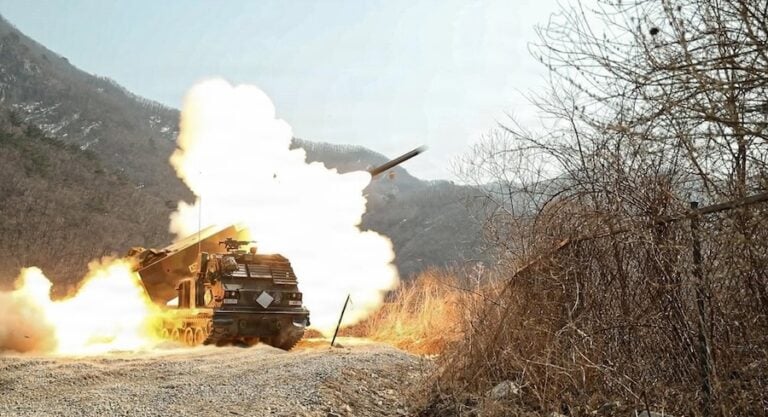
The 1,000-kilometer (621-mile) requirement roughly doubles the range of the baseline PrSM. That missile began replacing the aging Army Tactical Missile System (ATACMS) in 2023 and reaches beyond 400 km. Each HIMARS launch pod holds two PrSMs, compared with a single ATACMS.
Increment 2 adds a multimode seeker to track moving targets. Army budget documents indicate Increment 4 will keep that seeker and pair it with new propulsion and a new warhead.
Propulsion is the main engineering hurdle. The Army wants nearly twice the range from a missile that must still fit existing launchers. Lockheed said in June that its design had completed a ground test at an L3Harris propulsion facility, demonstrating the handoff from a rocket booster to an air-breathing ramjet. The company planned full-scale flight tests for this fall.
Anduril, Castelion and Mach Industries have not disclosed their approaches.
Combat record
The PrSM family has already been used in war. U.S. Central Command said the military fired the missile in combat for the first time against Iranian targets. Some experts have linked a PrSM strike to the deaths of dozens of civilians in the Iranian city of Lamerd on Feb. 28. Central Command has denied the claim.
The Pacific calculation
For Army planners, the target set is the point. Ships and mobile missile launchers can relocate while a missile is in flight, so fixed coordinates are not enough. A HIMARS battery with 1,000 km of reach could hold ports, air defenses, launchers and surface ships at risk from dispersed positions far from the front line.
That capability will depend as much on networks as on hardware. The weapon will need off-board sensors, targeting-quality tracking data and communications that hold up under pressure.