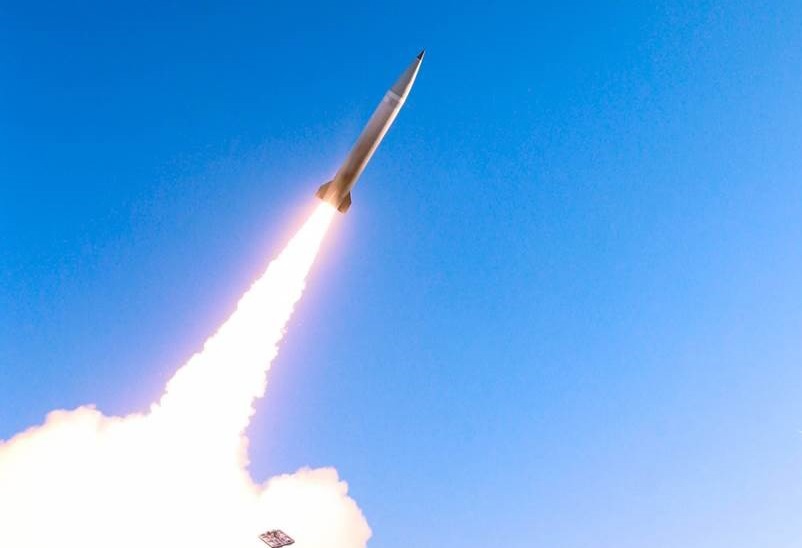
Taiclet detailed the strategy during Lockheed Martin’s second-quarter 2026 earnings call, describing PrSM as part of a wider surge in demand across the company’s missile portfolio. Management is looking for ways to increase output quickly without relying solely on new factories and additional capital spending.
“We’re being asked to triple PAC-3 MSE production, quadruple THAAD production, and scale up PrSM production faster than we ever thought we would,” Taiclet said. He said Lockheed Martin is using available industrial capacity, automation and partnerships to raise production rates as quickly and efficiently as possible.
PrSM currently occupies about one-third of Lockheed Martin’s Camden facility, according to Taiclet, who described the line as “next generation, highly automated, AI informed.” He compared the operation with a modern automotive plant, where a relatively small workforce manages automated machinery and robotics.
The older ATACMS line occupies roughly two-thirds of the same building and requires considerably more space and labor, Taiclet said. That imbalance has given Lockheed Martin an opportunity to reconfigure its industrial footprint rather than build an entirely new facility for PrSM.
“We’re basically partnering with Rheinmetall, as you heard, to move that ATACMS line into factory space in Germany, where the customer base largely is now, and expand the PrSM line without building another building for it,” Taiclet said.
The planned transfer would free additional floor space in Camden for PrSM while shifting ATACMS production closer to a large part of its current customer base. Rheinmetall would provide factory space, workforce and investment in Germany, reducing the amount of new infrastructure Lockheed Martin would need to fund itself.
“We’ve got an international partner that’s going to provide floor space, factory space, talent that we need, and investment that we don’t have to then put in,” Taiclet said. He presented the arrangement as an example of how Lockheed Martin can add capacity faster while keeping additional capital requirements under control.
The approach reflects a broader shift in how the company is responding to the current demand cycle for missiles. Taiclet said Lockheed Martin and its government customer would both favor solutions that deliver production increases more quickly while requiring less incremental capital.
PrSM is also continuing to evolve technically while production capacity expands. Taiclet said PrSM Increment 4 cleared a technical gate in June that confirmed the missile’s extended range while preserving capability and compatibility with existing HIMARS launchers.
The U.S. government is also giving Lockheed Martin greater flexibility on requirements and other elements of the acquisition process in an effort to shorten timelines, Taiclet said. He described speed as a recurring priority in his discussions with senior government officials.
“The government’s giving us a lot more flexibility than they traditionally would have done on requirements and other facets that they traditionally provide that we can be faster,” Taiclet said. “Faster, faster. So we’re using all the cards in the deck to be as efficient as we can as we try to go faster.”
For Lockheed Martin, the PrSM ramp is becoming as much an industrial-capacity challenge as a missile-development program. The company’s answer is to combine automation at Camden with European manufacturing capacity, allowing it to expand the newer missile line without waiting for construction of another U.S. production building.