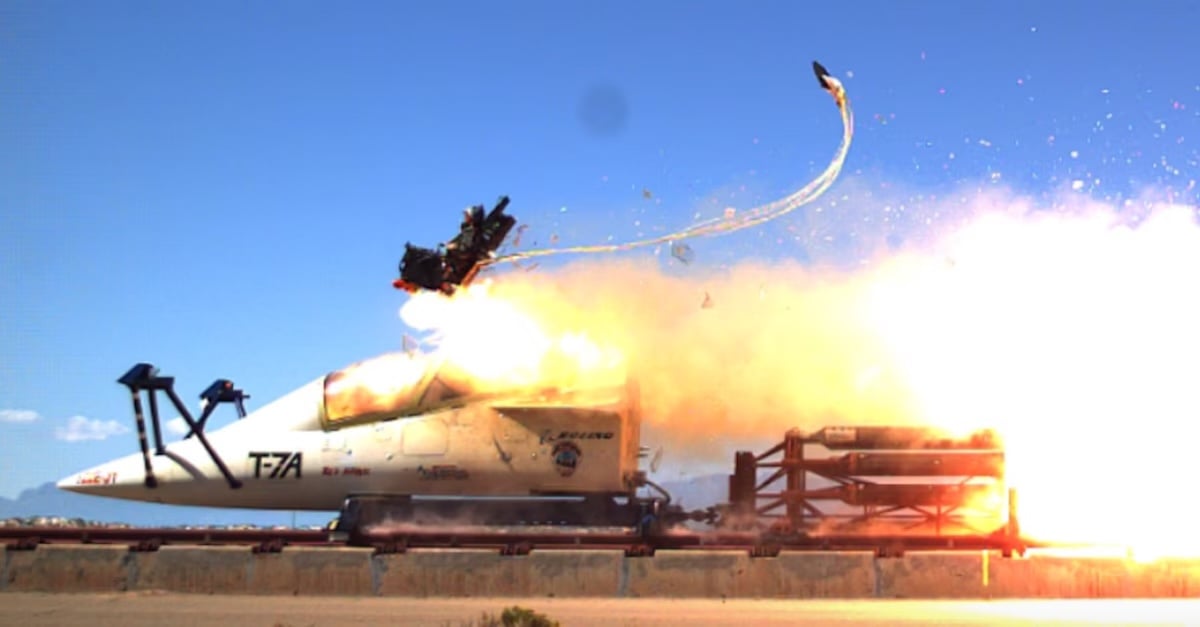
An initial video review indicated that the upgraded ejection seat sequencer worked as intended, though engineers are still analyzing the full test data.
The 846th Test Squadron conducted the test at Holloman Air Force Base, New Mexico, on Oct. 7, 2026, simulating an ejection at an effective airspeed of 550 knots.
The test evaluated a redesigned canopy-fracturing pattern and a modernized sequencer that controls the ejection seat’s operation.
Engineers used an anthropomorphic test device representing the lightest occupant in the pilot candidate range to assess protection for smaller aircrew members.
The initial review showed that the sequencer kept the stabilizing drogue parachute deployed for longer, helping stabilize the seat during separation.
The Air Force said the revised timing reduces peak loads on the occupant’s neck and spine and provides a smoother descent.
“Completing this final sled test represents a major achievement in our rigorous qualification process,” said Col. Robert Volesky, the Air Force Life Cycle Management Center’s T-7A system program manager.
“The engineering enhancements validated today ensure that when our pilots enter the cockpit of the Red Hawk, they are protected by an escape system engineered to the highest modern standards.”
Seat trajectory, acceleration and biometric sensor data remain under formal engineering review.
The event concludes a series of static and dynamic sled tests supporting final escape-system qualification and future production aircraft deliveries.
The T-7A is intended to replace the T-38C Talon, working alongside an advanced Ground Based Training System to prepare pilots and weapon systems officers for fourth-, fifth- and emerging sixth-generation fighters and bombers.