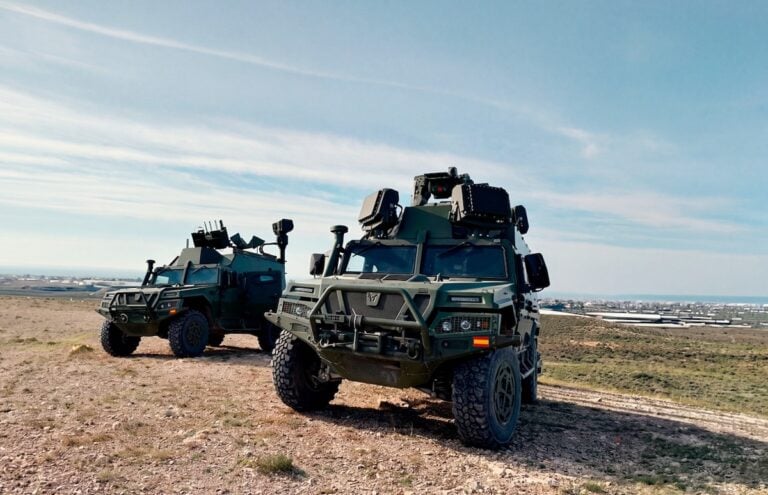
Four autonomous ground vehicles searched for targets and supported a simulated strike at Fort Knox, Kentucky, in a DARPA demonstration of robotic operations beyond friendly front lines. The vehicles handled movement and target detection independently, while a human operator retained authority to approve any engagement, according to the U.S. Army.
The October 15 test at St. Vith Range followed a request from U.S. European Command to explore how robots could detect threats ahead of soldiers. It was the team’s first demonstration linking satellite imagery to tactical ground operations, following component and integration testing at contractor sites.
The vehicles use technology developed under DARPA’s Robotic Autonomy in Complex Environments with Resiliency program, known as RACER. The program aims to enable autonomous off-road travel at speeds at least comparable to those of a human driver.
“We’ve completed about a five-year program on software development for autonomous mobility to go highspeed off-road in complex environments,” said Dr. Jason Gregory, a technical advisor at DARPA. “So, now we can take a vehicle that has a sensor suite and drive-by-wire and equip it with autonomy software so it can be tasked by a Soldier as opposed to manually driven.”
At Fort Knox, an operator received satellite imagery indicating a simulated threat and sent the robotic team to investigate. The lead vehicle drove along a road, spotted a potential target halfway up a hill and stopped to await a command.
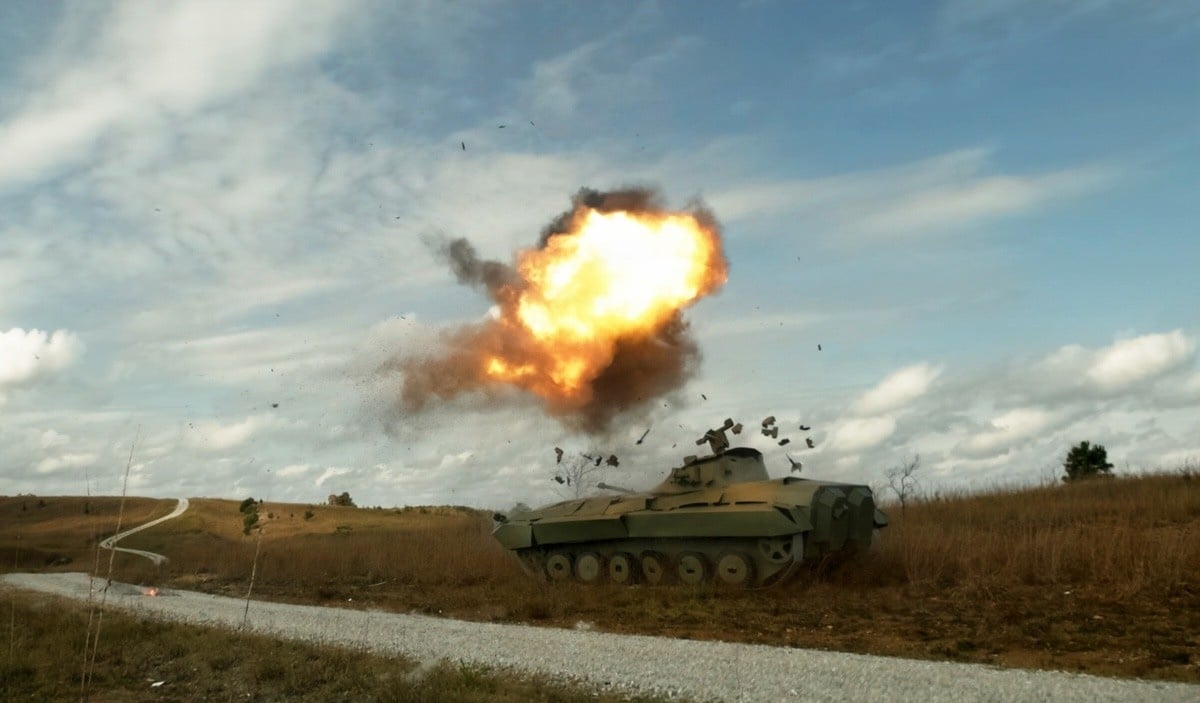
It carried a drone inside a closed box that, in an operational scenario, could be launched to inspect a target or carry munitions for an aerial strike, the Army said. Two other vehicles moved forward to provide cover and support before a simulated rocket hit a target about 300 yards away on an adjacent hill.
The fourth vehicle then advanced while the lead vehicle continued over the hilltop. Gregory said the distinction between autonomous movement and human control of weapons was central to the demonstration.
“All the targets that are detected by our autonomous assets provide a chip of what they have seen downrange to a human, who then has to approve any type of engagement,” Gregory said. “The operator has total control as to what they want to do about what the robots are seeing.”
“All the mobility, all the movement, all the detections, all of that is autonomous,” he said. “But they don’t pull the trigger until a human says pull the trigger.”
European Command’s request focused on deploying robotic assets beyond the forward line of troops to provide early warning and help soldiers decide how to respond. Fort Knox was recommended as a test location because its terrain represented conditions in the European theater, Gregory said.
“We always had intentions for EUCOM applicability,” Gregory said. “When working with our stakeholders and touchpoints, they had recommended Fort Knox specifically as a representation of the European theater.”
The Army said different payloads could also allow the vehicles to transport food, ammunition and other supplies or support casualty evacuation. A further test is expected in December, when DARPA plans to ask soldiers how they would employ the systems.
“Soldiers are the best evaluators because they give you honest feedback,” Gregory said. “They know best how they would want to use it.”
Go deeper: U.S. Army.